


The Red Cross has appealed for an immediate truce to facilitate aid deliveries and has called for all land, air and sea routes to be immediately opened
AFP
Aden
Fierce clashes raged yesterday between rebels and loyalists in southern Yemen, leaving more than 140 dead in 24 hours, as the Red Cross faced delays to urgently needed aid deliveries.
Relief workers have warned of a dire situation in the impoverished state, where a Saudi-led coalition is waging an air war on the Iran-backed Houthi Shia rebels.
The bloodiest fighting occurred between rebels and loyalists of President Abd-Rabbu Mansour Hadi in the main southern city of Aden, officials said.
More than a third of those slain in the past 24 hours - 53 - were killed as rebels tried to seize a port in the city, which sits on an extinct volcano jutting out into the sea.
At least 19 Houthis and 15 pro-Hadi militiamen were killed overnight in the town of Daleh, north of Aden, officials said, and seven other people died in the southern province of Abyan.
Pro-Hadi fighters have laid siege in Abyan to the base of a renegade army brigade loyal to ex-president Ali Abdullah Saleh, who is accused of backing the Houthis.
Ten rebels were killed in coalition air strikes that hit Al Anad airbase near Abyan and a military camp in Lahj, while many more died in Shabwa province.
Hadi, considered by the UN to be Yemen’s legitimate leader, took refuge in Aden in February after the Houthis, who hail from the mountainous north, seized power in Sanaa.
Hadi fled to Saudi Arabia last month as rebels advanced on his southern stronghold, prompting the military campaign by the Saudi-led coalition, now in its 12th day.
Yemen, strategically located near key shipping routes, is sinking deeper into a multi-sided civil conflict.
The fighting has drawn in an array of armed groups including the Houthis, pro-Hadi militia, army units loyal to Saleh, southern separatists, Sunni tribes and Al Qaeda militants.
The Red Cross has appealed for an immediate truce to facilitate aid deliveries and has called for all land, air and sea routes to be immediately opened to allow the delivery of 48 tonnes of medical supplies the organisation has ready to treat up to 3,000 wounded.
The situation is particularly dire in Aden, where some neighbourhoods have had no electricity or water in days.
The Red Cross has been trying to fly emergency supplies into Sanaa but the plane is still stuck on the tarmac.
“We have a cargo plane with medical supplies which is ready to go,” said Sitara Jabeen, a spokeswoman for the International Committee of the Red Cross.
“We have the permission for this plane but we have logistical problems for the landing. There are less and less planes landing in Yemen. We are trying to solve the logistic problems,” she said.
The Red Cross is also trying to deploy a team of surgeons to Aden, but says it is still awaiting authorisations from all sides in the fighting.
But the spokesman of the Saudi-led coalition, General Ahmed Assiri, said the Red Cross had evacuated 11 staff members from Sanaa airport.
It was unclear if they were to be redeployed elsewhere in Yemen or replaced.
Russia has urged the UN Security Council to push for a humanitarian pause in the strikes.
On Monday an Indian vessel evacuated 450 people from the western Hodeida port, while 100 others boarded a Chinese vessel to safety. France evacuated 63 foreigners from the eastern port of Balhaf.
Jordan said it had evacuated almost 300 nationals since the conflict began and an AFP photographer said three Indian aircraft and one Russian plane landed yesterday in Sanaa to evacuate their citizens.
Pakistan said it had been asked by Saudi Arabia to contribute aircraft, ships and ground troops to Operation Decisive Storm.
Despite close ties with Riyadh, Pakistan has so far held back from joining the offensive, saying it does not want to get involved in any conflict that would inflame sectarian tensions.
Iran has strongly criticised the intervention in Yemen and has rejected accusations of arming the Houthis.
Its foreign minister, Mohamed Javad Zarif, is due to visit Islamabad tomorrow to discuss the situation.
In Riyadh, the Saudi cabinet reiterated the kingdom “is not seeking war” and that the offensive was to “rescue a neighbouring country... and its legitimate authority”.
UN warns of
humanitarian
disaster due
to conflict
Reuters
Dubai
Yemen’s conflict is driving an already impoverished country towards humanitarian disaster, displacing tens of thousands of families and exposing many more to the threat of disease and malnutrition, the United Nations children’s agency Unicef said yesterday.
The Arabian Peninsula’s poorest state has endured years of unrest, but nearly two weeks of war between rebel Houthi fighters and pro-government forces has put millions of people in danger.
Unicef’s Yemen representative Julien Harneis said “many, many children” had been killed in the fighting. Hospitals have been shelled and schools taken over by combatants.
Fuel shortages threaten to disrupt child immunisation programmes - which need vaccines to be kept refrigerated - and government cash handouts to the poorest third of the population have been suspended.
At the same time the cost of water has risen, as generators pumping the water become more expensive to run, and prices of increasingly scarce food have gone up as people’s incomes fall.
The huge displacement of people, with families fleeing the worst-hit cities, also means deteriorating hygiene and sanitation conditions and possible spread of disease.
“We are rushing to a humanitarian disaster,” Harneis said.
Unicef and the International Committee of the Red Cross are both trying to fly aid shipments into Yemen today to start addressing the dire conditions, but say they have struggled to find planes which will fly into the conflict zone.
“Our main focus is going to be water and sanitation, and medical (aid),” Harneis said by telephone from Jordan.
Unicef said at least 62 children were killed in the last week of March in Yemen. Harneis said the figure was likely now to be “much, much worse”.
In part that may be because of the large proportion of children fighting in the ranks of Yemen’s many armed factions.
Harneis said child recruitment was widespread. “All of those more tribal type groups ... up to a third of them are children.”
On Thursday, the United Nations put the overall death toll from two weeks of fighting in Yemen at more than 500. Scores more have died since then, including 60 people killed on Sunday in fighting for the port district of Mualla in the southern city of Aden, residents and eyewitnesses said.
Central Aden has endured some of the worst of the conflict, with residents complaining that water and electricity have been cut off in some neighbourhoods for days.
A Reuters correspondent in the city saw a refuse truck yesterday ferrying around 10 corpses, piled on top of each other, towards one of the city’s hospitals.
In the Houthi-controlled capital, Sanaa, residents have also been caught up in the fighting. A local rights group said 29 civilians were killed in an air strike near the airport on the first day of the Saudi-led campaign.
In the longer term, the fighting threatens to reverse steps in health and education which Yemen made despite political turmoil since 2011 street protests, inspired by the broader Arab uprisings, and tribal and provincial unrest.
“We’re expecting a real peak in malnutrition,” Harneis said.
Yemen is just one of a handful of Arab countries including Syria, Iraq and Libya which show many signs of failed statehood, as armed insurgencies erode central authority. But even before the latest conflict, it was more fragile than others.
“It doesn’t have the oil resources of Iraq. It didn’t have the infrastructure of Syria. So it’s already a very vulnerable society,” Harneis said. “On top of this you are adding a layer of intense conflict in the south and bombardment and destruction of the infrastructure in the north.”
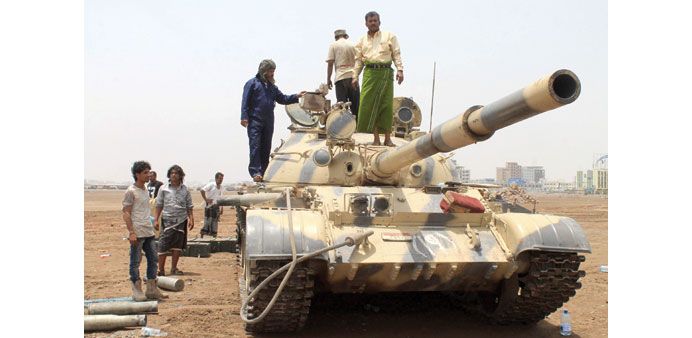
Supporters of the separatist Southern Movement stand on a tank in Aden yesterday.