The government’s capital spending of $182bn until 2018 is expected to drive double-digit growth in Qatar’s non-hydrocarbon sector, QNB has said in a report.
Strong population growth and economic diversification will also boost Qatar’s non-hydrocarbon sector, which will increase its share of nominal GDP to 68.5% in 2017, QNB said.
The Qatari economy continued its strong performance, growing by 6.2% in 2014; QNB said, citing latest data from the Ministry of Development Planning and Statistics (MDPS). Growth was driven by the non-hydrocarbon sector, which sustained its double-digit growth.
The strong growth data are evidence to the resilience of the Qatari economy and its ability to withstand the decline in oil prices, thanks to its strong macroeconomic fundamentals.
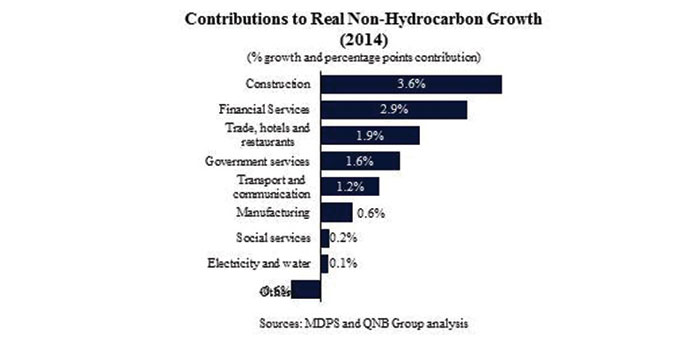
The non-hydrocarbon sector was the engine of growth in 2014, growing by 11.5% on large investment spending. The largest contributors to real GDP non-hydrocarbon growth were construction; finance, insurance, real estate and business services; and trade, hotels and restaurants.
Construction expanded by 18% on the implementation of major infrastructure projects, such as the development of Lusail, Barwa City and Education City. Finance, insurance, real estate and business services; trade, hotels and restaurants; and government services benefited from the rapid population growth (estimated to have been 10.1%), which added a further boost to the expansion of the non-hydrocarbon sector.
“Going forward, and given its substantial financial resources, Qatar has ample external and fiscal buffers to continue implementing its ambitious investment programme ahead of the FIFA 2022 World Cup,” QNB said.
In its 2014/15 budget, the government earmarked a capital spending of $182bn until 2018. The figure excludes the oil and gas sector, where annual investments are forecast to average $3.4bn over 2015-17.
In turn, this is expected to drive double-digit growth in the non-hydrocarbon sector, which will be further boosted by strong population growth.
In contrast, the hydrocarbon sector shrank by 1.5% in real terms in 2014. Gas production fell slightly due to temporary maintenance shutdowns. Meanwhile, crude oil production and condensates (associated with gas production) fell to an average of 1.96mn barrels per day (bpd) reflecting maturing oilfields and the necessary shutdowns to implement enhanced oil recovery techniques. “However, we expect the hydrocarbon sector to recover in the medium term, growing by 0.8% in 2015, 1.8% in 2016 and 1.9% in 2017,” QNB said. Gas production is expected to increase due to the Barzan gas project while crude oil and condensate production is forecast to remain stable.
The Barzan project is a $10.3bn North Field gas development to increase production for domestic use. This includes power generation and water desalination to accommodate the needs of the rising population.
The Barzan project is an exception to the moratorium on further gas development on the North Field. Following the completion of train 1 and 2 in the first half of 2015, Barzan production is expected to start in the second half of 2015 with incremental growth until 2017.
“Overall, the performance of the Qatari economy in 2014 is all the more impressive given the significant decline in oil prices, which fell by nearly 50% in the second half of the year.
“We expect the diversification drive to continue and for the non-hydrocarbon sector to increase its share of nominal GDP to 68.5% in 2017. Low inflation, healthy fiscal balances and significant current account surpluses should provide a conducive macroeconomic environment for the growth momentum to continue gathering steam,” QNB said.
Business / Business
Qatar’s $182bn capital spending likely to drive double-digit growth in non-energy sector: QNB