


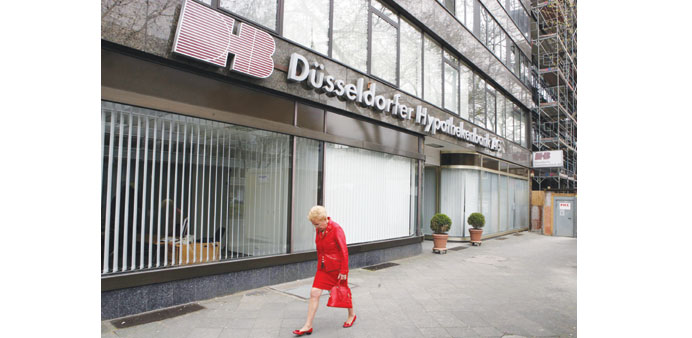
A pedestrian passes the headquarters of Duesseldorfer Hypothekenbank in Germany. The near-collapse of the German lender hit by Heta Asset Resolution’s debt moratorium, was prompted in part by a margin call from Eurex, people familiar with the matter said.
Bloomberg
London
The near-collapse of Duesseldorfer Hypothekenbank (DuessHyp), the German lender hit by Heta Asset Resolution’s debt moratorium, was prompted in part by a margin call from Eurex, people familiar with the matter said.
Eurex, Europe’s largest derivatives market, asked DuessHyp to post additional collateral as the German bank faced writing down its €348mn ($375mn) of bonds issued by Austria’s Heta, said the people.
The hit to the bank’s capital from the Heta losses and the extra posting of margin forced the lender, laden with swaps, to seek a rescue, said the people. The Association of German Banks, or BdB, on March 15 said it would back DuessHyp, a lender to public entities, and a day later agreed to buy the company from US private equity firm Lone Star Funds.
The repercussions of winding down Heta, a bad bank that became the first institution to be resolved under new European Union rules for bank failures, are an example of how one firm’s collapse can spread across the region. German and Austrian banks’ finances have been damaged by losses induced by Heta. At the same time, investors reassess the risk on €1.3tn of state-guaranteed debt in the euro area.
BdB spokesman Lars Hofer, DuessHyp spokeswoman Barbara Hugo-Dilworth and Frank Herkenhoff, a spokesman for Deutsche Boerse, which owns Eurex, declined to comment.
DuessHyp’s trouble began when Austrian regulators ordered a debt moratorium on Heta March 1, forcing the bank to consider writing down the bond holding that exceeded the bank’s €233mn of core capital as of June 30. BdB stepped in to rescue the lender two weeks later.
DuessHyp held swaps with a notional value of €13.8bn as of June 30, after cutting the holdings from €17.6bn at the end of 2013, according to its half-year report. That included interest-rate swaps with a notional value of €13.3bn and cross-currency swaps of €500mn, both used to hedge risks, the lender said, without providing details on its counterparties.
A margin call is a demand on an investor to deposit additional funds with a broker or clearinghouse after the value of its trading position falls below a predetermined point.
“The derivative portfolio is bigger than the total assets, which is pretty significant and unusual for a bank with such a simple business model,” said Patrick Rioual, a credit analyst at Fitch Ratings. “This is mostly a legacy from the past, because before the crisis they underwrote all sorts of assets from different countries and in different currencies and they used swaps to hedge the risks.”
DuessHyp was in the process of changing its business model ever since it had to be bailed out for the first time in 2008. The bank planned to exit low-margin public sector lending and establish itself as a niche commercial real estate lender, it said in its annual reports since 2009.
Its balance sheet continues to be dominated by legacy assets linked to public sector borrowers - such as the Heta bonds due to their guarantee from the Austrian province of Carinthia. That allowed the bank to run on very little capital compared to its total assets.
With 59% of DuessHyp’s balance sheet being public sector loans, which are deemed risk-free under European banking rules, assets weighted for risk amounted to €2bn. That left the bank with a core capital ratio of 11.6% by the end of June, more than twice the legal minimum.
Meanwhile, its leverage ratio, which compares capital to total assets, was 2.1%, or half the average of major European banks, according to data compiled by Bloomberg.
“In case it would have been needed, that in my view was the last wake-up call to all regulators around the globe to not consider sovereign debt as risk free,” Felix Hufeld, president of German financial regulator BaFin, said on March 25.