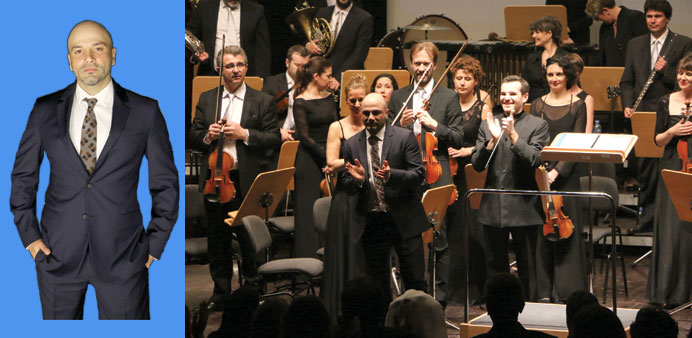
DETERMINED: Wael Binali is in demand everywhere, but he wants to fetch glory for Qatar. Right: APPLAUSE: Wael Binali, left, basks in glory with the conductor on the right and the orchestra. Photos by Umer Nangiana
By Umer Nangiana
Shepherding an immersing balance amongst 50 different musicians in an orchestration, young French conductor Lionel Bringuier joined Alma Chamber Orchestra to lead the national premiere of Qatar’s very own Wael Binali’s showpiece rendition Earth at the Katara Opera House.
Before a packed house, the orchestra under the baton of Bringuier and the bow of artistic director Anne Gravoin on violin solo began the evening with Beethoven’s famous Egmont Overture. The powerful and expressive composition went on to lend space to Mozart’s Flute Concerto No. 1 with soloist Vincent Lucas standing beside the conductor.
Before moving on to play Mendelssohn’s Symphony No. 4, the orchestra of 50 musicians involving violins, altos, cellos, double bass, woods, harp and percussions played Earth by Binali, the Qatari orchestral and film music composer.
Binali enjoyed it from amongst the audience that, among others, comprised Dr Hamad bin Abdul Aziz al-Kuwari, the Minister of Culture, Arts and Heritage, the French ambassador and members of diplomatic corps.
It was the first time ever that his orchestral composition was played in his home country.
“It was a great experience. It was definitely special because it was the first time I have been played in my own country,” Binali, whose original name is Wael Hassan bin Ali bin Ali, tells Community soon after the performance.
“They (the Alma Chamber Orchestra) have actually played it before in Paris and Dubai last year. This is a chamber version of Earth while the original version is for 94 players. For Alma, I did a special version for around 50 players so I had to re-orchestrate it,” he says.
Earth bears the message of hope and is composed by Binali around the idea of climate change. He says he was asked in 2012 by Fahad al-Attiyah to write a piece for COP18 which was for the climate change conference taking place in Qatar.
“With climate change, you are basically talking about earth. So (the piece) starts hectically and how we are over-using earth’s materials and basically, damaging (the earth) and unless we are going to change, it is not going to get to the point where it is redeemable,” warns the composer.
“After that we are going into a wound section where it sounds a little bit sad but I did not want to labour on that too much and wanted to end it with hope so then we go into more of a positive note,” he elaborates.
Binali refers to the example of places like San Francisco, which he says, used to have so much pollution and now is the one city that has zero pollution; there is a zero waste programme and everything is recycled.
“So we can change as long as the countries that are (contributing to) the most pollution realise that change has to happen. We can change and we can reverse everything that we are doing so I wanted to end it with a big hope kind-of-feeling and hopefully, I conveyed that with the music,” the Qatari composer enthuses.
For the premier performance of his piece, the composer did a sound check and rehearsal with the orchestra.
“It was, of course, very special to play music with Wael Binali. It was as wonderful for us to play his music here as it was for him to be played in his home country,” Bringuier, the conductor, tells Community after the performance.
He says he always enjoys the process of making music and collaborating with musicians. Sometimes it’s 50 musicians and sometimes more, but the most important thing is to trust them, says the conductor. He works a lot with Alma Chamber Orchestra but it was his first time in Qatar.
“I am very happy to have made my debut here and the audience here was very good. They did appreciate the quality of the music,” says Bringuier.
Born in London in 1968 to Qatari and Lebanese parents, Binali had his rites of passage into classical music at the age of 11 when he began training to play Oboe (a double reed woodwind musical instrument) and from there on, to start writing music.
Since then, it has been a great journey for him. “It has been tough as well because coming from a country like Qatar where music is not something that is put across as, ‘Oh! We do this’,” contends the composer.
“Unfortunately, we have a culture where if we see someone with talent, we kind of stifle the talent to go like “‘this is not for us’, you know; you are supposed to be a doctor or a lawyer or a businessman,” he points out.
Fortunately for him, he says, his father, was not like that and when he saw the talent and was told by Binali’s boarding school that “(t)his boy should be doing music”, he decided that if the young Binali decided to do music, he would encourage him 100 percent.
“And when I did, he just turned around and said, ‘you are not joining the company like most people would do here, you are going to do music and be the best that you can be and that is how I do what I do,” eplains the Qatari composer, with pride.
So how did he take to classical music and what does he think of Arabic music?
“Again, my father used to take us to ballets in London when we were kids and also my uncle (my mother’s brother) loved listening to gypsy music with violins and orchestra and I just fell in love with it,” recalls Binali.
“To me, Arabic music has its own beauty, but it is simple like pop music has its own beauty and is simple. Let’s put it this way, a five-minute pop piece would take me five minutes to write while a five-minute classical piece would take three months to conceive,” says the classical musician, and that he would much rather be in that world “where there are only a few of us who can do it.”
“For me, it is because I can also hopefully, put Qatar on the map….because as far as I know there are no other people in the GCC countries that do what I do. And hopefully, I can be an ambassador with music for Qatar,” a determined Binali says.
“In classical music you have to actually write every single note for every single instrument. There is no room for interpretation,” he points out.
His future plans include a TV show in Qatar, which he says, he has been asked to do by a Qatari friend. It is a 20-episode TV show, but Binali did not want to divulge the details at this stage.
“I have got a movie that I have been asked to do in the US next year as well. The Michigan Philharmonic has asked me to write a piece for them in September. The Qatar Philharmonic just recorded my piece earlier this month and they are playing two of my pieces late April or early May,” he disclosed.
While he burst onto the international stage with Through Time, a 17-minute piece for the opening ceremonies of the 2006 Asian Games held in Qatar, Binali had already established himself as a dynamic young composer.
He has worked with award-winning composers such as Christopher Young on the 2001 Golden Globe-nominated score for the major motion picture The Shipping News as well as scores for the Runaway Jury, Something The Lord Made, and An Unfinished Life.
He has a long-standing collaboration with composer Lior Rosner on films such as Rocket’s Red Glare for Fox Family Channel and the popular TV hit Power Rangers. He has also collaborated on composing original scores for the film Closure, the documentary SEEDS, and the Internet feature animation Atlantis Falling.