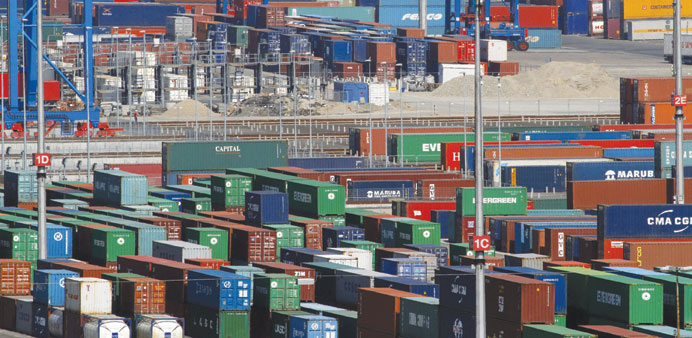
South Korea’s exports in March fell 4.2% from a year earlier, the sharpest fall since February 2013, the trade ministry data showed.
Reuters/Seoul
South Korean exports fell the most in two years in March and inflation hit its lowest since 1999, weakening economic momentum and putting the central bank under pressure to cut interest rates again.
The central bank has said the South Korean economy would pick up in the March quarter after suffering its worst growth in almost six years in October through December, but a recent run of data provided little evidence of a sharp rebound.
“Local exporters have become daunted as global trade is weak while some countries have expanded production facilities for products we mainly export,” said Kwon Pyong-oh, head of the trade ministry’s trade and investment bureau.
Exports to China and the EU fell 2.4% and 9.7%, respectively, while shipments to the US rose 17%.
“South Korea’s economy needs both consumption and exports to escape this rut, and exports are more important out of the two,” said Im No-jung, chief economist at IM Investment & Securities in Seoul.
Im said he sees another rate cut as soon as May this year while exports will remain depressed until the fourth quarter.
Exports in March fell 4.2% from a year earlier, the trade ministry data showed, the sharpest fall since February 2013 while imports dropped 15.3%. Both were worse than median forecasts in a Reuters poll of analysts.
The declines took the trade balance to a record $8.4bn surplus in March.
The ministry blamed lower oil and oil products prices for the poor exports, but overseas sales excluding oil products and petrochemicals rose just 0.2% in March over a year earlier, worse than gains of 0.8% in February and 6.6% in January, as demand from China and Europe remained depressed.
The won rose more than half a% against the dollar by midday on a globally softer dollar and on news of the record trade surplus.
The average export value per working day was $1.96bn in March, 10.1% lower than $2.18bn in March 2014, Thomson Reuters calculations showed.
Adding to the gloom, consumer prices rose only 0.4% in March on-year and hit a 16-year low while a private-sector survey showed South Korea’s manufacturing activity and new export orders both contracted in March from February.
The Bank of Korea cut its policy interest rate by 25 basis points to a record low of 1.75% in early March, the sixth cut since the current easing cycle started in early 2012. It will next review its policy on April 9.