By Andy Home /London
US aluminium producer Alcoa has this week announced the full shuttering of the Alumar smelter in Brazil.
Alcoa and minority partner BHP Billiton curtailed two potlines at the 440,000-tonnes-per-year plant over the course of 2013 and 2014. Now the third and last will also be mothballed.
It’s the fifth, and largest, Brazilian smelter to be shuttered since 2009 – a major retreat for what was once one of the world’s top producing countries.
And it’s symptomatic of a broader decline in primary aluminium production in South America.
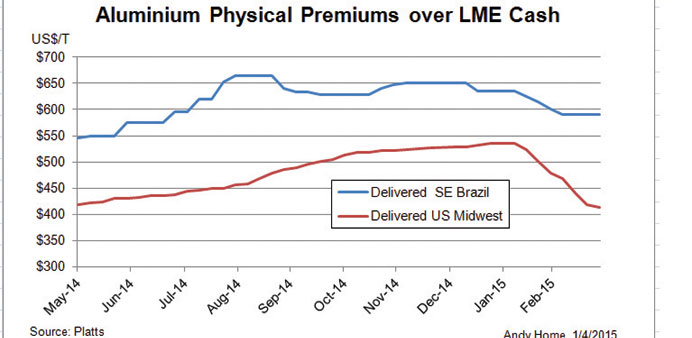
A region that was once a major exporter is now becoming increasingly dependent on imports, a tectonic change in flows with major implications for aluminium pricing.
The first, 127,000-tonnes-per-year, potline at the Alumar smelter in the Brazilian state of Maranhao was fired up in 1984.
A second line, at 156,000 tonnes per year, followed in 1986 with a third launched in 1990.
This was a period of rapid expansion of primary aluminium capacity in Brazil.
Operators were attracted by the country’s seemingly abundant hydropower and the resulting cheap electricity prices, a key cost input in aluminium smelting.
True, a warning of things to come occurred when Alumar was forced to reduce output in 2001 due to compulsory power rationing. But the joint owners were still sufficiently confident in the plant’s future to expand the third potline in 2006.
Now, though, the smelter is one of the highest-cost in Alcoa’s portfolio, which is why the company has been incrementally trimming its output since 2013.
The final cut comes after the company said on March 6 it was placing 500,000 tonnes of annual smelting capacity under review for mothballing, closure and sale.
Alumar is the first, and by inference the most economically compelling, casualty of that review. Alumar’s story is symptomatic of the broader decline in Brazil’s primary aluminium sector.
Alcoa’s Pocos de Caldas smelter in the state of Minas Gerais was the company’s first foray into Brazil back in 1970. It has been fully shuttered since May of last year.
The Valesul smelter was closed in 2009, while Novelis closed its Aratu plant in 2010 and its Ouro Preto plant in 2014.
There are now only two primary smelters left operating in Brazil: Hydro’s 460,000-tonnes-per-year Albras and CBA’s 475,000-tonnes-per-year Sorocaba. National production has fallen from a peak of 1.67mn tonnes in 2007 to 962,000 tonnes in 2014.
Annualised production was running at just 828,000 tonnes in February, according to the latest figures from Brazilian aluminium association ABAL.
With the full curtailment of Alumar, it will fall even further. The sector’s shrinkage is largely attributable to rising power costs. Hydropower, which seemed so plentiful back in the 1990s, has turned out to be an increasingly scarce resource after years of chronic drought.
Faced with historically low reservoir levels, Brazil will have to import power from Argentina and Uruguay this year. Even that may not be enough to avert power rationing if the rainy season fails to live up to expectations.
Such constraints represent a major challenge for power-hungry smelters, particularly at a time of low prices and compressed producer margins.
Venezuela’s two smelters, both owned by the government, have so far avoided closure but are doing no more than limping along. Here the prime cause of steadily dwindling production is the combination of years of underinvestment and labour unrest. Venalum has a capacity of 430,000 tonnes per year but it hasn’t produced anything close to that since 2009.
A management report, quoted by local newspaper El Universal in January 2014, lamented the fact that only 262 production cells out of 905 were operating at the end of 2013 due to a lack of raw materials, supplies, equipment and spare parts.
Production last year declined further to just 110,000 tonnes and the company has warned customers it will no longer be able to meet industry-standard purity levels due to its “difficult financial situation”.
Some of those customers, a Japanese consortium, have been trying to negotiate the sale of their stake for years.
If anything, Venezuela’s other primary smelter, the 170,000-tonnes-per-year Alcasa plant, is faring even worse with output last year running at just 17% of capacity. Production from Venezuela, like Brazil once a smelting powerhouse and a major exporter to world markets, hit a 30-year low in 2014, according to the industry ministry’s annual report.
The only other primary smelter in South America is Argentina’s Aluar, which seems to be still operating, having narrowly avoided a cut-off of its power supplies early last year.
Andy Home is a columnist for Reuters. The opinions expressed are his own.