AFP/Reuters
Ankara
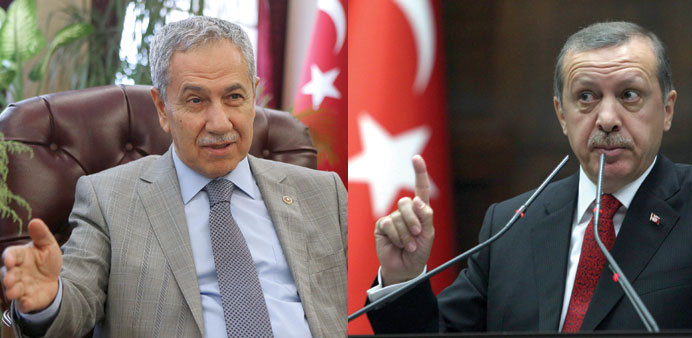
Turkish President Recep Tayyip Erdogan dug in his heels yesterday in what appears to be a widening rift with his own government over the Kurdish peace process.
In a sign of simmering tensions at the top, Erdogan’s long-time deputy Bulent Arinc told the president over the weekend to stop interfering and making “emotional” statements about efforts to end the three decades-long insurgency in the southeast.
“We love our president. We’re aware of his power and the good service he gives to our nation. But there is a government in this country,” a clearly exasperated Deputy Prime Minister Bulent Arinc said on Sunday, after Erdogan criticised the government’s handling of a peace process with Kurdish militants.
“Our nation would like to see a powerful government, a powerful decision-making mechanism. Nobody has the right to cast a shadow on this,” he said, promising to defend Prime Minister Ahmet Davutoglu, also a member of the AK Party, from “any danger that could tarnish him”.
But Erdogan, seen as all-powerful since being elected head of state last year after 11 years as prime minister, hit back yesterday in a televised speech: “The peace process began and reached the current stage under my responsibility. It is both my right and duty to voice my opinion.”
Ankara Mayor Melik Gokcek, an Erdogan loyalist, later called on Arinc to resign, accusing him of trying to undermine the ruling Justice and Development Party (AKP) – which he co-founded with Erdogan – from within.
In a series of tweets he accused the deputy prime minister of being a tool of the “parallel state”, a reference to the Gulen movement – once a staunch ally of the Islamic-rooted government – which Erdogan claims plotted to overthrow him.
“I always wondered ... how they will strike at us,” Gokcek wrote. “I must confess I wasn’t expecting such a blow ... they wanted to strike at us from within.”
Arinc, who is also the government’s official spokesman, had crossed swords with Erdogan earlier this month, telling him he had “no right” to threaten the central bank over its reluctance to lower interest rates.
The rift comes in the run up to the June 7 legislative election seen as crucial by Erdogan to rewrite the constitution to create a powerful executive-style presidency if the AKP party secures a thumping majority in the parliament.
The latest dispute is rooted in a government plan to create a monitoring committee to oversee the peace process with the outlawed Kurdistan Workers’ Party (PKK).
Erdogan had taken personal control of the peace process through his spy chief Hakan Fidan. But he claimed he was not informed about the committee.
Fidan – who Erdogan calls his “secret keeper” – sensationally quit his job in February to enter politics apparently encouraged by Davutoglu, but was forced to backtrack when the president stunned observers by angrily demanding that he stay.
“The Fidan episode certainly suggests that Erdogan still has significant clout. He seems to have a tremendous amount of say in choosing candidates for seats and it’s likely to be his party after the election,” said Howard Eissenstat, Turkey expert at St Lawrence University in New York.
Erdogan also expressed dismay at a joint public appearance by a pro-Kurdish lawmaker and a government minister on February 28.
After a meeting at the Dolmabahce palace – the prime minister’s official office in Istanbul – pro-Kurdish lawmaker Sirri Sureyya Onder relayed jailed Kurdish leader Abdullah Ocalan’s call for disarmament at a joint press conference with Deputy Prime Minister Yalcin Akdogan.
“I personally do not find it appropriate for the deputy prime minister to pose side by side with a party which currently holds seats in the parliament,” said Erdogan, in comments published at the weekend.
Arinc snapped back at Erdogan’s “emotional” statements, insisting that the government was responsible for the peace process.
“In the end it’d be very difficult to have an effective party rebellion against someone whose position is secure ... and who has captured the imagination of such a large part of their base,” Eissenstat said. “The frustration is palpable.”
Even pro-government observers see the friction as a sign of worrying cracks in the ruling party, which seemed to be cruising to another electoral victory.
Columnist Abdulkadir Selvi, of the Yeni Safak newspaper, wrote: “The AK Party used to have a magic. The masses preferred the AK Party as they saw it as a symbol of stability. But this magic is breaking down.”
Senior officials acknowledge Erdogan’s desire to be involved in every decision is causing tension between the palace and government, but forecast it would calm after the election.
“Davutoglu will come out successfully from this election and prevail. A balance will be restored between him and Erdogan. Erdogan wants an executive presidency but it’s not something that will happen overnight,” one government official said.
Those close to Erdogan and Davutoglu say they see themselves on a historic mission to reshape the Turkish republic and that such spats are little more than twists in the road. But others fear the damage to Turkish institutions will be irreparable.
“It’s a dangerous thing when politicians move from thinking about governance to thinking about legacy,” Eissenstat said.