


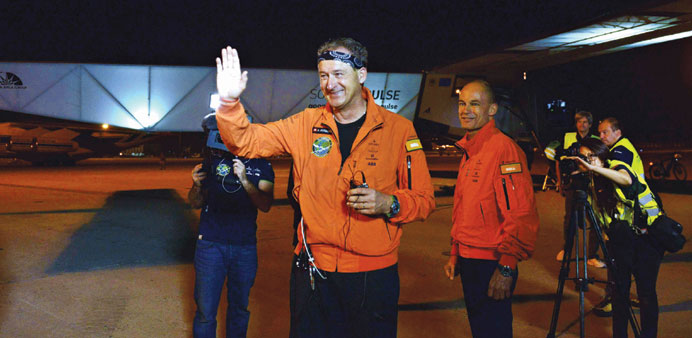
Pilot Andre Borschberg waving before boarding Solar Impulse 2 as he prepares to take off from Sardar Vallabhbhai Patel International Airport in the Indian city of Ahmedabad yesterday. The first attempt to fly around the world in a plane using only solar power launched on March 9 in Abu Dhabi in a landmark journey aimed at promoting green energy.
By Updesh Kapur/Doha
The magic of flight: the four words say it all. A magical feeling of taking a journey that can be jaw-dropping, compelling and fascinating all rolled into one.
Two stories within the space of just a few days have done just that: captured the imagination.
And through both, technology has helped take flying to an all new exciting and invigorating level. Once again the Gulf became the focus of attention for two remarkable record-breaking feats around flight – a global voyage in a solar-powered plane; and a dramatic journey with a truly bird’s eye view.
Earlier this month, two Swiss aviation entrepreneurs embarked on a trip of a lifetime that would be the envy of any pioneer – flying around the world in an aircraft powered by the sun’s energy. The specially-made aircraft with a wingspan wider than a Boeing 747 is completely decked with solar panels. To be precise, 17,000 solar cells fixed on the wings.
Bertrand Piccard and former jet fighter Andre Borschberg started their 35,000km global journey in Abu Dhabi with an easterly route of 12 planned stops before their planned return to the UAE in five months’ time. The duo is taking it in turns at the controls of the single cockpit plane across the Indian sub-continent, Asia, North America and Europe.
The second leg of the flight last week from the Omani capital Muscat across the Arabian Sea to the western Indian city of Ahmedabad took 15 hours covering almost 1,500km. In doing so, the fuel-free carbon fibre aircraft, named Solar Impulse 2 with a weight equivalent of a small car, set a new world record for the longest distance flown in a solar-powered plane.
Solar Impulse 2 typically takes off early morning “on a full tank of the sun’s energy” using 30% of solar power to fly during the day, another third to climb to cruising altitude of around 9,000m and the remainder stored in 400kg of rechargeable lithium batteries that drive the propellers and allow the plane to fly at night. The aircraft completed its third leg last night, touching down comfortably in the eastern Indian city of Varanasi with the next flight to Myanmar earmarked for today.
Having previously flown record-breaking trips across Europe and America in their first solar aircraft, Solar Endeavour, the latest mission is geared for up to five days and five nights non-stop on certain legs of the round-the-world journey. It will be across the Pacific and Atlantic Oceans that will prove a test of human endurance as much as aircraft capability. Their stops en route are educational, engaging the local community including schoolchildren, teachers, researchers and the media to see the plane first hand and learn about the importance of sustainability in a carbon-free environment.
With live inflight broadcasts and social media engagement, this makes for a captivating epic journey that can be followed through www.solarimpulse.com Though passenger flights on solar-powered aircraft are nowhere on the horizon, using solar energy to power aircraft brings to fore the advancement of technology in providing alternative forms of energy to charge any form of mechanical equipment.
Born into a family of explorers – his father was the first to reach the deepest place in the ocean, and grandfather flew a balloon into the stratosphere – Bertrand Piccard earned a world record 16 years ago for circumnavigating the world non-stop with his co-pilot in their Breitling Orbiter 3 balloon.
“We increasingly need to explore new ways of how to live and travel for sustainability of the environment. The objective is to improve the world we live in by using energy more efficiently and conserving natural resources,” Piccard told me last year during tests in Switzerland of Solar Impulse 2.
By contrast, just a few days ago, a flight of a different kind grabbed headlines.
In a bid to raise awareness of the plight of the eagle, an endangered bird of prey, conservationists successfully staged a world record attempt that saw images of a fascinating flight go viral – and in doing so gave a whole new meaning to the phrase “a bird’s eye view”.
With a camera strapped to it, Darshan the eagle was released from the summit of Burj Khalifa in Dubai – the world’s tallest building – with video images of its journey down to earth beamed live around the world.
The organisers, Freedom Conservation, claim it is the highest-ever recorded bird flight from a man-made structure. But what made this so fascinating was not just the spectacular views of Dubai during the five-minute descent to its target trainer near the foot of the skyscraper, but the way in which Darshan glided majestically from a height of over 830 metres to its final resting point with sheer precision, demonstrating the close bond between man and a bird of prey.
Eagles have very good eyesight, three or four times better than humans hence their vision is so sharp, they can hunt their prey at distance with ease. With precision, Darshan landed safely on the arm of its trainer. With the technology that exists today, capturing moments like these with a tiny mounted camera, has helped man get closer to its natural surroundings and able to better understand the feathered creatures.
Freedom Conservation hope that the flight will show that humans and nature can live together. The key to eagles’ survival – and of course to all plants and animals –is to ensure they have enough natural habitat to fulfil their life functions. Humans must set aside enough land for eagles and the ecosystems that they depend on so much for survival if they are to live another 100 years.
For wildlife researchers and conservationists, learning about the behaviour and habitats of bird species like the eagle, present them with an invaluable insight. The camera that captured Darshan’s movements weighed just 300g, equating to 10% of the bird’s total weight. Darshan showed little or no distress during its mission.
The synergy between the two stories is quite interesting.
Aircraft have been developed through analysis of the aerodynamics of birds and their wings, designed to achieve lift through differences in pressure as air moves over and under the wing.
Birds, including eagles, have hollow yet very strong bones to decrease their total body weight and help them in flight. Unlike many other birds though, eagles are fairly heavy, bulky birds. Due to this, they need a lot of room and a lot of energy to take off, just like an aircraft.
Once airborne, they use their large wings, taking advantage of air currents and natural thermals, to float almost effortlessly at great heights and over long distances.
Technology has played a crucial role in bringing together man and the environment. Solar Impulse and Darshan the eagle are just two fitting examples that also demonstrate the magic of flight forever remains. Page 22
♦ Updesh Kapur (below) is a PR & communications professional, columnist, aviation, hospitality and travel analyst. He can be followed on twitter @updeshkapur