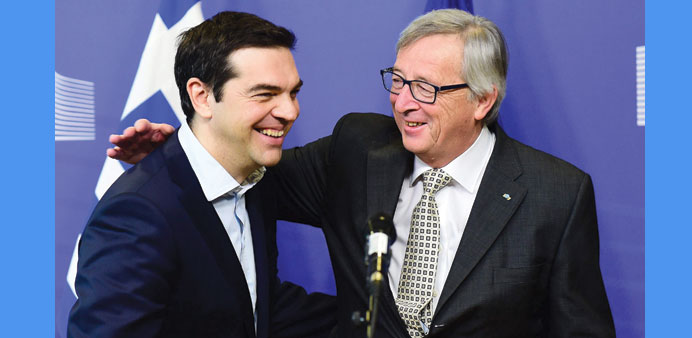
Greece’s Prime Minister Alexis Tsipras (left) is welcomed by European Commission President Jean-Claude Juncker at the European Commission in Brussels on March 13. Tsipras has requested a meeting with top European leaders including German Chancellor Angela Merkel at this week’s EU summit, a Greek official said yesterday.
Reuters, AFP/Athens
Greek Prime Minister Alexis Tsipras has requested a meeting with top European leaders including German Chancellor Angela Merkel at this week’s EU summit, a Greek official said yesterday, as his cash-strapped government scrambles to stave off bankruptcy.
As well as Merkel, Tsipras also wants European Central Bank chief Mario Draghi, European Commission head Jean-Claude Juncker and French President Francois Hollande to take part in the meeting on the sidelines of the summit, which takes place in Brussels tomorrow and Friday.
The request appears to be the latest effort by Tsipras to hammer out with EU leaders a “political solution” to resolve Greece’s funding problems, which are worsening as the country remains shut out of debt markets.
Athens could run out of cash within weeks but its EU partners, angered by the new government’s fiery anti-bailout rhetoric, have frozen financial aid until it shows evidence it is implementing reforms.
Greece’s funding issues have so far been the domain of the Eurogoup of eurozone finance ministers — who have extended the country’s bailout by four months to the end of June — but Tsipras has long called for a more comprehensive decision on the country’s future by European political leaders.
The Greek official said Tsipras had personally made his appeal for a meeting this week in a phone call to Donald Tusk, president of the European Council, who organises EU summits and coordinates business between the EU’s 28 national governments.
Tusk’s spokesman Preben Aamann confirmed yesterday that Tusk was in contact with Tsipras and other EU leaders about organising a meeting on the margins of the summit.
Merkel spoke with Tsipras on Monday amid simmering tensions between Berlin and Athens over his government’s economic plans and invited him for talks in the German capital on March 23.
At that meeting Tsipras plans to reiterate Greece’s commitment to implementing reforms and to raise Athens’ cash problems, the Greek government spokesman said.
“It will be a meeting of substance, not a meeting for communication purposes or a ‘photo opportunity’ in Berlin,” government spokesman Gabriel Sakellaridis said.
Just before the appeal for this week’s meeting, a Greek government official announced that Tsipras had accepted an invitation to meet Russian President Vladimir Putin in Moscow on April 8, a month earlier than originally expected.
The radical Greek government said Tsipras, who was already scheduled to visit Russia in May for its annual Victory Day parade, would now also travel to Moscow on April 8 to see Russian President Vladimir Putin.
“The prime minister will visit the Kremlin following an invitation from Putin,” a government source said without giving reasons for the change of date. Tsipras, a former Communist, has made no secret of seeking closer ties to Russia at a time when Moscow is at loggerheads with the European Union over the conflict in Ukraine.
A number of Greek officials have openly broached the prospect of Athens turning to Russia or China for financial assistance if loan talks with the EU end in failure.
The prospect of NATO member Greece moving into the Russian orbit is alarming to some in Brussels including European Council chief Donald Tusk.
“Can you imagine Europe without Greece,” the former Polish PM said in an interview with six European dailies this week.
“The consequences for Europe would not only be financial, the results would be the most dramatic chapter in all the history of the European Union,” he said.
Greek daily Ta Nea said the Moscow visit was linked to the cash crunch Athens is facing because it has not received the funds remaining in its €240bn ($255bn) EU-IMF rescue package as Brussels has demanded to approve first Greece’s revised reform plan.
Athens “sought to bring forward” the meeting with Putin owing to “stifling economic conditions caused in the country from the European side,” the daily said yesterday.
The new foreign minister Nikos Kotzias later said that the EU should avoid “spasmodic” moves against Russia.