


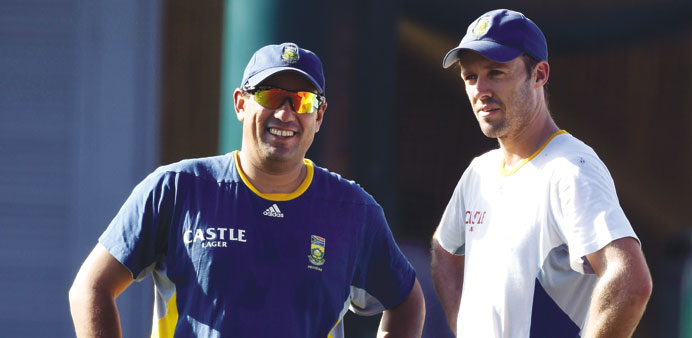
South African coach Russell Domingo (left) smiles as he talks to captain AB de Villiers during a training session at the Sydney Cricket Ground. (AFP)
AFP/Sydney
South Africa coach Russell Domingo insisted his side had faced up to their unwanted tag of cricket’s serial “chokers” ahead of a World Cup quarter-final with Sri Lanka in Sydney tomorrow.
Despite boasting some of the world’s most outstanding one-day players during the past two decades, the Proteas have not won a knockout match at the World Cup since being allowed into the 1992 edition ahead of the end of apartheid. That tournament infamously saw South Africa lose in the semi-finals to England at the Sydney Cricket Ground after the rain rule in use at the time left them with the impossible task of scoring 22 runs off one ball.
“I was in Matric (secondary school), I was 16-years-old. There’s nothing we can do about what happened in 1992, all our energy is focused on what we need to do leading into this game,” said the now 40-year-old Domingo at the SCG yesterday. “The legacy of 1992 has very little bearing on now, we want to play our game on Wednesday.”
South Africa lost in the World Cup quarter-finals in 1996 and went out on tournament net run-rate after a tie with eventual champions Australia in a thrilling semi-final in 1999. Another tie, this time with Sri Lanka in Durban, after a failure to correctly interpret the Duckworth/Lewis rule for rain-affected matches—which owed its origin to what happened to the Proteas in 1992 -- meant South Africa bowed out at the initial group stage when they were the main hosts of the 2003 World Cup. Then came a 2007 semi-final loss to Australia in the Caribbean before a quarter-final defeat by New Zealand four years ago.
Asked about South Africa’s habit of ‘choking’ in crunch games, Domingo said: “It’s been part of South African cricket for quite some time, every time we get to these events it’s going to be questioned. “We’ve spoken about it, we’ve faced the fact that in the past we have let opportunities slip by us. Hopefully, we have learnt from the mistakes that previous sides have made at events like this.
“And by all means we want to avoid that happening to us. But at the end of the day, we just want to play good cricket if the opportunity arises. If somebody is in that stage of the game under pressure, we try to focus on things we’ve done really well and not get too caught up in the past.”
Domingo added: “We know we’ve come here with a clean slate...We come here knowing that if we play to the best of our abilities, we’ve got a good chance of winning on Wednesday.”
The Proteas have again used the services of South Africa-born explorer Mike Horn in a bid to ease the pressure on their side. “He’s done a lot scarier things in the world than facing Dale Steyn or Morne Morkel, he’s done some extreme things,” said Domingo.
“He will put it all into perspective for us over the next couple of days about what pressure and fear’s like and being out of your comfort zone, because he’s been in that situation a lot of times with real-life experiences, not just facing a cricket ball.”
Domingo added: “He’s been with us before and adds a lot of energy, he connects with the players, it’s great fun to have him with us.”
Amla sure De Kock will fire
Sydney: South Africa’s Hashim Amla is convinced his struggling opening partner Quinton de Kock will be soon be back among the runs as the Proteas look to bury their reputation as World Cup “chokers” in the knockout stages.
Amla, described as the “rock” of the team by skipper AB de Villiers after his 159 against Ireland earlier in the tournament, has not consistently produced his best form so far. With 307 runs to his name, though, his performances with the bat have far outstripped those of 22-year-old De Kock, whose six innings have produced just 53 runs.
With the South Africa openers charged with laying the platform for some prolific batting down the order, it is something of a concern heading into their quarter-final against Sri Lanka in Sydney tomorrow. Amla is well aware of the role the duo play for the side, however, and on Sunday dismissed the idea that De Kock’s string of failures was also making him bat more aggressively.
“You’ve got to look at the context of the game, sometimes you get a loose ball up front and you manage to score from that, unconsciously you score quickly,” the 31-year-old said. But I haven’t consciously been any more attacking. Quinny will come good at some stage. My game plan is to bat for as long as possible and to set the game up for the guys.”