Reuters/London
Fund managers who bet on beaten-down Russian stocks and bonds have been rewarded with some of the best returns in emerging markets so far in 2015.
Foreign investors fled Russia last year, panicked by an oil price collapse, a simmering conflict on the Russia-Ukraine border and Western sanctions that effectively froze the country out of credit markets. The subsequent 50% plunge in the rouble’s exchange rate between May and December provided another catalyst for the exodus.
Those fears have not entirely vanished. Yet since the start of the year, oil has bounced 25%, the rouble has stabilised, and the central bank is reversing last year’s interest rate hikes, cutting rates on Friday to 14%.
“We held nothing (in Russia) from about February last year, to December, and since December we have put our money back to work,” said Paul McNamara, investment director for emerging markets at GAM.
Russian asset prices, always cheap but especially so these days, were a factor, McNamara said.
“Usually one of the things we try and do is buy things that are beaten up – after owning no Russia last year we started buying Russia,” he added.
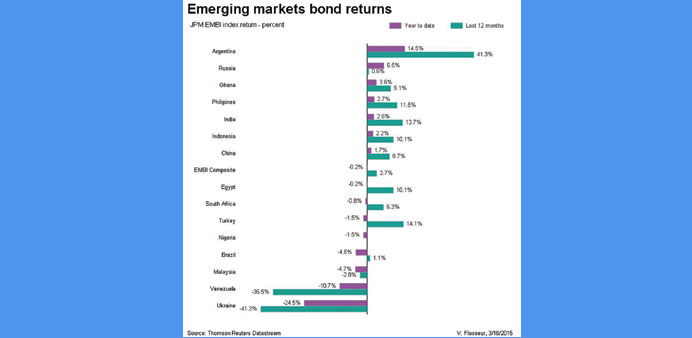
Investors such as McNamara have been amply rewarded so far, as Russian stocks and bonds have returned in excess of 5%, outstripping most other emerging markets as these graphics show:
Russia-dedicated bond funds tracked by Boston-based data provider EPFR Global have received $116mn so far this year, though this only partly reverses last year’s $864mn.
For some bond investors, the 13% yield on one-year local government debt appears a fair compensation for political risk. Dollar debt yields almost 5 percentage points above US Treasuries, close to what countries such as Ethiopia and Pakistan, with far lower credit ratings, pay.
Moreover, with the Russian government and companies unable to place new hard currency debt, sovereign external debt stands at $54bn, down $2bn from year-ago levels.
Costa Vayenas, head of EM investment at UBS Wealth Management says he is “not underweight” Russia.
“What you have are bonds that are certainly at the sovereign level very cheap, especially when you consider the Russian sovereign can pay back the entire stock of debt this afternoon if it wants to,” Vayenas said, referring to Russia’s $350bn war chest.
A key component of recent investor confidence has been the rouble’s relative stability compared to other high-yielding emerging currencies such as Turkish lira and Brazilian real that are feeling the heat from the looming US interest rate rise.
The rouble’s real effective exchange rate (REER) – a gauge of whether a currency is overvalued or undervalued – stood 25% below its 10-year average in February.
Those who correctly timed their return to Russian stocks will also have watched them outperform virtually every other emerging market this year. In dollar terms, Russian equities are up 15% this year.
Russia equity funds tracked by EPFR have done better than any other developing country group, enjoying inflows of over $400mn this year, even though falling retail sales, wages and capital spending all point to a deep economic recession.
One reason for the bounce is that Russian stocks are at least twice as cheap as emerging market peers on a forward earnings and price-book.
But for Matt Linsey, who runs GAM’s North of South emerging equity fund, Russian companies’ propensity to return money to shareholders via dividends is the main lure. Russian dividend yields – the ratio of dividends versus share prices – are among the highest in the world.
“What you have seen is some of the domestic stocks have been increasing their dividend quite surprisingly,” said Linsey. “Companies are returning a lot more cash to shareholders.”
Gas firm Novatek for instance has recommended raising dividends by a third, while Lukoil, said it would maintain dividends even if oil falls to $40 a barrel.
Whether market gains continue will hinge on oil and a rollback of Western sanctions imposed on Russia’s financial and energy sectors last July. Many are not convinced.
“I can’t deny the pricing is not attractive but to my mind there are still non-economic non-market risks attached to investing in Russia,” said Kieran Curtis, a bond fund manager at Standard Life Investments who is happy to stay on the sidelines. He noted that Russia’s weighting in the emerging market debt benchmark GBI-EM has more than halved in the past year to 4.5% as outstanding debt has fallen. That makes missing a market bounce less painful for fund managers.
“If Russia was still 10% of the benchmark that my fund is measured against, it would be more uncomfortable for me to be short,” Curtis added.