


AFP/Reuters/Suva
Relief supplies began arriving in cyclone-devastated Vanuatu yesterday as the Pacific nation declared a state of emergency amid reports entire villages were “blown away” when a monster storm swept through.
The official death toll in the capital Port Vila stood at six, although aid workers said that this was likely just a fraction of the fatalities nationwide.
Communications were still down across most of the archipelago’s 80 islands, although the airport in Port Vila reopened with limited facilities to allow much-needed aid in.
Two Australian air force planes landed with food, shelter and medicine while a New Zealand military aircraft also arrived loaded with eight tonnes of tarpaulins, water containers, chainsaw packs and generators.
Commercial flights were scheduled to resume today.
The government said it was still trying to assess the scale of the disaster unleashed when Super Cyclone Pam, a maximum category five system, vented its fury on Friday night, with winds reaching 320kph (200mph).
The UN had unconfirmed reports that the cyclone had killed 44 people in one province alone and Oxfam said the destruction in Port Vila was massive, with 90% of homes damaged.
“This is likely to be one of the worst disasters ever seen in the Pacific, the scale of humanitarian need will be enormous ... entire communities have been blown away,” said Oxfam’s Vanuatu director Colin Collet van Rooyen.
Vanuatu Red Cross president Hannington Alatoa said: “Effectively the whole country ... is flattened.”
While the focus was on Vanuatu, Tuvalu – some 1,550km (960 miles) to the northeast – saw thousands forced from their homes.
The dire situation prompted Pope Francis to send a message of support.
“I express my solidarity to the people of Vanuatu ... I pray for the dead, the injured and the homeless,” said the Pontiff.
“Forty-five per cent of the population of Tuvalu, most of whom are on the outer islands, have been affected, badly, severely affected,” Prime Minister Enele Sopoaga told Radio New Zealand International yesterday.
The island chain is some 1,550 kilometres (960 miles) northeast of Vanuatu.
“We are worried about the aftermath in terms of hygiene and supplies of essential materials like food, medicine and water,” Sopoaga added.
Few details of the impact were given.
Sopoaga told the broadcaster that there were health and safety concerns after cemeteries were destroyed and government boats were setting off later in the day to assess the extent of the damage.
Aurelia Balpe, the Fiji-based head of delegation for the International Federation of Red Cross and Red Crescent Societies in the Pacific, said there had been extensive flooding in the low-lying nation.
“Tuvalu has had storm surges and up to six of its islands have been affected. People have spoken of four-to-five metre (13-16 foot) waves,” she told AFP, adding that “people are hip-high in water”.
“Some houses have fallen over and other infrastructure has been hit, with one hospital destroyed.”
Balpe said other Pacific nations, including the Solomon Islands and Kiribati, had also been battered although not as badly as Vanuatu.
“Kiribati has also had storm surges,” she said, with the main causeway on the islands badly damaged. “There’s basically one road on the islands and the bridge has been destroyed, which is seriously impacting transport.”
On the Solomons, several houses were razed with areas inundated by water, causing landslides.
“It is unprecedented in terms of the number of places impacted,” Balpe said of the Pacific. “But we have not heard of casualties in the Solomons, Kiribati and Tuvalu at the moment.”
Australian Foreign Minister Julie Bishop said Canberra was responding to a request from Tuvalu, one of the world’s smallest and most remote countries.
“Tuvalu has announced a state of emergency and we are responding to that request with basic supplies, water, sanitation, tents, blankets and food,” she said in Perth. “In the case of Fiji, Solomon Islands and Kiribati, we understand assessments are being made. The impact is not as great but we wait to hear.”
In Vanuatu, police commissioner Colonel Job Esau said some areas of the capital – such as shopping districts and the waterfront – had been put off limits to try to stop looting as darkness approached, including possible thefts from yachts that had been washed away.
Ivan Oswald, an Australian cafe owner who has lived in Vanuatu for 13 years, said he had seen “opportunistic looting” of houses and boats.
“It’s a sad thing ... I’ve seen some people running around and started looting. Resorts are being pilfered. It’s just getting a bit lawless at the moment,” he told AFP by phone.
Oswald’s Port Vila harbour cafe was “smashed up” by the cyclone. He said: “People are behaving differently. Some are fixing things, some are unable to, they are just a little bit shell-shocked.”
Vanuatu’s President Baldwin Lonsdale described the storm as “a monster that has devastated our country”, his voice breaking as he described Port Vila’s devastation.
“Most of the buildings have been destroyed, many houses have been destroyed, school, health facilities have been destroyed,” he told the BBC from Japan, where he was attending a disaster management conference when the cyclone hit.
Aid workers described scenes of desperation following what Unicef spokeswoman Alice Clements said was “15-30 minutes of absolute terror” as the cyclone barrelled into the island.
“People have no water, they have no power, this is a really desperate situation right now. People need help,” she told AFP.
Clements said most of the dwellings on Port Vila’s outskirts, largely tin shacks, stood no chance.
World Vision spokeswoman Chloe Morrison said the situation also appeared grim for outlying islands in the nation of around 270,000.
“We’re seeing whole villages and houses blown away,” she said.
Despite the problems, relief began to trickle in to Vanuatu, a day after Lonsdale made an emotional call for international aid.
The president said that offers of aid had been very generous, adding: “We are not begging, but we are asking for assistance.”
Vanuatu’s climate change minister, James Bule, said people were used to storms, though not usually such strong ones, and he also hoped loss of life might be limited.
“We have people aware of what to do,” Bule said.
Australia promised A$5mn in aid, New Zealand NZ$2.5mn while Britain, which jointly ruled Vanuatu with France until independence in 1980, has offered up to £2mn ($2.95mn) in assistance.
The World Bank said it was exploring a swift insurance payout to the government.
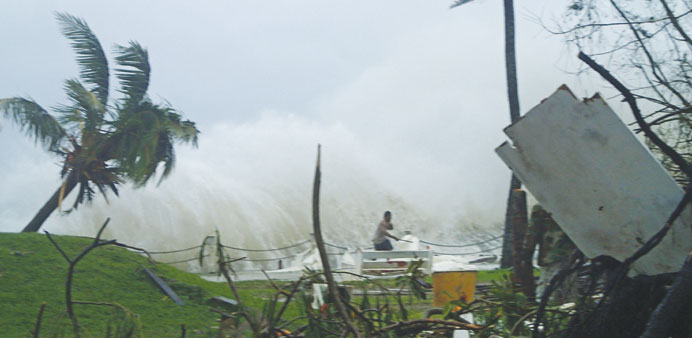
This handout photo taken on Saturday and received yesterday by CARE Australia shows a man fleeing high waves caused by Cyclone Pam, crashing along the