


By Anand Holla
That Qataris, and Arabs in general, are massive fans of Japanese pop culture staples such as anime (animation) and manga (comics) is no secret.
But if one had any doubts over the sheer extent of this craze, a visit to the artists’ corner at the recently held IGN Convention would have sufficed.
At the two-day event that brought the nation’s video game, film, and comic community together, a dozen Qatari women were seated through two rows of mini stalls, sketching and colouring their cool creations. Apart from a fine and wide range of manga characters on display, what seemed interesting were their own characters spun off from manga motifs.
Young Qatari artist Reem Hani Ballan, who started drawing five years ago and goes by the handle @Zafzoofa on Instagram and Twitter, is working on a manga novel featuring Arab characters Reem, a princess who ran away from home, and Saif, her guardian.
“I love anime series like One Piece, Kuroko’s Basketball and Naruto, and my manga novel draws inspiration from all the anime I grew up on,” she said.
Mai al-Kubaisi, who is part of a ladies artists’ group called Gathering Point, stocks tools and colouring kits one would need to draw manga. “Although we are doing different work, we know each other and are part of the manga artists’ community of Qatar,” Al-Kubaisi said, looking over at the other women around her, “We at Gathering Point have also released our own manga book titled Our World. We hope to take manga art in Qatar to new heights.”
Huda al-Emadi, who has been drawing for the past 12 years, has even drawn her avatar — a violent one at that. “This is the way we get to live other characters,” she says, smiling and throwing a glance at a pile of t-shirts, stickers, posters and books on display at her stall.
At the far corner, immersed in her manga drawings was Dina al-Falasi. “I have been watching anime since I was 12,” said Al-Falasi, who is now in her thirties, “I would be hooked on video games and old anime. I grew up on Japanese anime that would be dubbed in Arabic like Adnan wa Lina (Future Boy Conan) and Grendizer.”
In fact, it’s the Arabic-dubbed anime that has been winning the hearts of many generations of Arabs as they have grown up watching these cartoons aired on local television networks across the Middle East.
For Al-Falasi, drawing is a hobby. “Whenever I find time, I do it,” Al-Falasi said, “People contact me through my Instagram account, often placing requests for drawing various anime characters.”
The huge number of manga readers, anime viewers, Japanese fashion and Cosplay followers in Qatar point to the rise and rise of Japanophilia.
The signs of this are hard to miss — be it hundreds of youth flocking to the Japanese booth and a manga comic store at the Doha International Book Fair in January or young Qatari couple Fatma al-Jassim and Jassim al-Mass opening the country’s first anime and manga toy store, Hobby Chan, featuring figurines, merchandise and custom-made dolls, at Bin Omran, last year.
“I love Japan and I went there because I love anime,” Al-Falasi said, “I love how their anime characters have big eyes, and their outfits reflect the Japanese lifestyle.”
However, the current crop of anime may not be as appealing to the generations that grew up on “more meaningful anime.” “Our anime was strong on moral values. Now it isn’t so,” Al-Falasi said, “I love the action in the new ones though, like in Naruto and Bleach. The anime and manga trend is certainly growing among teenagers here.”
That shouldn’t surprise us. As author and Japanese pop culture expert Takamasa Sakurai once put it aptly: “Japanese pop culture is, in a contemporary society, what young people are interested in at the moment. That is pop culture, and my definition of youth does not depend on the biological age, but on what the person feels or is interested in.”
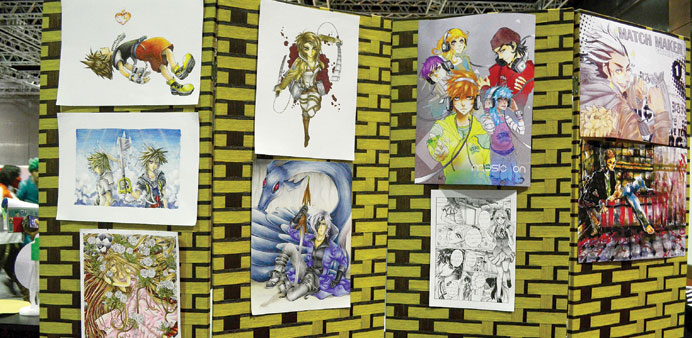
The work of Huda al-Emadi.Photo by Anand Holla