Bloomberg Business
Washington
It’s not only the just-released University of Michigan consumer confidence report and February retail sales on Thursday that surprised economists and investors with another dose of underwhelming news. Overall, US economic data have been falling short of prognosticators’ expectations by the most in six years.
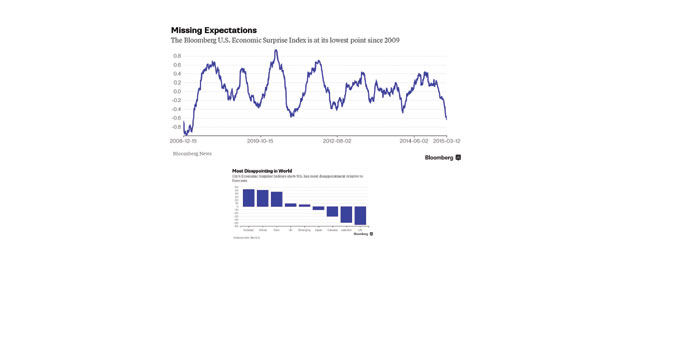
The Bloomberg ECO US Surprise Index, which measures whether data beat or miss forecasts, fell to the lowest since 2009, when the nation was in the deepest recession since the Great Depression.
There’s been one notable exception to the gloom, and it’s a big one: payrolls. The economy added 295,000 jobs in February and 1.3mn over four months, a reflection of a healthier labour market in which the unemployment rate has fallen to the lowest in almost seven years.
Most everything else? Blah.
This month alone, personal income and spending, manufacturing as measured by the Institute for Supply Management, auto sales, factory orders, and retail sales have all come in a bit weak.
Citigroup keeps economic surprise indexes for the world, and its scoreboard shows the US is most disappointing relative to consensus forecasts, with Latin America and Canada next, as of March 12.
Emerging markets were supposed to be hurt by falling oil prices but are now delivering positive surprises. US policymakers frequently talk about weakness in Europe and China, though both are exceeding expectations.
And there’s one rub. The surprise shortfall in the US doesn’t necessarily mean the world’s largest economy is in dire straights. It’s just falling short of some perhaps overly elevated expectations.
Where are the data beating economists’ forecasts most consistently? Sweden.
Jack Ablin, chief investment officer of BMO Private Bank in Chicago, said he pays attention to the surprise indexes as a way to gauge when a particular national economy may be turning and looks for good value in equities.
“It is an early indication of a momentum shift,” he said, adding that he’s been raising the amount of money put into international stocks. While Ablin expects moderate US growth, he said a strong US dollar has the potential to dampen the expansion.
Federal Reserve chair Janet Yellen gave no hint of concern in recent congressional testimony, where she cited an “overall improvement in the US economy and the US economic outlook,” boosted by lower oil prices.
The data slump may give the Federal Open Market Committee reason to wait before raising rates, said Jonathan Wright, a professor at Johns Hopkins University in Baltimore who worked at the Fed’s division of monetary affairs from 2004 until 2008.
First-quarter US growth forecasts continue to be cut, and like last year, weather is getting a share of the blame.
JPMorgan Chase’s Michael Feroli cut his forecast to 2% from 2.5% on March 6. Barclays Capital has reduced its estimate to 1.5% as of March 12. Macroeconomic Advisers’ tracking forecast was lowered to 1.7% on March 12.
The Atlanta Fed published a tracking forecast for GDP in the first quarter, and that was halved to 0.6% after the retail report.
If this all seems vaguely familiar, pretty much the same thing happened last year.
Then, a contraction in the first quarter that most everyone blamed on the weather was followed by two blockbuster quarters with GDP averaging 4.8%.
Fed officials have shown a willingness to look through a few bad pieces of economic data—”noisy” as Yellen called a pickup in inflation last year that turned out to be meaningless.
Data can be noisy, and a loud surprise on the downside can pave the way for performances that go on to beat expectations. Fed policymakers, who meet on Tuesday and Wednesday, may need some positive surprises to begin to feel confident this year is on the right track.