


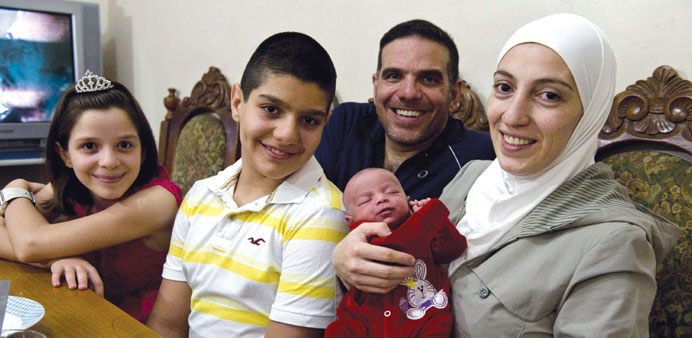
Syrian refugee Talal al-Tinawi with his wife Ghazal and their children at their home in Sao Paulo. Brazil hosts some 1,700 Syrian refugees who have fled from the civil war which began in 2011.
By Natalia Ramos/Sao Paulo/AFP
“Good day, my name is Mouaz.” The Portuguese is rudimentary, but the effort is sincere. The young man at a Sao Paulo mosque left the horrors of the Syrian civil war for a new life in Brazil, and he’s adapting as well as he can.
The South American giant has been home for some decades to a sizeable Arab diaspora, and 1,700 Syrians have joined their ranks over the past four years.
They found a country with 15mn people of Arab origin, mainly Lebanese or Syrian, who began arriving in the late 19th Century.
The latest newcomers who arrived with at most a couple of suitcases to tackle a new language and a very different culture.
Mouaz Tawakalna, a 28-year-old telecoms engineer, touched down just a week ago and speaks in Arabic, using a friend as translator.
“I need to learn Portuguese to integrate and communicate with people. I want to stay and make a life for myself here,” he insists.
Sao Paulo’s popular, bustling downtown Bras district is crammed with clothes shops and small restaurants.
The area also boasts a mosque, where Ahmed Almazloum, 28, works as a volunteer.
“I am a biomedical engineer,” he says. “Here in Sao Paulo I worked selling clothes and now I am a supervisor in a textiles factory.
“I was never into politics, never took part in protests, but as my studies drew to a close I had to go off and do my military service in the middle of a war,” he explains.
“I didn’t want to. It was kill or be killed.”
The mosque is a focal point for Syrians in the city.
“They are all here because of the war,” said Luiz Fernando Godinho, of the office of the UN High Commissioner for Refugees (UNHCR).
Brazil has agreed to grant refugee status to all the Syrians who have requested it, the spokesman said.
They generally hail from urban areas and have professional or technical qualifications, according to the UNHCR.
Many are single men. Others have brought their families with them. Some are Muslims, others Christians. Still others profess no faith.
“ I am a communist,” says Victorios Bayan, a 39-year-old journalist and an “opponent of the government of Bashar al-Assad since before the revolution”.
Bayan says he reached Sao Paulo two months ago and took language classes at the mosque.
“I was detained, beaten and maltreated,” he explains. “When will I be able to return? Will there be a solution?”
Talal al-Tinawi, 42, came to Brazil in 2013 with his two children and his wife. They first stayed with a friend of Syrian origin and now are renting a small apartment in a dingy city centrestreet. A few weeks ago a new addition arrived in the shape of Sara, a Brazilian-born little girl for the family.
On their wall is a map of Brazil along with several framed verses from the Qur’an.
Dinner is served - chickpeas, bread, olives and tea.
“We arrived here knowing nothing of Brazil. Everything was new and strange,” recalls Tinawi, who decided to leave Syria after he was detained for several months.
With help from Brazil’s Arabic-speaking community, Tinawi found employment at an engineering firm having held a similar position in Damascus. His children attend a local school.
Tinawi’s wife Gazhal covers her head with the veil and soon her daughter Yara, 10, will do likewise.
Her son Riad, 13, meanwhile, insists he will have not have any girlfriends before marriage.
His father reflects for a moment as he looks to the future.
“I don’t know how things will be when the children grow up and things change,” Tinawi muses.
“But one thing is for sure. Here and now we are better off” than before they arrived.