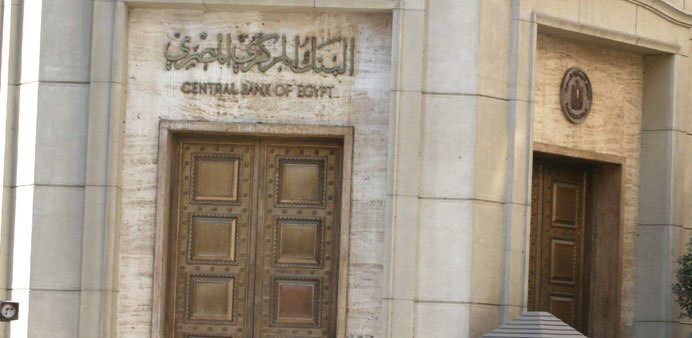
The central bank surprised analysts with a 50 basis point cut to the two benchmark rates in January, bringing the overnight deposit rate to 8.75% and the overnight lending rate to 9.75%
Reuters/Doha/Abu Dhabi/Khobar
Gulf Arab governments are encouraging - and in some cases pressuring - hundreds of companies to attend an international investment summit in Egypt this week, in a move that may help the firms become top players in a rebounding Egyptian economy.
Over 270 of about 1,300 foreign officials and executives registered for the event, which will declare Egypt open for business again after years of economic and political turmoil, are from the six oil exporting states of the Gulf.
That makes the Gulf the largest regional contingent at the conference, eclipsing Europe, which traditionally dominated foreign investment in Egypt before the Arab Spring uprising of 2011. The roughly 160 delegates from the UAE far outnumber the 55 from the US - though some of them are UAE-based representatives of Western firms.
The disparity in numbers suggests that initially at least, Gulf firms may grab the lion’s share of the billions of dollars of investment opportunities on offer in sectors from power generation to real estate, finance, retailing and industry.
Egyptian officials have said they hope the conference, to be held from Friday to Sunday in the resort town of Sharm el-Sheikh, will confirm domestic and foreign investments worth up to $12bn. Half the projects which Egypt will propose are expected to be in the energy sector, a minister said last month.
There are good reasons for Gulf firms to be interested in Egypt. Its 90mn population is nearly double that of the Gulf oil states, where markets are more mature and in many cases more competitive.
The UAE, Saudi Arabia and Kuwait are signalling to Gulf firms that they will back investment in Egypt politically and perhaps financially.
“There is support from the UAE government,” Hussain al-Nowais, chairman of Abu Dhabi’s General Holding Corp (Senaat), a major state-owned industrial investment firm, said of UAE participation at Sharm el-Sheikh.
“The UAE and Egypt have a strategic relationship - our leadership is committed to Egypt. So many projects are going on, on the government and private sides,” al-Nowais, who will attend the conference, told Reuters.
An 18-page pamphlet released by UAE authorities in the run-up to the conference describes Abu Dhabi’s deep involvement in engineering Egypt’s economic recovery.
In addition to direct financial aid, the UAE is “garnering economic and political support for Egypt” and providing technical assistance in designing its economic programme, partly by hiring expert consultants from around the world.
Stimulating corporate investment is key to the plan. Since former president Mohamed Mursi was ousted in mid-2013, the governments of the UAE, Saudi Arabia and Kuwait have averted a financial crisis in Cairo by providing it with $23bn of oil shipments, cash grants and deposits in the Egyptian central bank.
Such heavy official aid cannot continue indefinitely; it could make Cairo largely dependent on the Gulf, and the Gulf’s state budgets are in any case being pressured by the plunge of oil prices since last June.
So officials in the Gulf and Cairo say they want to move economic assistance into a new phase, in which corporate capital from the Gulf helps revive economic growth and create jobs.
To some extent, the Gulf will be doing what it has already done successfully in its own economies. Many of its big banks and other companies are linked to governments through large minority shareholdings.
For example, state-linked property developers and investment firms have built much of Dubai in the past two decades, basing projects on the government’s long-term economic strategy as well as shorter-term profit goals. Saudi Arabia is building new industrial cities through public-private partnerships.
Gulf businessmen going to Sharm el-Sheikh said they expected their governments to provide some degree of financial support for many projects on offer there - for example, by guaranteeing purchases of electricity from new power plants.
“Definitely Saudi will support (investments) from the Public Investment Fund, from the project finance point of view,” said Yassin al-Suroor, chief executive of A’amal Group, a private Saudi engineering group.
More broadly, Gulf investors may be able to count on political goodwill in Egypt to navigate its considerable bureaucratic and legal obstacles - an advantage which US and European companies, whose governments have had sometimes strained relations with Cairo, may lack.
“If you don’t have the political will to support the commercial business, it will not be as strong,” Osama Bishai, CEO of Egypt’s Orascom Construction, said in the UAE. “We’re happy co-operation is very strong between the two governments, and it will allow us to work closely with entities in the Emirates.”
There is a question mark over the participation at Sharm el-Sheikh of companies from Qatar. A copy of the conference’s guest list obtained early this week showed just one businessman from Qatar attending, from a hypermarket chain. Industry sources said the Qatari government was supporting other firms to attend, but for now at least, many Qatari firms may miss out on any Egyptian investment bonanza.
Banking on summit
After four years of political turmoil, Egypt is staking its economic revival on an investment summit in the Red Sea resort of Sharm el-Sheikh this weekend. Here is a look at how the economy’s key indicators have changed since the fall of autocrat Hosni Mubarak in 2011 and what the government expects to achieve in the coming years.
ECONOMIC GROWTH: Egypt’s gross domestic product (GDP) grew at 4% to 7% before the Arab Spring, but slowed to below 2% in 2011. Growth recovered to 5.6% in the last six months of 2014, a step towards plans for economic expansion to average 7% by the end of fiscal year 2018-19.
FOREIGN DIRECT INVESTMENT: Egypt hopes to attract investments worth $60bn over the next four years. Africa’s third largest economy saw inflows of around $8bn before the 2011 uprising shrivel to half that in recent years as political upheaval kept most foreign companies on the sidelines.
BUDGET DEFICIT: Egypt’s budget, long strained by costly energy subsidies and bloated public sector payrolls, ballooned to 14% of GDP last year. The government hopes to get that down to 10% next year and 8.5% by fiscal year 2018-19.
INTEREST RATES: The central bank surprised analysts with a 50 basis point cut to the two benchmark rates in January, bringing the overnight deposit rate to 8.75% and the overnight lending rate to 9.75%. The bank raised the rates by 100 basis points in July in an attempt to hold down inflation following an initial round of cuts to fuel subsidies.
EXCHANGE RATES: The dollar has been selling at a cut-off price of 7.5301 pounds for more than a month in the central bank sales that give the bank effective control over official exchange rates. Earlier in the year, the bank let the pound weaken in an effort to wipe out black market trading. It has also widened the band around the official rate at which banks can trade dollars and imposed a limit on dollar deposits in banks, which traders say has dramatically reduced black market activity.
FOREIGN RESERVES: Currency reserves plummeted in the months after the 2011 uprising from $36bn to critically low levels below the $15bn needed to cover three months of wheat imports for the most populous Arab country. Reserves have stabilised above $15bn for the past 18 months. But a boost in tourism and foreign investment is needed to return reserves to earlier heights.
UNEMPLOYMENT: Joblessness is a chronic problem in Egypt. The official unemployment rate is about 13%, but the real figure is thought to be much higher. The government is aiming to get the rate below 10% over the coming four years.