


Qatar Shell sponsored the 31st GCC Traffic Week, organised by the Ministry of Interior (MoI), in an effort to reach out to the Qatari community to reduce road accidents.
The initiative is part of Qatar Shell’s social investment strategy and showcases its commitment to work with the MoI to raise awareness on road safety, according to a statement.
Sheikh Thani al-Thani, deputy managing director of Qatar Shell, joined Staff Major General Saad bin Jassim al-Khulaifi, Director-General of Public Security, and Brigadier Mohamed Saad al-Kharji, Director-General of the Traffic Department, at the official inauguration of the 31st GCC Traffic Week.
During his visit to Qatar Shell’s stand, Staff Major General al-Khulaifi praised the company for its contribution to road safety and continuous support to the Traffic Department.
“We are proud to have participated in the GCC Traffic Week for five consecutive years, and to work closely with the Ministry of Interior and Traffic Department to help reduce the number of road accidents in Qatar,” said Sheikh Thani.
The 31st GCC Traffic Week took place in Darb Al Saai, where Qatar Shell showcased a specially-designed interactive exhibition stand and presented the Rakkiz Tislam programme in co-operation with the Ras Laffan Industrial City Community Outreach Programme.
Rakkiz Tislam (meaning focus and be safe), which has been brought to the Middle East for the first time, is a realistic driver learning software module based on a successful young driver scheme in the UK. The programme, designed to help young drivers identify and respond to potentially unsafe traffic situations, was designed and tailored to Qatar’s roads and driving environment, and includes real traffic scenes filmed on Qatar’s roads.
The stand has been visited by thousands of visitors, especially young people, who learned about road safety and participated in the Rakkiz Tislam challenge, the statement adds.
The initiative was targeted at young drivers (aged 14-21 years) who pose the greatest risk of being involved in road accidents. The stand included various training sessions, which are part of the Rakkiz Tislam programme, for the young drivers.
Qatar Shell also presented its Hizamak Amanak programme, which emphasises the importance of wearing a seatbelt to avoid serious injuries.
Statistics from a road safety attitudes survey conducted by Ipsos Mori for Qatar Shell in 2012 show that only 64% of Qataris aged 16 to 21 years wear a seatbelt, compared to 75% among the 22 to 49 age category. Statistics also highlight that the percentage of expatriates who buckle up is almost 90%.
Safety regulations were found to be the major factor in forcing drivers to adopt road safety measures. On an average, 81% of drivers buckled up. Statistics also indicate that only 31% of children aged under 12 years use a child’s car seat, posing a great risk to the safety of the remaining 69% who don’t use a car seat.
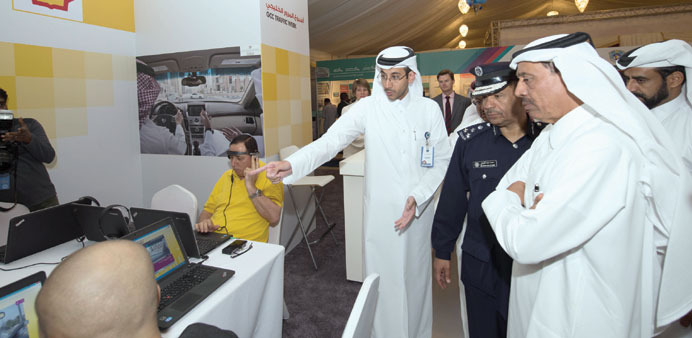
Officials and dignitaries at the Qatar Shell stand.