


By Santhosh V Perumal/Business Reporter
Qatar will establish next month the Middle East’s first centre for clearing and settling Chinese currency, paving way for greater bilateral trade between the two countries and also lessen the dependence on the US dollar.
Moreover, Qatar’s commercial banks will be able to convert their representative offices in China into full-fledged branches and the country’s Islamic banks could establish their presence in the vast Chinese market.
“The (clearing and settlement) centre will be opened next month,” Qatar Central Bank (QCB) governor Sheikh Abdullah bin Saoud al-Thani told the Meed Qatar Projects conference, which got underway in Doha yesterday.
Industrial and Commercial Bank of China’s Doha branch was last year appointed as the clearing bank for the Chinese currency deals in Qatar.
QCB had signed a memorandum of understanding and a swap agreement with the People’s Bank of China (PBC) in November 2014 during the visit of HH the Emir Sheikh Tamim bin Hamad al-Thani to China.
The MoU establishes the framework for a centre for renminbi (RMB) clearing and settlement in Doha, Qatar. The yuan is the basic unit of RMB.
Under the MoU, the central banks will jointly review the implementation of the necessary arrangements for the RMB businesses in Qatar and co-operate on related supervisory matters.
The signing of the MoU and the appointment of the RMB clearing bank will increase the strong ties between China and Qatar and position Qatar as the regional centre for the RMB clearing and settlement, Sheikh Abdullah said.
The central banks also agreed to extend the RQFII (Renminbi Qualified Foreign Institutional Investor) pilot to Qatar with an initial quota of 30bn Chinese yuan. The RQFII quota will be available to asset managers licensed in Qatar by the QCB, the Qatar Financial Markets Authority or the QFC Regulatory Authority.
Sheikh Abdullah said another agreement with South Korea will pave way for better financial co-operation and exchange of information, expertise and training. These pacts are part of its strategy to engage with regional and international financial centres.
QCB had also signed an agreement with PBC to establish a reciprocal 3-year currency swap line with a value of RMB35bn. The swap line will facilitate RMB trade and investment and provide liquidity and support for financial stability.
In another session, Qatar Chamber CEO Remy Rowhani elucidated how Qatar, despite being a small country, was able to steer the Doha Round of WTO, which was on a limbo for more than a decade, to victory at the Bali Ministerial summit.
Col Abdul Rahman M K al-Sulaiti, director (Strategic Planning), Ministry of Interior, said Qatar was ranked top in the security and safety indicators in the Middle East and this itself prompted more foreign investments into the country.
Qatar has now embarked on a sustainable economic development in line with National Vision 2030 to knowledge-based economy, diversifying away from hydrocarbons.
All the indicators point to strong advancement, he said, adding the country’s economy grew 7.3% in 2014.
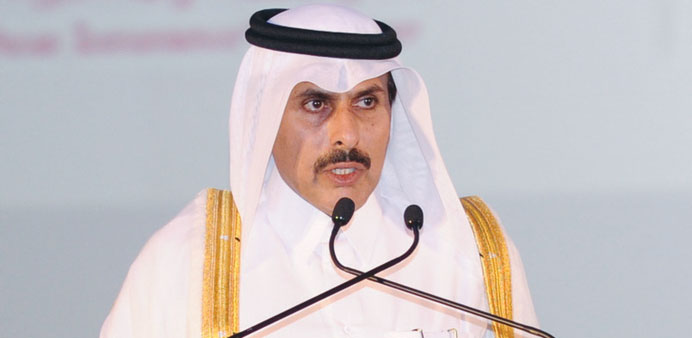
Sheikh Abdullah addressing the Meed conference in Doha yesterday.