


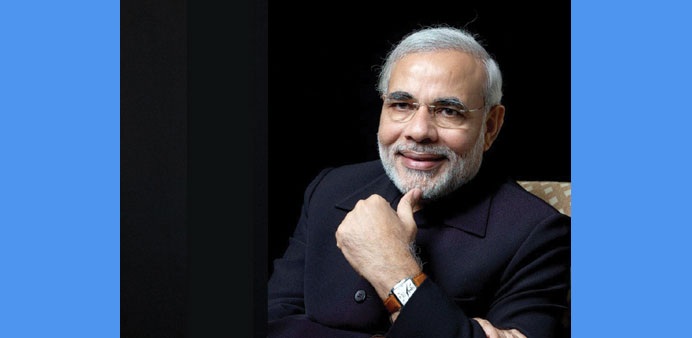
Modi: Committed to upgrading India’s antiquated rail network over the next five years.
Bloomberg/New Delhi
India’s decision to allow tax-free bonds after a 12-month hiatus should cut borrowing costs for a $1tn development push.
Finance Minister Arun Jaitley said in his budget speech last month that tax-free bond sales to individuals for rail, road and irrigation projects will be permitted from April 1. While issuance wasn’t banned as such this fiscal year, offerings halted because no quotas were allocated.
Asia’s third-largest economy plans to spend about Rs8.5tn ($137bn) upgrading its antiquated rail network over the next five years, budget documents released in New Delhi show, as it seeks to support economic expansion as fast as 8.5% next year. A second international airport for Mumbai is in the works, as is a dedicated rail transport corridor for freight between Delhi and Mumbai, the nation’s two largest cities.
“Tax-free bonds will reduce the cost of borrowing for issuers and will have a multiplier effect on job creation,” Indian Railway Finance Corp Managing Director Rajiv Datt said by phone on March 2. “We can raise funds from the bond market at lower rates and longer tenors than borrowing through bank loans.”
Spending on infrastructure will increase by Rs700bn in the coming fiscal year, Jaitley said, part of a $1tn plan to improve India’s highways, harbours and power plants between 2012 and 2017. Prime Minister Narendra Modi’s government forecast a wider budget deficit than projected on February 28 and said better infrastructure will be key to achieving growth of 8% to 8.5% in the coming fiscal year.
Indian Railway Finance, the funding unit of Asia’s oldest rail network, had a tax-free bond sale quota of Rs100bn in the 12 months ended March 31, 2014. State-owned companies raised at least Rs400bn via tax-exempt debt that year, when the government of former Prime Minister Manmohan Singh set a quota for companies of Rs500bn.
India is ranked 87 out of 144 nations by the World Economic Forum for infrastructure quality, below war torn Ukraine and 25 spots below Kazakhstan, which has roughly the same land mass.
“The government’s thrust is on building infrastructure and it wants to raise money through all possible avenues,” said Vibha Batra, the New Delhi-based head of financial industry ratings at ICRA Ltd, the local unit of Moody’s Investors Service. “A gap of more than a year will surely result in strong investor demand.”
Other measures have been introduced to help spur infrastructure spending too. The Reserve Bank of India eased rules for banks in July to make it easier to sell longer-dated debt whose proceeds will be used for affordable housing. The central bank also exempted bank bonds maturing in seven years or more from reserve requirements so long as sale proceeds are for highways, harbours and power plants.
Indian Railway Finance last sold tax-free notes in February last year. It paid an 8.19% coupon for the notes due March 2024, versus a weighted average fixed coupon on all its rupee-denominated debt of 8.33%, according to data compiled by Bloomberg. NTPC Ltd, which operates power plants that supply state electricity boards, also sold tax-free notes in February 2014, raising 5bn rupees via a three-part sale. It’s also paying an 8.19% coupon for 10-year debt, 98 basis points less than similar maturity securities it sold in September.
Other issuers of tax-free bonds have included Cochin Shipyard Ltd, a boat builder in India’s south, New Delhi-based Housing & Urban Development Corp, which helps finance urban infrastructure projects, expressway builder National Highways Authority of India, and Rural Electrification Corp, which funds power projects.
“The entire funding cycle will be positively impacted because of tax-free bonds,” Rural Electrification Finance Director Ajeet Agarwal said by phone from New Delhi on March 5. “Projects will benefit from lower borrowing costs.”
Yields on top-rated 10-year corporate bonds have fallen 23 basis points this year to 8.36%, Bloomberg-compiled data show. The rupee has appreciated 1.4% against the dollar, making it Asia’s best-performing currency.
While India’s infrastructure has improved over the past decade, more work is needed. Modi unveiled plans in July last year for a high-speed bullet train between Mumbai and Ahmedabad, a main city in the neighbouring state of Gujarat. Bigger airport terminals for New Delhi and Mumbai have already been completed, as has an upgraded highway between Delhi and Agra, home to the Taj Mahal. Borrowing costs should drop further after the RBI eased last week, Rural Electrification’s Agarwal said. Governor Raghuram Rajan unexpectedly reduced the repurchase rate by 25 basis points to 7.5% on March 4 in the bank’s second reduction this year.
“Tax-free bonds are attractive instruments for issuers as well as investors, and also help the government to bridge the funding gap,” said Ajay Manglunia, the Mumbai-based head of fixed-income markets at Edelweiss Financial Services Ltd “I expect the government to allow issuance of 300bn to 400bn rupees of untaxed bonds next fiscal year.”