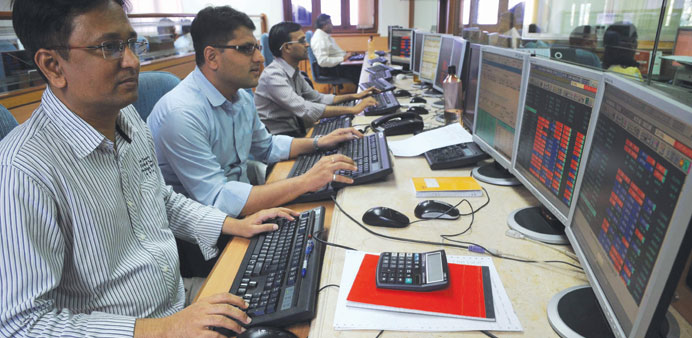
Traders at the Bombay Stock Exchange. The Sensex, which opened at 29,316.54 points yesterday, closed the trade at 28,844.78 points, down 604.17 points from the previous day’s close at 29,448.95 points.
IANS/Mumbai
Negative global cues and a weak rupee led a benchmark index of Indian equities markets, the 30-scrip BSE Sensitive Index (Sensex) to plunge 604 points or 2.05% in yesterday’s trade.
The wider 50-scrip Nifty of the National Stock Exchange (NSE) also closed the day’s trade with heavy losses. It was down 181 points or 2.03% at 8,756.75 points.
On the Nifty, the market breadth turned negative as there were only 982 stocks advancing against 1,883 stocks declining.
The S&P Mumbai Stock Exchange (BSE) Sensex, which opened at 29,316.54 points, closed the day’s trade at 28,844.78 points, down 604.17 points or 2.05% from the previous day’s close at 29,448.95 points.
The Sensex had touched a high of 29,321.06 points and a low of 28,799.76 points in intra-day trade. On the BSE out of 2,973 company’s shares that were traded yesterday, 1,889 declined and 977 advanced and 107 remained unchanged.
The losses were so broad-based that all the main indices – S&P 100, 200, mid-cap and small-cap – registered declines.
The S&P BSE mid-cap index closed lower by 1.33%. The S&P BSE small-cap index was down 0.94%. The S&P BSE 100 index was down 177.15 points or 1.96% at 8,874.56 points. The S&P BSE 200 index fell 69.04 points or 1.86% at 3,636.40 points.
All sector-based indices of the BSE closed the day’s trade in the red except for the healthcare index. Banking, capital goods, IT, metal, automobile, oil and gas and technology, entertainment and media (TECK) came under heavy selling pressure.
The BSE S&P Bank index was down 681.32 points, followed by capital goods index which was lower by 502.02 points, IT index plunged 245.71 points, metal index decreased by 241.39 points, automobile index declined by 213.52 points, oil and gas index fell 163.65 points and TECK index was down 122.71 points.
However, the BSE S&P healthcare index was up 51.01 points.
According to analysts, the Indian markets have reacted negatively to the sharp increase in the US non-farm payroll data for January. It rose by 295,000 jobs last month. The unemployment rate fell to 5.5% from 5.7% in January 2014. The Indian markets were anxious as rapid increases in non-farm payroll data might lead to an increase in inflation.
This can make the US Federal Reserve raise interest rates sooner than previously expected. With higher interest rates, foreign institutional investors will be led away from emerging markets such as India.
“In the coming week the Indian market will be cautious as the US non-farm payroll data has gone up rapidly. This might lead to a sooner than expected interest rate rise in the US,” ZyFin Advisors chief executive Devendra Nevgi told IANS. Market analysts also said that post the union budget and the Reserve Bank of India’s rate cut, the Indian markets are currently deprived of any new triggers.
“The next momentum will depend on the budget Session, where expectations are high. In the meantime the market has looked at global concerns on the US rate hike and negative development in Grexit,” said Vinod Nair, head, fundamental research, Geojit BNP Paribas Financial Services.
Meanwhile, the rupee yesterday fell to two-month low and closed with a sharp 39 paise loss at 62.55 against the US dollar after better-than-expected jobs data spurred expectations of an early hike in US interest rates.
Fresh dollar demand from importers amid strong cues in overseas markets and a steep fall in local equities also weighed on the rupee value. The dollar gained as strong payrolls data raised bets of a Fed rate hike, as early as summer. This pushed the dollar index to fresh 11-year high. At the Interbank Foreign Exchange (Forex) market, the Indian rupee opened lower at 62.60 against last Thursday’s close of 62.16. It declined further to a two-month low of 62.7350 – a level not seen since January 8, 2015 when it touched an intra-day low of 63.20.