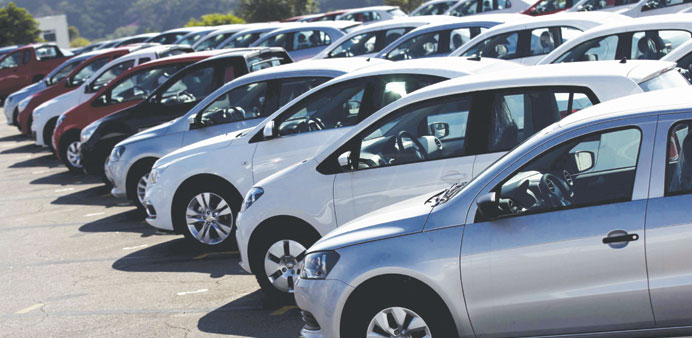
Vehicles sit parked in a lot at a General Motors’ vehicle factory in Sao Paulo. GM said yesterday it would aim to keep $20bn in cash on its balance sheet and return free cash flow beyond that to shareholders.
Reuters/Detroit
General Motors said yesterday it would launch a new, $5bn share buyback in an agreement with dissident investors, and put forward a more detailed plan for capital allocation that promises investors the potential for further cash returns.
GM said it had reached a deal with an investor group that averts a proxy fight over its balance sheet and governance. As part of the agreement, investor Harry Wilson will drop his effort to get a seat on GM’s board.
Wilson yesterday praised the company’s capital plan, which offers investors a more transparent view of GM’s cash investment proposals than previously disclosed.
GM also confirmed yesterday it will boost its quarterly dividend to 36 cents a share from 30 cents previously. It had disclosed plans to raise its dividend last month.
In all, the actions should return about $10bn to shareholders through 2016.
The automaker outlined its plans for managing cash as part of a deal that averts a battle with an investor group that last month challenged its hoarding of cash in what the company called a “fortress balance sheet.”
Some investors had expressed frustration with that approach as GM shares traded in a range near $33 a share, the price set at its post-bankruptcy initial public offering in 2010. In premarket trading yesterday, shares were up 2.6% at $37.78.
GM had built up roughly $25bn in cash as its sales and profits rebounded following its 2009 government-led bankruptcy.
But from now on, GM said it would aim to keep $20bn in cash on its balance sheet and return free cash flow beyond that to shareholders. The framework depends on GM maintaining an investment grade balance sheet.
GM Chief Financial Officer Chuck Stevens said $20bn in cash should be enough to allow the automaker to manage through a recession, and he said GM would try to work that minimum cash level down over time.
That suggests the company could eventually return more cash to investors than outlined yesterday.
GM said it would aim to generate a minimum 20% return on invested capital when it spends on new model programs and other investments. The company said it achieved 20.8% return on invested capital in 2014, excluding recall costs, and a 20.2% return in 2013.
As part of the deal, the investor group’s leader, Harry Wilson, will drop his effort to get a seat on GM’s board of directors.
Wilson praised GM’s agreement to provide details on its policies for investing capital in the coming years.
“The real question is how does the company govern itself in a way that maximises shareholder value,” Wilson told Reuters.
The Detroit auto giant signalled last month that it intended to return to investors a chunk of its roughly $25bn cash pile. But company executives didn’t offer specifics, and said any significant new share repurchases would have to wait until the resolution of certain legal proceedings.
GM is under investigation by the US Department of Justice in connection with its mishandling of recalls relating to a deadly ignition switch defect in older cars. The company faces a separate and potentially costly legal challenge in US bankruptcy court connected to the delayed ignition switch recalls.
A group of hedge funds led by Wilson disclosed in February that it had amassed a 1.9% stake in GM shares, and said GM should launch an $8bn share buyback over the next year.
Wilson, a former member of the Obama administration auto task force, was instrumental in GM’s federally financed bankruptcy restructuring in 2009. Last week, another big GM shareholder, Warren Buffett, told CNBC he disagreed with putting “somebody on the board who has an option on some other people’s stock which is only good for two years.” He was referring to an agreement Wilson has with his hedge fund allies that could pay him 2% to 4% of the gains on their GM shares over the next two years.
GM’s largest single shareholder is a healthcare trust controlled by the United Auto Workers union.
UAW President Dennis Williams told Reuters last month he was concerned that a proposed $8bn buyback was premature, but didn’t oppose a smaller return of cash.