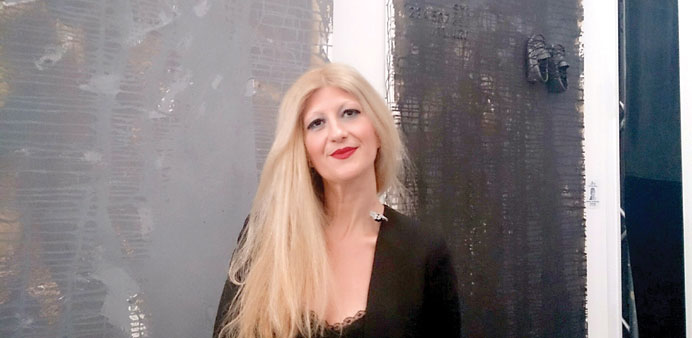
DETERMINED: Pandora Sazdovska participated in Al Asmakh Inernational Symposium of Art Doha 2015. Photo by Umer Nangiana
By Umer Nangiana
She knows why war is bad; she has seen it from very close. She knows what lies in the ruins of the once towering buildings that housed life and nurtured hope. From her work as a visual artist, photographer, and then a conservator of buildings and monuments, she realises how humanity suffers every time there is violence.
And now with her conceptual art, Pandora Apostoloska Sazdovska, the Macedonian artist, is showing the world how individuals hold the power to draw red lines and say no to war and violence. She believes an individual’s opinion matters as much, and must not be silenced.
Participating in Al Asmakh International Symposium of Art Doha 2015, alongside dozens of other artists from different parts of the world recently, Sazdovska exhibited a painting installation depicting the horrors of children suffering from the war in Syria.
A three-piece painting set complemented with an installation that the artist completed in the ten days of her stay at the symposium talks about the greed for power and wealth in the world, and the ensuing conflict.
“The first colour — white, in this case — represents innocence and the children are the most innocent. The second one is grey and it represents greed; the greed for power, money and all else, and the last one is black,” Sazdovska tells Community, explaining the concept behind the set of three paintings.
The black one has a child’s shoe fixed on it as if lost in darkness.
“It represents the Syrian children to whom I dedicated this one. Until now, violence in Syria has claimed the lives of 11,220 children — the number is growing as the war has not yet stopped. This is my message to the world,” she adds.
A professional artist for more than 15 years now, the Macedonian bases her work in extensive research. She says she researches a certain concept and tries to understand the philosophy behind different phenomena. For the last five years, she has been doing research about war and borders.
“Earlier, I had another project called Red Line. It was installations with messages asking can we, as individuals have power to make a red line and to say, ‘stop the war?’ Now, we can change the world if we have power and if we are not politicians,” believes the Macedonian artist.
Her project Red Line researches the aspects of war. Children, she says, are supposed to have a happy family and a happy childhood — every single one of them. Coming from one of the volatile regions of the world, the Balkans, where some thing or the other of violent nature keeps happening, Sazdovska’s work is highly influenced by the atrocities of war.
“We have a civil war and though it is not on as big a scale as in Syria, Iraq or other countries, yet I feel it. We have lost a lot of soldiers. (Ravages of war) definitely have an effect on my work,” says the artist.
To start with, she was a visual artist and studied at the Visual Academy of Art but is now doing conceptual art. Besides doing live performances and installations, Sazdovska is also into political activism.
Besides different art forms, another skill that she acquired and which impacted her thinking and ideas was the art of conservation and restoration.
“I started some 15 years ago after I finished the Academy of Fine Art in Skopje (Macedonia) and I also did photography and with that I learnt restoration and conservation. So I have the experiences of restoring the old buildings and ruins from wars like the very old buildings from the 11th and the 12th centuries,” says the Macedonian artist.
“This work of restoration influenced me a great deal and, later on, had an impact on my work. It is this awareness about the state of world affairs that made me a political activist I believe,” she adds.
Sazdovska does not believe in organisations, only individual opinion. If you have one, you have to express it loud, she says. “And artists have the power to do it through their artwork. I have been having exhibitions all over the world. My next one is in New York. I think art has the power to change things,” believes the conceptual artist.
She says she has been greatly influenced by the work of fellow conceptual artists also working on the concepts of non-violence and horrors of war. One of them is Cornelius from Greece. The other one is Banksy, an American artist. He has never exhibited in a gallery. His method is to go to areas hit by war and conflict and he does his graphics with very powerful messages, says Sazdovska.
“There are a lot of other artists involved in conceptual art and politics who I like — but politics not in a politician’s way, rather in a very different way,” clarifies the artist.
About her style, she says an artist constantly evolves. From her experience of 15 years, she knows she had a different style to start with and another now. She says she knows that as an artist she has to evolve because if she does not, it would not be good for art itself. She thinks she might be a different artist a few years down the line.
It is her first trip to Doha but Sazdovska says she has been to this part of the world before and loves it. “I have been to Abu Dhabi twice before. Here, it is a little bit different but not so much because the traditions are similar, including art, architecture, food and history. I like it very much. I think the people here are very nice and there’s great atmosphere,” says the artist.
Working with so many different artists at the symposium and exchanging ideas with them, she adds, was another great experience. “That was perfect. It was very inspiring. We have exchanged thoughts and that process itself is very important for an artist,” she says.
It also helped that she was able to meet people from Syria who were coming directly from a situation her research centres on. In return, she says, she might have helped others with her thoughts. These kinds of symposiums and conferences, she believes, are very important and should, therefore, be a regular feature.