


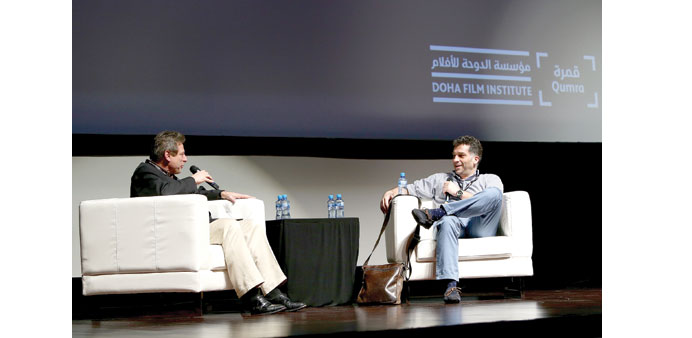
TALKING POINT: Richard Pena (left) moderates the first Masterclass with Academy Award-winning Bosnian director Danis Tanovic during the inaugural edition of Qumra, an event by the Doha Film Institute dedicated to the development of emerging filmmakers, in Doha yesterday.
The legendary director of No Man’s Land had some interesting
anecdotes to share at the first Masterclass of Qumra. By Anand Holla
The fragile nature of the world we live in is such that anti-war films can perhaps never lose their timelessness. And when we speak of No Man’s Land (2001), one of the finest anti-war satires of recent times, it makes all the more sense to revisit it – or better still, simply listen to the man behind it.
The first Masterclass of the inaugural edition of Doha Film Institute’s (DFI) Qumra, on Saturday morning, had the film’s director Danis Tanovic talk about his cinema, the stories behind them, what ticks him, and his outspoken point of view on the mucky politics that has done Bosnia harm.
Tanovic’s session was the first in a series of ‘Qumra Masters’, which features four modern super-talents of World Cinema in discussions, and screenings of their films. Apart from Tanovic, the Masters scheduled to delight Qatar’s movie lovers are actor-director Gael Garcia Bernal, and filmmakers Abderrahmane Sissako and Cristian Mungiu.
After flagging off Qumra – Qatar’s first international film and creative industry gathering – with Tanovic’s moving film An Episode in the Life of an Iron Picker (2013) on Friday evening, the Katara Drama Theatre witnessed a great turn-out last morning for Tanovic’s Masterclass which was moderated by Richard Pena, who was the Director of the New York Film Festival from 1988 to 2012. In a free-wheeling chat, Tanovic spoke about everything from how he and his friends had to break into a film school and steal cameras so as to start making movies, to how he is “getting harder and harder” on himself over creative choices as he is getting older.
“For me, movies are not business. It’s a very well-paid hobby that I love to do,” Tanovic said, when asked about the business of cinema. “I was 31 when I made No Man’s Land. So I had that film inside me for 31 years. It was cooking,” he said on the film set in the thick of the Bosnian War that earned him an Oscar for Best Foreign Language Film and more than 40 other awards, “I wanted to tell about the absurdity of war and I wanted to be funny.”
Things hadn’t gone as planned with the film’s shoot though. While they had only 36 days to wrap up the shoot, after the first day, nine days of unabated rain lashed through the locales and ruined their schedule, recalled Tanovic. In a bizarre turnout of events, a bolt of lightning injured some crew members, while a lady suffered a heart attack, and the same day, the filmmaker learnt of a death in his family.
“I am not even religious but I asked the producer: Is God against this film? To this, he told me; Just go to sleep. We will start shooting soon,” Tanovic said. Eventually, the film was shot in 26 days.
Tanovic, who had spent two years on the frontline filming for the army when Sarajevo fell under siege, has made two more films about war and its consequences – Cirkus Columbia and Triage.
“When you get an Oscar, you become a ‘master’. Nobody dares to speak against you,” he said, wryly, referring to how winning an Oscar or a Palme d’Or puts a filmmaker in another league. “Winning an Oscar makes things very easy. I totally recommend that you win one of those, if you can,” he joked.
The Bosnian director admitted that he didn’t have a directorial pattern, like, say, Woody Allen has. “It’s not possible for me. Each time, each film is different for me. The content of the story dictates the form of the film,” he points out.
That explains how distinct An Episode in the Life of an Iron Picker, which was screened to a near-full house at Katara, seems from his other works. The film, Tanovic’s fifth feature, tells an important, heart-rending story of a Roma family in Central Bosnia and Herzegovina. Iron picker Nazif, who hunts for scrap metal every day, can barely makes ends meet. His wife Senada tends to their home and two young daughters, while a third baby is on the way.
After a hard day’s work, Nazif returns home one evening to find Senada curled up in pain. As it turns out, she has had a miscarriage but is still carrying her dead five-month-old fetus because they don’t have the money – around 500 Euros – for her urgent treatment, or the state-provided health insurance card. What follows is the couple’s struggle in accessing timely medical care as Nazif tries everything he can to save Senada’s life, and eventually succeeds by cheating the very health care system that has failed them.
What made this project interesting is that it was a true story that Tanovic came across in the newspaper many months after it was published. While there was no screenplay, Tanovic had a clear idea of the story he wanted to share. “By the time we started shooting, Senada had gotten pregnant again,” Tanovic said.
Armed with three Canon 5D cameras, Tanovic had the film shot in eight days flat. Almost all of the film’s shoestring budget of 17,000 Euros went towards paying the cast of the film and for the crew’s seven nights’ stay in the hotel.
Summing up his opinion on this reconstruction of real events, Tanovic said that his intention was to show the discrimination faced by minorities in Bosnia and Herzegovina. “You can have a bad system. But as long as you have good people, there is hope,” he said.
For the upcoming filmmakers, Tanovic shared some crucial words of wisdom. “When you have something to say, just go say it. Don’t wait for things to fall in place,” he said, referring to how funding may not always come through as one expects.
“For me, the screenplay is most important. If you experience some feelings after you have finished writing your screenplay, then it’s a good story,” Tanovic said, “If you don’t, you have to work on it again.”