


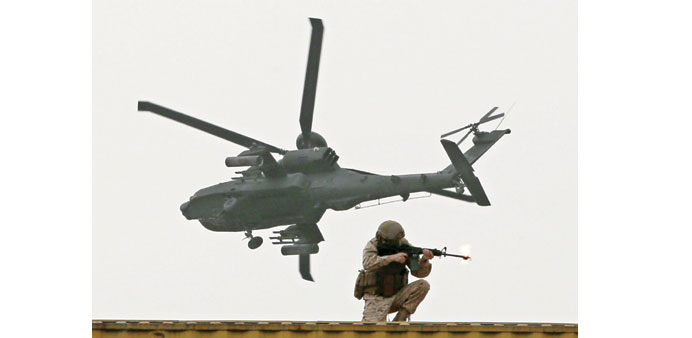
A member of the Emirati armed forces takes part in a military show at the opening of the International Defence Exhibition and Conference (IDEX) in Abu Dhabi on February 22. Mideast military spending has jumped 40% since 2010 according to the International Institute for Strategic Studies.
Bloomberg
Dubai
Soaring Middle Eastern arms budgets are spurring the UAE to build a home-grown defence industry capable of meeting more of its own military needs while exporting weapons to markets spanning Tunisia to India.
The UAE plans to fulfil half its defence requirements by 2030 via a local arms sector making up as much as 5% of the economy and working with Western companies on more collaborative terms that foster overseas sales, said Homaid al-Shemmari, chairman of the new Emirates Defence Industries Co.
“The biggest fundamental success, in my mind, is being able to become a regional player,” al-Shemmari said. “The Gulf, the Indian subcontinent, north Africa - we have a lot of leverage and a lot of government-to-government relationships and there’s a lot of capabilities we can offer those countries.”
Mideast military spending has jumped 40% since 2010 according to the International Institute for Strategic Studies (IISS), as the war with Islamic State and instability that has prevailed since the Arab Spring add to tensions. The UAE spent $14bn in 2013, about the same as Iran, the IISS says, and is building world-class capabilities in armoured vehicles, munitions and drones.
EDIC, formed in December, consolidates 16 local defence companies with 10bn dirhams ($2.7bn) of assets.
The new group is being run by Luc Vigneron, the former chief executive officer of French defence-electronics and avionics specialist Thales, where current CEO Patrice Caine said last month that orders from the Middle East should jump 50% this year to €3bn ($3.3bn).
Export markets likely to be targeted by EDIC include Egypt, Morocco, Algeria, Tunisia and even Libya, once the political situation there is more settled, al-Shemmari said at the Idex defence expo in Abu Dhabi, adding that the aim is “to win something big there.”
The company’s workforce should reach as many as 20,000 people, 60% UAE nationals, he said.
EDIC’s businesses, previously units of state defence players Mubadala Development Co, Tawazun Holding and Emirates Advanced Instruments Group, include firearms firm Caracal, armoured vehicle manufacturer Nimr Automotive, ADASI, which makes the Camcopter S-100 drone in alliance with Austria’s Schiebel, repair and overhaul specialist AMMROC, and Bayanat, a provider of mapping and surveying services.
The UAE already leads the region in military maintenance and can easily compete with mid-size European and Asian rivals in drones, munitions and armour, said Bilal Saab, senior fellow for Mideast security at the Atlantic Council in Washington. Emirates Defence Technology, which sits outside EDIC, has developed the Enigma armoured vehicle that will be tested in the desert this summer and is designed and engineered entirely by the company, CEO Mohammed al-Suwaidi said at the Idex show.
Still, the spread of Islamic State has emphasised the importance of air power, special forces and intelligence, surveillance and reconnaissance, areas in which the UAE can’t generally meet its own requirements unaided, so that military self-sufficiency “is not achievable anytime soon,” Saab said.
EDIC is consequently in talks about partnerships with international companies, al-Shemmari said. Mubadala already has ties to defence heavyweights including Lockheed Martin Corp, Boeing Co and Thales.
European missile maker MBDA has partnered with Nimr to fit an air-defence system on a UAE-made vehicle, with the system set to produce at least €1bn of Mideast orders, Florent Duleux, MBDA vice president for exports, said at Idex.
“We’re always going to be big buyers of military and civil equipment, but whoever we buy from we want them to collaborate with us to establish our industry,” al-Shemmari said. “The benefits are primarily commercial. We’re not going to compete with those technologies yet, but in future we want to.”