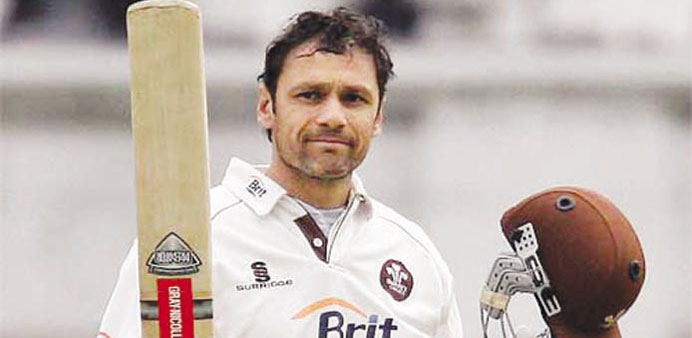
As a Test player, Mark Ramprakash couldn’t live up to expectations.
By Mike Selvey/The Guardian
Mark Ramprakash has always been a cricketing enigma. On the one hand, there was the most stylish, technically efficient English batsman of his generation; and then on the other, the batsman who played 52 Test matches, the same number as Bradman, without ever cracking it.
He made 114 first-class centuries, the latest, and almost certainly the last of 25 batsman to achieve that. Yet only in Bridgetown in 1998, when he made 154, and The Oval three years later, when he made 133 against Australia, did Ramprakash reach three figures in a Test. There were 35,659 first-class runs and of the 35 batsmen with more career runs than that, only Walter Hammond, Geoffrey Boycott and Sir Leonard Hutton averaged more than his 53.14.
Yet he made 27 in his first Test innings, again in his second, and, so the statistics tell us, averaged that figure for the rest of his 97 Test innings, his first-class average cut almost precisely in half.
Ramprakash is a delightful man who in the past has set this against a reputation for the most volcanic temper in the business. He has known great success up to a certain level and what it is to fail when reaching the top, a function of an intense temperament and drive to succeed rather than any technical batting failings. And it is this, his intimacy with Kipling’s twin impostors, that, he feels, allows him as the England batting coach, to empathise not just with the leading players in the team but those on the fringes who sit on the bench and wait their chance, or have been discarded.
So he knows what it is like to be Alex Hales, touted as the answer to England’s constipated batting at the top of the order, but who has been sidelined for the present. Or Ravi Bopara, given 119 ODI chances to nail down a place until patience ran out before England’s World Cup opener against Australia. Or Alastair Cook, England captain with a burning desire to lead his country into a World Cup but jettisoned at the last minute and left at home to ruminate on where his career might go from there.
Ramprakash is a considered, articulate speaker unencumbered by management gobbledegook. It is easy to imagine him offering strident opinion at England management meetings, even if they were to go against the general grain. He would see no value in that.
On the eve of England’s trial against New Zealand inside Wellington’s Cake Tin today morning, he spoke about progress and individuals. He was encouraged, he said, by the progress made by the batting group as a whole, considering there were a number of players with very limited ODI experience. They are fast learners, was Ramprakash’s judgment, and will only get better with time, even in the short term.
He also expressed admiration for the manner in which Eoin Morgan was able to compartmentalise the demands of leadership and separate them from his ownbattle for runs. Ramprakash sees his role as a sounding board, asking questions rather than seeking to impose a quick fix: Morgan knows his own game too well to need that.
Hales has been a mighty Twenty20 batsman and is still ranked third in the world, despite failing to pick up a contract in the latest Indian Premier League auction. Two years ago, his unbeaten 80 from 42 balls propelled England to a 10-wicket win over the Black Caps in the same Westpac stadium. In seven ODIs, though, he has scarcely got going, averaging 18 but, significantly, at a strike rate of only 70 runs per 100 balls, seven fewer than Cook.
There is a school of thought that says Hales has been worked out quickly by bowlers who recognise the need for width to swing his arms, and so bowl into him. “I’m glad you brought him up,” Ramprakash said, “because he batted extremely well in the nets in a very challenging scenario I set up. I was very impressed. The whole trip he’s had a real shift in his maturity and his level of professionalism. It’s always a challenge for any player if they’re not playing in the final 11 to get themselves motivated and practise well. Bu1t he’s done that. He’s been knocking on the door hard in my opinion.”
How about Bopara? “He’s highly skilled and has played over 100 one-day internationals so that suggests a high-calibre player,” Ramprakash said. “He was left out of the one-day squad against India in England but came back into the fold very determined and I was impressed with him in Sri Lanka. It’s never easy batting at six or seven and I think he’s felt since he’s hit Australia he’s not had much time at the crease and he’s found that quite difficult.
“The selectors will make that judgment on whether in that role he’s bowling enough and doing enough with the bat. Since he’s been left out of the side, which is always difficult, especially after playing in Sri Lanka and then the Tri-series, he’s been pretty good. He could still have a major role to play.”
And finally Cook, who is said to be back in training and batting with Graham Gooch, the man whom Cook was instrumental in removing from the role Ramprakash now fills. “As disappointed as he was to miss out on this World Cup – and he was hugely disappointed – he is a very resilient character,” Ramprakash said. “I think he will get over that and channel his energies into looking forward to 17 Test matches for England in the next year. Knowing his character and ability and experience I fully expect him to do that. He’ll be very determined I’m sure.
“He’s still a young man. It comes down to the motivation of the individual. He’s already achieved a huge amount in his career but this break he’s had, albeit enforced, will give him the chance to re-evaluate where he’s at in his career and what else he wants to achieve. I think it comes down to motivation and as far as I’m aware he’s, still highly motivated.”
Ramprakash added: “Overall, I have a lot of empathy for players not selected in the final 11. The World Cup is quite long, there’s plenty of time to think about it. I certainly feel I made mistakes in my career about how to handle it best. That’s why I mentioned Alex Hales, who is really champing at the bit and batting very well and he wants an opportunity. Ravi’s got to take a bit from that I guess, take some time out, reassess but when he comes here to the ground looks like he means business and looks to improve.”