


The Hubble space telescope has spotted what resembles a “smiley” in deep space.
An image published by the US space agency Nasa and its European counterpart ESA, operators of the low-Earth-orbit telescope, shows “two orange eyes and a white button nose” along with arcs of light that look like a smile and partial contours of a face.
According to the space agencies, the “eyes” of the happy face are very bright galaxies in a galaxy cluster known as SDSS J1038+4849 – about 4.5bn light-years from Earth in the Ursa Major constellation – and the arcs are caused by an effect known as strong gravitational lensing.
Explained by Einstein’s general theory of relativity and first observed nearly a century ago, gravitational lensing is the bending of light by the gravitational field of a massive object.
In this special case of the phenomenon, a ring is produced because the light source, a gravitational lens and observer are aligned.
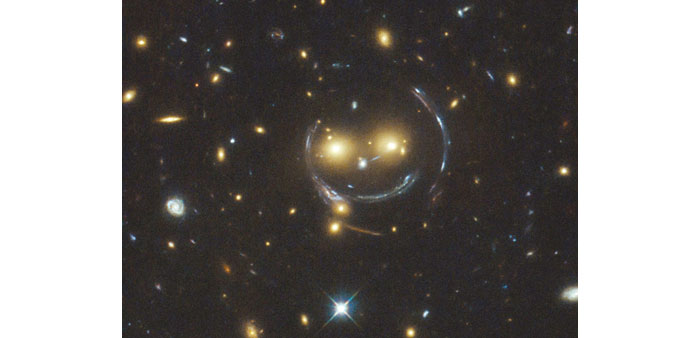
This Nasa image obtained on February 12 taken with the Nasa/ESA Hubble Space Telescope, shows the galaxy cluster SDSS J1038+4849 u2013 which appears to be