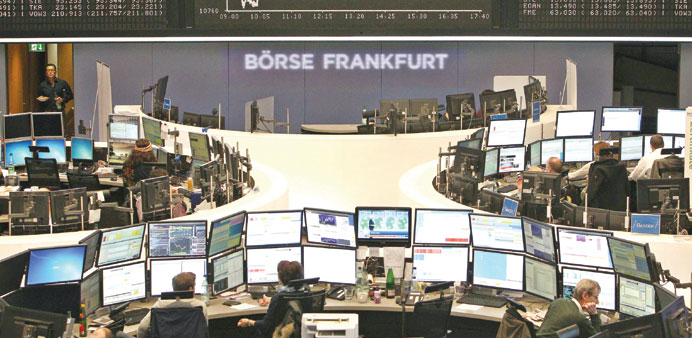
Traders work at the stock exchange in Frankfurt. The DAX 30 slipped 0.25% at 10,895.62 points yesterday.
AFP/London
Europe’s main stock markets yesterday showed “resilience” following the collapse of Greek bailout talks, while Athens shares slumped on fears the country could be forced out of the eurozone.
Athens’ main index lost 2.45% to end the day at 838.61 points, while the main exchanges closed mixed but little changed.
London’s benchmark FTSE 100 index rose 0.60% to stand at 6,898.13 points at the end of trading.
Frankfurt’s DAX 30 slipped 0.25% to 10,895.62 points while the CAC 40 index in Paris was stable, gaining a slight 0.04% to 4,753.99 points.
The euro gained to $1.1394 from $1.1355 late in New York on Monday, when the single currency and Greek borrowing costs soared after the hard-left government in Athens refused a demand by eurozone partners that it apply for an extension to its EU bailout.
“The resilience of the markets suggests investors are confident that a (Greek) deal will eventually be reached, perhaps as soon as this week,” noted Fawad Razaqzada,
analyst at dealers Forex.com.
Greece and its eurozone partners raced to scrape together a last-minute debt deal for Athens and avoid a Greek exit from the single currency bloc a day after talks ended bitterly.
Eurogroup head Jeroen Dijsselbloem, who is also Dutch finance minister, on Monday gave an isolated Greece the rest of the week to request the extension to the bailout programme that expires at the end of the month, a demand that Athens refuses.
The chaos surrounding the debt talks alarmed analysts, with economists at Commerzbank now predicting that a Greek exit from the euro was 50% likely, up from 25%.
That view was shared by analysts at Capital Economics who estimate that global markets are unprepared for a “Grexit”.
“We think this failure (of the Greek talks) has raised the risk of a Greek exit from the eurozone significantly. What’s more, the mechanisms in place to prevent contagion are not as bullet-proof as many think,” the London-based consultancy said in a research note.
US stocks were slightly lower over concerns about the unresolved debt deal with Greece. Around mid-day in New York, the Dow Jones Industrial Average was down 0.11% at 17,999.64 points.
The broad-based S&P 500 slipped 0.08% to 2,095.37, while the tech-rich Nasdaq Composite Index was off a mere 0.01% at 4,893.27.
Despite the high tensions, investor sentiment in Germany is at it highest level in 12 months, buoyed by the feel-good effects of the European Central Bank’s latest policy moves and positive growth figures, data showed yesterday.
The widely watched investor confidence index calculated by the ZEW economic institute rose by 4.6 points to 53.0 points in February, its highest level since February 2014, ZEW said in a statement.
“Over in the economic nightmare some call the eurozone, things are looking ever so slightly brighter, as Germany’s ZEW economic sentiment hit a 12-month high, whilst the overall figure for the region also beat expectations, allowing the eurozone (stock) indices some breathing room to grow,” said Connor Campbell, analyst at Spreadex trading group.
In Britain, the annual inflation rate slowed to a record low of 0.3% in January on the back of plunging oil prices and lower food costs.