


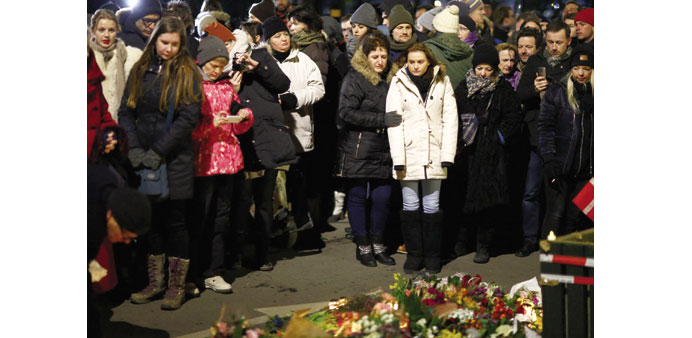
People gather at a memorial service for those killed on Saturday.
Agencies/Copenhagen
Two men were charged in Copenhagen yesterday with helping the gunman who killed two people in twin weekend attacks that have stoked renewed fears of Islamist and anti-Semitic violence in Europe.
Flags were flying at half-mast across Denmark after the shootings that stunned one of the world’s most peaceful nations.
The suspected attacker, gunned down by police in a pre-dawn shootout on Sunday, was identified as a 22-year-old Dane with a history of violent crime who had only been freed from jail two weeks ago.
Danish intelligence said the gunman, who killed two people in attacks just hours apart at a cultural centre and a synagogue may have been inspired by last month’s Islamist attacks in Paris.
“A new type of war,” thundered the right-wing Jyllands-Posten newspaper, which had itself triggered violent protests across the world.
Two suspects were charged yesterday with helping the Copenhagen attacker get rid of his weapon and giving him somewhere to hide, according to the lawyer of one of the men, Michael Juul Eriksen, told AFP.
Police confirmed two men had been charged with aiding the gunman but did not confirm the specific allegations against them.
From Tokyo to London, Riyadh to New York, expressions of sympathy and outrage poured after the shootings described by Danish prime minister Helle Thorning-Schmidt as a “cynical act of terror”.
Several media identified the gunman as Omar El-Hussein, who was said by the Ekstra-Bladet tabloid to have been released from prison two weeks ago after serving a term for aggravated assault -- raising fears he may have become radicalised behind bars.
Investigators said the man, who was born and raised in Denmark, had a history of assault and weapons offences.
In a killing spree that bore a striking resemblance to the Paris attacks, the gunman first fired off a volley of bullets outside the Krudttoenden centre on Saturday afternoon during a panel discussion about Islam and free speech.
Documentary film-maker Finn Norgaard, 55, who colleagues said had a special interest in the problems of integration in Denmark, was killed.
In the second attack in the early hours of Sunday, the gunman opened fire outside the synagogue during a bar mitzvah, killing a 37-year-old Jewish man named as Dan Uzan who was guarding the building.
Five policemen were wounded in the two incidents before the gunman was tracked down to a working class district of Copenhagen and killed in a shootout with police.
Police said the gunman was already “on the radar” of the intelligence services and that they were investigating if he had travelled to conflict zones such as Syria and Iraq.
“He may have been inspired by the events that took place in Paris a few weeks ago,” national intelligence chief Jens Madsen told reporters Sunday.
A photo of the suspect showed him wearing a black puffer jacket and a maroon balaclava and carrying a black bag.
Armed officers raided a Copenhagen Internet cafe in one of a series of operations on Sunday as police stepped up patrols on the streets of the city of one million people.
The central area of the capital that is home to both the synagogue and Noerreport station, the country’s busiest rail hub, was cordoned off by police carrying machine guns.
Tearful Danes have laid flowers and candles at the sites of the killings, while the Copenhagen bourse said it would observe a minute’s silence in honour of the victims.
A columnist in the left-of-centre Politiken newspaper linked the shootings to the rise of the anti-immigrant Danish People’s Party in a country were immigrants make up about nine percent of the population.
The attacks have revived fears in Europe about jihadist violence and anti-Semitic attacks against Jews since the bloody events in Paris on January 7-9.
Israeli Prime Minister Benjamin Netanyahu immediately urged European Jews to move to his country after Saturday’s shooting, echoing a similar call made after the Paris attacks.
But France responded icily to his comments, with president Francois Hollande saying that Jews belonged in Europe and “in particular in France” despite anti-Semitic incidents including the defacing of hundreds of tombstones at a Jewish cemetery.
World governments reacted with outrage to the Copenhagen killings.
British PM David Cameron condemned them as an “appalling attack on free speech and religious freedom”, while the United States branded them “deplorable” and UN chief Ban Ki-moon said there was “no justification” for the bloodshed.
A Swedish cartoonist believed to have been targeted in one of the Copenhagen shootings at the weekend has been sent into hiding, police said yesterday.
Lars Vilks already lives under constant police protection.
But police spokeswoman Ewa-Gun Westford said that Vilks’ home in Hoeganaes, southern Sweden, “is not a safe place. And he needs to be in a safe place”.
The move comes after the 68-year-old emerged unharmed when a gunman fired off dozens of rounds at a cultural centre hosting a forum on Islam and free speech on Saturday.
Vilks, whose security detail was at the event, escaped into the kitchen as the shots rang out.
“The attack seemed to be directed at him. Regardless, the security assessment is that he cannot be in his home,” Westford said.
A 55-year-old documentary filmmaker, Finn Noergaard, was killed in the assault.
Residents in Vilks’ hometown had expressed concern following Saturday’s shootings about the risk of an attack against his residence.
Vilks -- a frequent speaker at international events on Islam and free speech -- will remain at an undisclosed location until further notice. “It’s been a tragic event but I am not affected personally by it,” Vilks told Swedish Radio yesterday. “It’s become routine.”
Vilks has survived a foiled assassination plot and other attacks since his cartoon was published in a local Swedish paper in 2007 along with an editorial on the importance of freedom of expression.
Prime Minister Helle Thorning-Schmidt sought yesterday to reassure Danish Jews after a deadly shooting at a synagogue in Copenhagen at the weekend.
She urged Jews not to emigrate despite a call from her Israeli counterpart Benjamin Netanyahu for European Jews to go to Israel following the twin attacks in the Danish capital.
She also vowed that Denmark would not be intimidated, saying there was a conflict between the core values of Danish society and “violent extremists” but not between Muslims and non-Muslims.
She said Denmark would not bow to intimidation and that the right to assembly and freedom of speech was “irreversible”.
Around 8,000 Jews live in Denmark, most of them in Copenhagen, according to the Jewish Community of Denmark, out of a population of around 5.5mn.