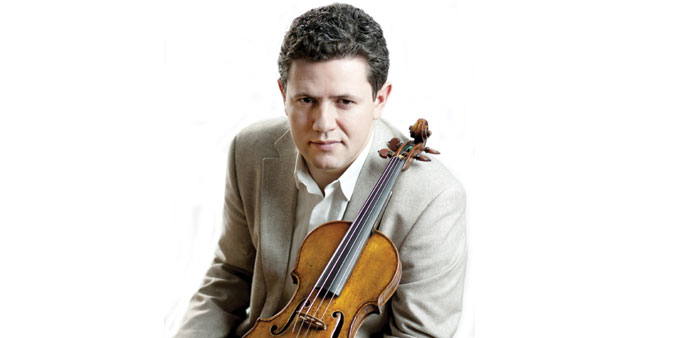
— Anton Sorokow, ace violinist
By Anand Holla
Anton Sorokow was all of four years old when his mother gave him his first violin lessons. That was in Moscow, where he was born into a musical family in the late Seventies.
At 12, he moved to Vienna, a time-honoured haven for Western Classical music and musical prodigies. Over the years, the ace violinist has excelled so remarkably that the finest orchestras and conductors of the world roll out the red carpet for him to join them for a performance or two.
After formal studies at the Central Music School in Moscow with Evgenia Tchugaeva at the age of 10, Sorokow graduated with honours from the Vienna University of Music and Performing Arts in March 1994. In 1996, he was selected on a scholarship to participate in the Isaac Stern Workshop in Verbier, Switzerland.
The list of top-draw orchestras that Sorokow has performed with is quite staggering: Vienna Symphony Orchestra, the Berliner Symphoniker, the Nuremberg Philharmonic Orchestra, the Nuremberg Symphony Orchestra, the Bayerische Kammerphilharmonie, the Vienna Concert-Verein, the Philharmonia Orchestra London, the Montpellier Symphony Orchestra, the Kärntner Symphony Orchestra, Sung-nam Philharmonic Orchestra, the Kharkov Philharmonic Orchestra, Janàcek Philharmonia Ostrava, the St. Petersburg Academic Symphony Orchestra and the Moscow Symphony Orchestra.
His run as a soloist is equally impressive, having worked with noted conductors such as Mstislav Rostropovich, Fabio Luisi, Myung Whun Chung, Ulf Schirmer, Lior Shambadal, Philippe Auguin and Alexander Shelley, and at venues as spectacular as the Vienna Konzerthaus, Tokyo’s Suntory Hall and Bunka Kaikan, as well as the Great Hall of the Moscow Conservatory.
Among other highlights, in summer 2007, Sorokow, a recipient of several awards such as first prize and the Grand Award at the Beethoven Competition in the Czech Republic in 1994, recorded popular violin concerts of Bach, Beethoven, Tchaikovsky and Kabalewsky, with the Vienna Classical Players for the Oesterreichische Nationalbank. The first concertmaster of the Vienna Symphony Orchestra, Sorokow is also a professor at the University of Music and Performing Arts Vienna.
Of the many international master classes he regularly holds, Sorokow held one in Qatar last week at the Gordon Ramsey conservatory at The St.Regis Doha, drawing the nation’s classical music players, child prodigies and enthusiasts to his insightful workshop.
The non-profit initiative Moving Young Artists (MYA), which aspires to develop music education programmes for children, and also find, support and encourage local talent in Qatar, hosted the event where nine-year-old violinist Tricia Ng played as well. Soon after the event, Community caught up with Sorokow for a chat:
What are your earliest memories of music?
My father was a famous violinist in Russia, so I grew up with the sound of his violin. I remember the first opera that I ever heard was Magic Flute by Mozart and I was completely fascinated by the beauty of that piece. When I was a boy, my parents took me to many concerts across Moscow, from famous violinist like Isaac Stern and Yehudi Menuhin, which also inspired me a lot to start playing, pick up and learn a musical instrument.
Growing up in Moscow, how different was the music scene there from Vienna?
My family and I left Russia in 1991, when I was 12. So, I don’t have many memories from that time. I just remember that it was a very tough time for musicians there, and many people involved with arts and culture had left Russia at the time.
Why did you choose violin as your instrument? What makes the violin stand out?
It was a choice of my parents because they are both professional musicians. My father was a famous soloist and also a concertmaster at the Moscow Soloist Chamber Orchestra and my mother is a violin teacher for children. My parents felt comfortable about starting to teach me this instrument. From the contemporary point of view, I prefer violin as among all other instruments, it comes closest to imitating the human singing voice.
How does playing with various orchestras and conductors help you evolve as an artist?
It’s a kind of exchange, where musicians often share experiences together with a view to achieve the best artistic result as a whole. Also, there are different interpretations and views that come together, making the whole experience of playing music so exciting.
What is your philosophy of music and its importance in life?
I see music as one of the most important cultural enrichments for the human world. In our time, when the technology and gadgets are becoming more and more dominant, I find it very important to bring together resources that could encourage every kind of music, and also, for visiting live concerts, because they help realise the possibility of coming closer to one’s favourite artiste’s performances.
Who are your favourite composers and what do you think makes their music timeless?
I guess I will have to say that I prefer Mozart for the incredibly dense energetic impact of his music, the melodic simplicity of it and at the same time, his incredible intricate treatment of the vocal lines. His music is undoubtedly timeless. Mozart was one of the greatest geniuses to have ever been born. But there are, of course, other composers as well, who deeply influence their time-periods and eras. For instance, the genius of Mozart could never develop on that scale, without the musical roots of J.S. Bach and J. Haydn around him. From Russian music, I prefer the music of Tchaikovsky and Schostakovich. They are the ones who touch me most with their music.
Of all your special performances, which one would you consider truly memorable?
I will always remember my performance of Gipsy Airs by composer Pablo de Sarasate, with the Vienna Symphony Orchestra and conductor Bertrand de Billy. This concert was held at the Golden Hall of Musikverein in Vienna and was broadcast live worldwide, on television and the internet. Until now, this has been the biggest artistic challenge for me, also from point of preparing myself for such a huge event.
How was your experience at the master class you held in Doha last week, and how promising does Moving Young Artists seem to you?
It was a nice experience. I worked with one young violinist, who is a rather big talent indeed. She is a student of my very good friend and colleague Dimitry Torchinsky, who is a member of the Qatar Philharmonic Orchestra, and I will follow her artistic development with utmost interest.
What is the single most important advice you would like to give to upcoming musicians?
Stay honest to the music that you play, and work seriously and dedicatedly on your weaknesses so as to turn them into your strongest skills.