


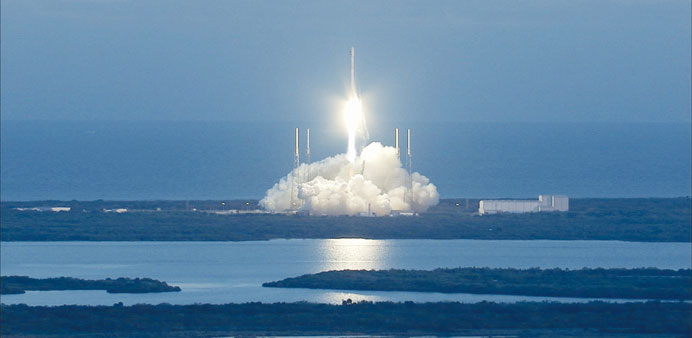
This Nasa handout photograph shows the NOAA’s DSCOVR satellite launching from Cape Canaveral Air Force Station. DSCOVR will provide NOAA space weather forecasters more reliable measurements of solar wind conditions, improving their ability to monitor potentially harmful solar activity. The new mission is now making its way to an orbit 1mn miles from Earth.
AFP/Miami
A $340mn deep-space observatory that aims to alert people on Earth of potentially dangerous solar activity and geomagnetic storms blasted off on Wednesday atop a SpaceX Falcon 9 rocket.
Experts say the DSCOVR – a joint collaboration of the US Air Force, Nasa and the National Oceanic and Atmospheric Administration (NOAA) – will help the preparation and response to space weather, thereby protecting utilities, consumers and industries.
It is headed to a destination between the Earth and Sun known as Lagrangian point, or L1. The journey will take 110 days, followed by 40 days of instrument tests.
“The Falcon takes flight, propelling the Deep Space Climate Observatory on a million mile journey to protect our planet Earth,” said Nasa commentator George Diller as the rocket took off from Cape Canaveral, Florida at 6.03pm (2303 GMT).
Space weather is the primary objective of the five-year mission, although the initial idea for the satellite came from former US vice-president Al Gore, who dreamed of a spacecraft that would observe Earth and send back live images that would raise environmental awareness of the planet’s fragility.
“It was inspiring to witness the launch,” Gore said in a statement shortly afterwards. “DSCOVR has embarked on its mission to further our understanding of Earth and enable citizens and scientists alike to better understand the reality of the climate crisis and envision its solutions.”
DSCOVR will replace an ageing satellite, known as ACE, that is many years past its expiration date. It should provide the same accuracy as its predecessor, officials said.
Initially known as Triana, it was built in the late 1990s but the mission was cancelled in 2001 by the George W Bush administration.
Nasa stored the observatory in a clean room, and about seven years ago determined the equipment was still viable, said Stephen Volz, assistant administrator of the NOAA Satellite and Information Service.
The name was changed to DSCOVR and the instruments were refurbished so that it could take real-time measurements of solar wind and send data swiftly to Earth.
Its secondary mission is to collect scientific data about aerosol levels, ozone and radiation balance on Earth.
Meanwhile, California-based SpaceX said that high seas off the coast of Florida had forced it to abandon another planned attempt at recycling its rocket by flying the first stage of the Falcon 9 to a controlled landing on an ocean platform, known as a drone ship.
Waves as high as three storeys were crashing over the deck and one of the four engines was not working prior to launch, the company said.
“Planning a significant upgrade of the drone ship for future missions to handle literally anything,” SpaceX chief executive Elon Musk wrote on Twitter.
SpaceX is embarking on a series of rocket-landing tests with the goal of one day making rockets as reusable as airplanes, instead of allowing them to fall to pieces into the ocean after launch.
An attempt to land the first stage on a floating barge in January was not successful. Instead of landing upright, the rocket collided with the platform and broke into pieces.
But the company said it intends to keep trying to refine the technology.