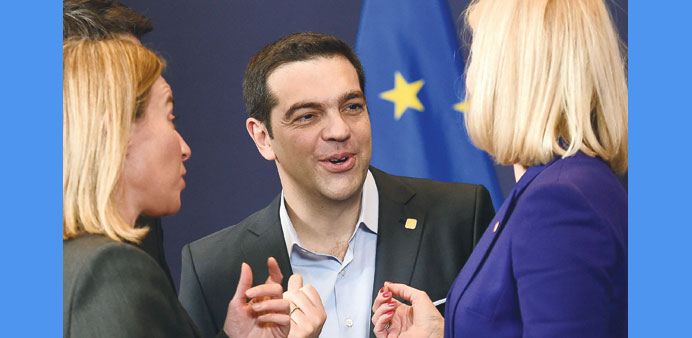
Greek Prime Minister Alexis Tsipras (centre) speaks with EU foreign policy chief Federica Mogherini (left) and Danish Prime Minister Helle Thorning-Schmidt at a family photo during a European Council leader’s summit in Brussels yesterday. Tsipras insisted his government had a plan for a new bailout that could satisfy both the austerity-fatigued Greeks and European partners tired of rescuing Greece.
AFP/London
European stocks rallied and the euro rose against the dollar yesterday, as markets welcomed a ceasefire and aid for Ukraine and held onto hopes for a deal over Greece’s bailout.
Frankfurt’s DAX 30 index rose 1.56% to close at 10,919.65 points and in Paris the CAC 40 climbed 1.00% to 4,726.20 points.
Madrid gained 1.90% and Milan 2.13%, while Greek stocks surged over 6%.
But the FTSE 100 index ended the day up just 0.15% to 6,828.11 points, ruffled by warnings British inflation could turn negative within months.
The euro meanwhile climbed to $1.1417 from $1.1319 late in New York on Wednesday, with the dollar hurt by disappointing retail sales and unemployment figures in the US.
“A generally positive session for European equity markets despite ongoing uncertainty surrounding Greece’s future in the eurozone as talks mediated by Germany and France between Russia and Ukraine resulted in a ceasefire,” said Sucden Research analyst Kash Kamal.
Marathon talks in Belarus ended with a ceasefire announcement in the war between Ukraine and pro-Moscow rebels, although German Chancellor Angela Merkel warned that “big hurdles” remained.
CMC Market UK analyst Jasper Lawler said the DAX, “an index that includes a number of big exporters to Russia and is a proxy for the German economy that does a lot of trade with Russia ripped higher on the ceasefire announcement”.
The DAX even flirted with the 11,000 level it has never breached.
Meanwhile the International Monetary Fund and conflict-torn Ukraine also reached a preliminary deal on a new financial rescue plan worth $17.5bn that could be a “turning point” for Kiev, IMF chief Christine Lagarde said.
In total, Ukraine will receive $40bn in assistance over four years coupled with bilateral loans from other sources, Lagarde said, helping to stabilise Kiev’s finances which have been drained by the fighting.
Despite a lack of progress at a meeting of finance ministers overnight, “traders are still optimistic that some kind of a compromise can be achieved before Greece will possibly be running out of money later this month,” said Markus Huber, senior analyst at broker Peregrine & Black.
Greece’s new Prime Minister Alexis Tsipras yesterday warned that Europe was at a crossroads as he prepared to discuss the row over the country’s huge bailout at a summit in Brussels.
It will be his first encounter with Merkel, Europe’s most powerful leader who is firmly opposed to making concessions to Athens.
Tsipras insisted his government had a plan for a new bailout that could satisfy both the austerity-fatigued Greeks and European partners tired of rescuing Greece.
Tsipras will try to persuade the other 27 EU leaders to back an austerity-light replacement plan for Greece’s 240bn-euro EU-IMF bailout, which expires at the end of February.
In London, some shine was taken off British company share prices after Bank of England governor Mark Carney said inflation in Britain could turn negative within months and interest rates cut, signalling fresh risks to the economy before the country’s general election in May.
But Stockholm’s main index shot up 1.97% to a record close after the country’s central bank pushed its main rate into negative territory and announced it would begin a QE (quantitative easing) programme to buy government bonds in order to ward off the risk of inflation.