


Bloomberg/Kiev
Ukraine reached a preliminary accord to expand an International Monetary Fund-led bailout to $40bn to avert default as the 10-month conflict in the nation’s east damages the economy and drains resources.
Managing Director Christine Lagarde said yesterday in Brussels she will recommend the plan to the lender’s board for approval. The package contains contributions from other sources, including the European Union, she said. The board will consider the deal in several weeks after Ukraine revises its budget, Finance Minister Natalie Jaresko told reporters in Kiev.
Ukraine, rocked by the pro-Russian insurgency in its industrial heartland, is struggling with the deepest recession since 2009, foreign reserves at an 11-year low and the world’s worst-performing currency. Russia, Ukraine, Germany and France, meeting in Belarus, announced a cease-fire beginning February 15 in the conflict. More than 5,400 people have died in the conflict, according to a UN estimate.
“It’s an ambitious programme, it’s a tough programme and it’s not without risk,” Lagarde told reporters. “But it’s also a realistic programme.”
Ukraine’s bond due July 2017 fell 0.2 cents to 55.9 cents on the dollar by 12:31 pm in Kiev, after jumping 1.3 cents on Wednesday to a three-week high. The hryvnia weakened 0.8% to record 26.2 per dollar, data compiled by Bloomberg show.
The country’s fiscal and economic condition will help determine whether it remains oriented toward the US and the EU or is drawn back into Russia’s orbit amid the worst standoff since the end of the Cold War. The US, EU and Ukraine blame Russia for aiding the rebels. President Vladimir Putin denies the charges.
The government of Ukraine faces debt repayments of $11bn this year and has said it will approach foreign bondholders over easier terms once the IMF-led financing is in place. The accord is an expansion of an original $17bn IMF aid program agreed last year.
Prime Minister Arseniy Yatsenyuk said the cabinet will meet the demands of the IMF.
“Ukraine will make those reforms that are needed for financial and economic stabilisation of the country,” he told a news conference in Kiev. The economy, which the IMF estimated shrank 7% to 7.5% last year, will start growing in 2016, he said.
“This reform program isn’t for the IMF,” Yatsenyuk said. “It is a reform programme for Ukraine.” Under the deal, the country will aim to slow inflation to below 10% by 2016. In January, the annual inflation rate rose 28.5% from a year earlier.
Ukraine’s allies stepped in with funding pledges in the run-up to the IMF talks being completed. The US promised as much as $2bn in loan guarantees, while the EU said it would disburse €1.8bn ($2.1bn).
“I wouldn’t be jumping of joy just yet - show me the money first that Ukraine needs so urgently right now,” Vladimir Miklashevsky, an economist with Danske Bank in Helsinki, said by phone. “The IMF board still has to agree on this and any escalation, any declaration of martial law, would put an immediate stop for the IMF. This does give hope, but there have been too many cease-fires in the past that didn’t hold.”
As part of the new programme, the country of more than 40mn people has pledged to put in place “further sizable energy tariff increases, bank restructuring,” to overhaul state-run companies and crack down on graft, Lagarde said. She didn’t give a specific breakdown of how the total envisioned $40bn be distributed, from which sources it would come, or the timing of disbursements.
Ukraine loosened its grip on the hryvnia, allowing the currency to slump by a third in a move that won praise from the IMF. The central bank also raised its discount rate by 5.5 percentage points to 19.5% to help the currency and increased its overnight rate by the same amount to 23%.
The monetary authority hopes to boost its foreign currency reserves, which dropped to a record low $6.4bn in January, to $17bn to $20bn by the end of the year, central bank Governor Valeriya Gontareva told reporters in Kiev yesterday.
Lagarde also declined to say whether Russia is involved as a contributor in the deal.
“Of course, the resolution of the conflict, so critical for people, would also strengthen and speed up prospects for macroeconomic stabilisation and growth,” she said.
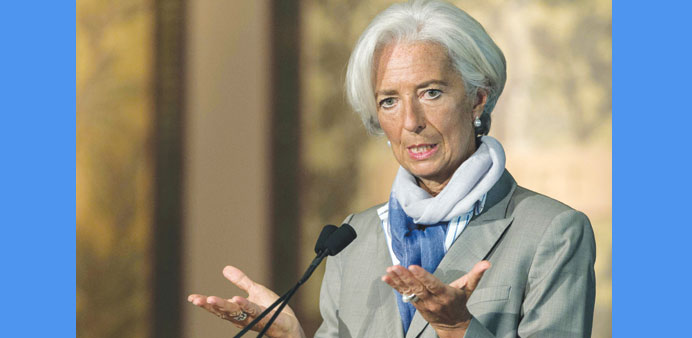
Lagarde: New fillip for growth prospects.