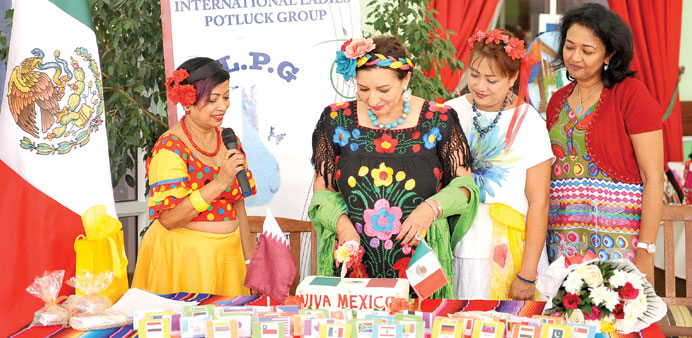
CELEBRATING MEXICO: Celina Hoyos de Torres, wife of Charge d’Affaires of the Embassy of Mexico in Qatar, cuts the cake as ILPG members look on. Photo by Najeer Feroke
By Anand Holla
Six women togged in beautiful white lace dresses and shawls lunge into a dance native to the port city of Veracruz in Mexico.
Their hair styled up in buns with colourful combs, they move fans in their hands as gracefully as their bodies, while their feet encased in hard-soled shoes routinely break into ear-pleasing zapateados (the rhythmic tapping and stamping of the heels).
The moment the ladies scream “Hey” to the rhythm of the regional folk music of Son Joracho, the audience — a hall full of members of the International Ladies’ Potluck Group (ILPG) — burst into cheers, too.
The eclectic gathering of womenfolk at the Al Jazi Gardens Clubhouse in West Bay, on Wednesday morning, had just witnessed a rich slice of Mexican folk dance, or ballet folklorico of Veracruz, at the Mexican Day of ILPG.
A nation that has given the world chocolate, corn and a wide variety of chilies, among scores of other goodies, bustles with a staggering diversity of culture, richness of tradition and a deep connection with art. Yet, the world at large knows little about the Mexican culture, which happens to be among the most fascinating and varied.
For two hours, a series of events and activities at the ILPG meet-up did its best to familiarise Doha’s multi-hued expat community with all things Mexican. So what followed was another special dance, ‘the hat dance,’ from the state of Jalisco — a place which some say is both the heart and soul of Mexico, given how it’s the birthplace of signature Mexican elements like Mariachi and Tequila.
A wide-ranging fashion show featuring the choicest of traditional attire set off a Mexican wave of oohs and aahs from the ladies throughout the hall. The dancers were now wearing clothes typical of the Mexican states of Nuevo Leon, Veracruz, Guerrero, Yucatan, Puebla, Oaxaca, Jalisco, Tamaulipas and perhaps, the most spectacular of all — Chiapas.
A heart-stopping work of art, the vibrant, handmade Chiapas dress consists of a satin blouse with a semi-circular neck and a long, wide satin skirt – both pieces embroidered in silk with multi-coloured floral pattern.
Beatriz Pérez Colin, who anchored the show, said, ‘Some historians believe that the black of the dress represents the jungle and the colourful flowers represent the majestic flora of the region.’
The ladies continued the celebrations with long conversations, and the mandatory raffle competition — the prizes for which were donated by Paloma Tex-Mex Restaurant at the Intercontinental Hotel, Marriott Hotel, Movepick Hotel, Sawasdee Thai Spa, Bellezza Salon and Beauty Dental Clinic. The Chief Organiser of the event was ILPG’s Yolanda Grandet, assisted by Pilar Colorado and a group of Mexican ladies.
And then, of course, there was some nice Mexican food being served, courtesy Mr Taco, which is located at Dar al Salam Mall. Silvia Hossfeldt, Director of the restaurant, who, too, was present, said, “We are very particular about offering authentic Mexican cuisine. We import genuine ingredients because nothing less will do.”
Seconding her was Chef Pepe Correa, who said, “To give our guests a good idea about Mexican food, we have prepared Tamales (corn husks filled with savoury or sweet dough), chilaquiles (dish made of fried tortillas with sauced chicken and cheese), classic Mexican red rice, and friend beans. While we have 100 versions of Tamales back home, we have made only the beans and chicken versions here.”
For those seeking to unwind with some chilled drinks, there was the combined might of the delicious Agua de Horchata (milk, rice and cinnamon), Agua de Tamarindo (iced tamarind water), and Agua de Jamaica (iced hibiscus drink). “Every small shop in Mexico stocks these fresh, organic and healthy drinks,” Correa pointed out.
Having tasted the spread, Colin said, ‘We Mexicans can tell you that this is some real good Mexican food.’ After living in Mexico City for around five decades, Colín moved to Doha three years ago.
‘My husband and I moved here after he lost his job at Mexicana de Aviacion (Mexico’s largest air carrier) because the airline wasn’t doing well. He is now a pilot at Qatar Airways,’ said Colin, who teaches English and Spanish at International House, Doha.
“I love it here and I have great friends here,” she said, mentioning a ‘Spanish-Speaking Friends’ group that she is a part of, “We Mexicans are like one big family here. We get together, and we also help each other because many of us had to leave our country because our husbands lost their jobs.”
It’s programmes such as these that help advance the cultural dialogue among the various communities in Qatar, feels Colin. ‘Most times, you only get to hear about the bad news from Mexico; like the drug cartels and such,’ she said, ‘Mexico is so much more than that, and it is also so much more than Cancuno, Acapulco, and Tijuana. It’s a country with a whole lot to offer.’
While the traditional clothes on display are all steeped in glorious heritage, they aren’t the look of choice for people there, Colin pointed out. ‘Nowadays, we don’t wear these dresses anymore,’ she said, ‘They are worn only during celebrations, or by school children who wear it on the Independence Day on September 15. It’s a rich custom but we don’t go to work in these dresses.’
That said, the elaborate motifs, patterns and designs that define them are everywhere to see in the contemporary wear, as well. Even famous fashion designers are weaving the folk flavours in to the modern line. “Mexico is blessed with amazing diversity because of the various tribes we would have in the past and the different climates throughout the country,” Colin said.
The adaptation of the tradition could be clearly spotted at the clothes corner, where Mexican dresses — mostly contemporary — were up on sale.
Cristina Cobos, who helms the ballet group that performed earlier in the day, picked up a soft cotton dress and said, ‘This one’s called Huipil and it originates from the state of Oaxaca, where in the olden days, the mother would embroider such a dress for her daughter before her marriage and the daughter would pass on the tradition.’
The huipils made in the mountainous part of Oaxaca are thicker, while the heat of the coast sees the other variant much lighter and brighter. ‘We have these modern hand-made blouses with traditional patterns and you will see Mexican women wear these with skirts or jeans,’ Cobos said.
For Cobos, the culture exchange exercise doesn’t stop at offering genuine Mexican hand-made clothes to Doha’s people. Having pursued Mexican ballet with dancers back in Singapore, she decided to do the same when she arrived in Doha six years ago. “I met a Colombian woman who told me: Don’t do it for Mexico but for all of Latin America,” Cobos said.
Thus was born Ballet Folklorico Latinoamericano, which has brought together a dozen women passionate about Latina dance forms. Cobos said, “We perform mostly at charities, and some times, at Arab weddings, too.”
One of the dancers, Ivonne Pulido, said the opportunity to showcase their dances, dresses and cuisine means a lot to them. “This is just a glimpse of our culture because people don’t know, for instance, the 1,000 kinds of dresses that have emerged from various parts of Mexico.”
Martin Torres, Charge d’Affaires of the Embassy of Mexico in Qatar, who along with his wife Celina Hoyos de Torres, played his part to ensure that the event was a success, said, ‘It’s a group of ladies who are not only used to such events but they also know how to appreciate it.’
“We are ready to grasp every opportunity to showcase what Mexico is all about because we want the local and expat community to understand and appreciate Mexico, a little bit more and a little better, every time,” Torres said, pointing out that there are around 1,000 Mexicans in Qatar.
“The ladies have used their imagination well, and done a wonderful job in bringing together everything that they could. It’s a very authentic sample of what we are all about; a little about our music, our traditional, dances, and cuisine. This is a really tangible manifestation of what Mexico is all about today and what our history has been before,” he added.