


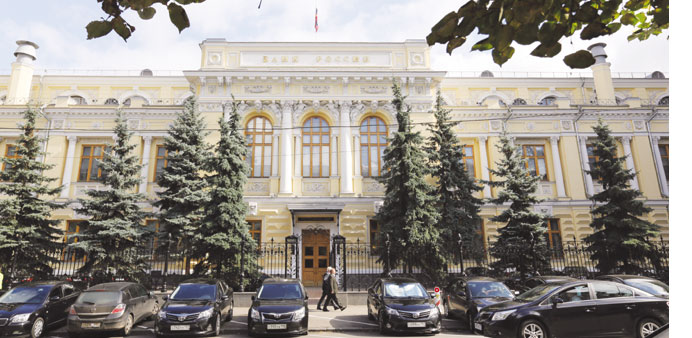
Pedestrians pass the entrance to the headquarters of Russia’s central bank in Moscow. The apex bank of the country left its key interest rate on hold at a regular meeting yesterday, signalling a dovish shift in policy which may mean that a recent cycle of rate hikes is over.
Reuters/Moscow
The Russian central bank left its key interest rate on hold at a regular meeting yesterday, signalling a dovish shift in policy which may mean that a recent cycle of rate hikes is over.
Speaking at a news conference after the rate decision, central bank governor Elvira Nabiullina said that the bank sees no need to raise rates at present as inflation is on track to fall over the medium term.
“Despite the fact that in the short term inflation will exceed an annualised 7%, the current level of the key rate is consistent with the objective of reducing inflation to the 4% target in the medium term without creating a risk of excessive cooling of the economy,” Nabiullina told journalists.
But the uncharacteristically dovish stance also suggests the bank is reacting to concerns about ebbing economic growth as Western sanctions over the Ukraine crisis bite, as well as political pressure not to tighten policy further.
In an annual monetary policy strategy document also published yesterday, the bank said it sees Western sanctions over Ukraine having a “prolonged” impact that would curtail economic growth next year.
The decision keeps the bank’s central policy rate, the one-week minimum auction repo rate, at 8%, and was broadly expected.
“Nabiullina is clearly worried on the growth front,” Standard Bank analyst Tim Ash commented. “She highlights the CBR’s assumption that geopolitical risks will remain elevated for some time, and that even the existing sanctions will weigh on the economy for some time.”
“I sense an unwillingness to further hike rates.” Ivan Tchakarov, Citi’s chief Russia economist, said that the bank’s statement accompanying its rate decision “strikes us as less hawkish than expected”.
“This less forceful rendition of the central bank’s recent hawkish views may have been at least driven partly by the continuing evidence of policy friction at the highest level,” he added. Following three rate hikes this year which have pushed the key lending rate to its highest level since 2009, the government’s patience with tight monetary policy is wearing thin.
In its statement, the bank continued to emphasise inflation goals rather than economic growth concerns - sticking to its previous line that Russia’s severe economic slowdown is the result of “structural” factors outside the bank’s control.
But shifts in the bank’s position are evident. It has essentially abandoned this year’s 5% inflation target, as well as a wider range of 3.5-6.5% allowed under the bank’s rules, following a sweeping ban on Western food imports adopted last month in retaliation for Western sanctions.
Inflation is instead likely to exceed 7% because of an “aggravation of geopolitical tensions, the imposition of external trade restrictions and the impact of these developments on the rouble exchange rate dynamics”, the bank said.
Nabiullina told journalists the import ban would add around 0.8 percentage points to the inflation rate by the end of this year, rising to a maximum of 1.5 percentage points by the middle of 2015.
Despite this boost, the bank said that it intends to stick to aggressive inflation targets for the next two years.
In its annual strategy document, the bank reiterated that its 2016 deadline for meeting the 4% medium-term target remains intact.
The bank also reiterated next year’s inflation target of 4.5%, although its inflation forecast was slightly higher at 4.5-5.0%.
Notwithstanding its continued focus on inflation goals, the bank’s language on economic growth was gloomier than usual, describing growth as “anaemic”.
It attributed this mainly to structural factors lowering output potential, but also anticipated a small shortfall in demand below the economy’s potential, which would help lower inflation.
Despite anticipating a protracted impact from Western sanctions, the bank expected a gradual recovery next year as the external political situation normalises.
It projected gross domestic product growth at 0.4% this year and 0.9-1.1% in 2015.