


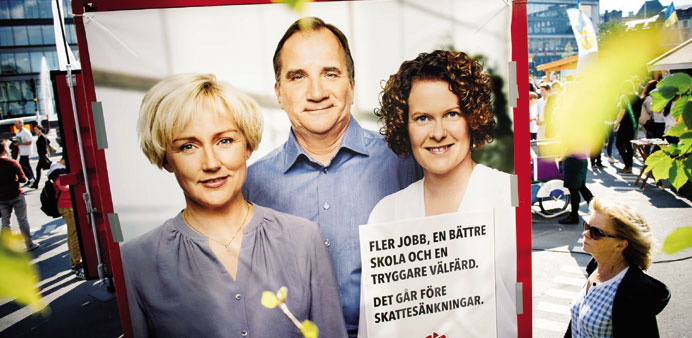
A woman walks past an election poster of the opposition Social Democratic party, featuring candidates Helene Hellmark Knutsson (left), Karin Wanngaard (right) and party leader Stefan Loefven in Stockholm.
Reuters/Stockholm
Sweden’s centre-right government has narrowed the gap on the centre-left opposition, polls showed yesterday, as voters switched support to a government with a proven track record in the face of political impasse after Sunday’s general election.
Prime Minister Fredrik Reinfeldt, who has cut spending and trimmed welfare in eight years of office, is battling an opposition led by Social Democrat Stefan Lofven promising to invest more in health and education and raise taxes on the rich.
With polls suggesting that both right and left might be unable to form a stable government, Reinfeldt may have benefitted from his image as a known leader over Lofven, who has never been elected to national political office.
The opposition has a lead of 3.6 percentage points over the government, a poll by Novus showed yesterday, while a poll by the Expressen newspaper showed a 6.3 percentage point lead, compared with more than 10 percentage points in August.
“We’re talking right now very much about governmental issues, accountability and economy. In particular the debate around government benefits the Alliance,” said Henrik Ekengren Oscarsson, political science professor at Gothenburg University.
“We have started talking about who goes with who after the election. That has probably benefitted Reinfeldt, who has a close-knit (Alliance bloc) team,” he said.
The Social Democrat, Green and Left parties - which are not part of a formal coalition - garnered 45.2% support against 41.6% for the four-party Alliance government, Novus said.
Sweden for decades was dominated by the Social Democrats, founders of Sweden’s welfare state and who would often take nearly 50% of the vote in elections.
But their share of the vote has steadily fallen in recent elections, with many voters switching to either far-right or far-left parties. The anti-immigrant Sweden Democrats may score one in ten votes on Sunday, double their result in 2010.