


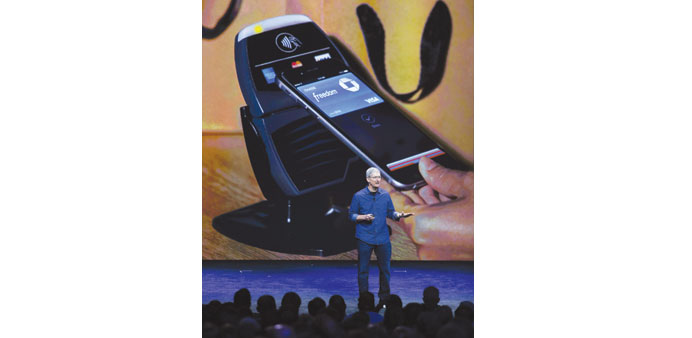
Apple CEO Tim Cook introduces the new Apple Pay system during Apple’s launch event in Cupertino, California. He uncorked Apple’s attempt at mobile payments, using NFC chips built into the firm’s two new iPhones and Watch.
Reuters
Apple’s long-awaited launch of tap-to-pay technology in its new iPhones and smartwatch may be the seal of approval that near-field communication technology needs to become as commonplace as Wi-Fi, Bluetooth and GPS.
Called NFC, the technology lets smartphones communicate wirelessly with other devices such as point-of-sale terminals by holding them together. While proponents have argued for years that it is ideal for secure payment systems that could eventually replace credit cards, none have taken off.
At a gala event on Tuesday, Apple Chief Executive Officer Tim Cook uncorked Apple’s attempt at mobile payments, called Apple Pay, using NFC chips built into the company’s two new iPhones and Apple Watch.
NXP Semiconductors NV’s dominates the market for NFC chips with Broadcom Corp accounting for much of the remainder. Chipmakers including Qualcomm, MediaTek and Marvell Technology Group have their own NFC offerings and will have a chance to stake out more significant market share if Apple sets off an explosion in mobile payments.
Samsung, Motorola and other manufacturers already include NFC in many Android smartphones, and some mobile-payment inroads have been made in Asia. But with major payment systems like Google’s Wallet failing to catch on, the technology has remained far from standard in handsets.
Now, trend-setter Apple’s adoption of NFC looks likely to provide the technology the long-needed respect it needs.
“Apple not supporting it always called some people to question its viability,” said James Anderson, senior vice president of mobile and emerging payments at MasterCard, which supports Apple Pay. “All those questions have gone away now. I expect NFC will be the predominant technology for point-of-sale payments between a smart device and a merchant terminal.”
Manufacturers included NFC chips in about 300mn smartphones last year, equivalent to around a third of all smartphones shipped. The number of NFC-enabled phones this year is expected to keep growing and reach around 550mn devices, helped by Apple’s devices and an expanding number of Android gadgets, Gartner analyst Mark Hung estimates.
As well as phones, NFC technology is being built into point-of-sale devices, video game consoles and medical tools. Shipments of NFC chips are expected to reach 1.64bn units in 2018, according to market research firm IHS iSuppli.
NXP’s stock surged 16% in the past month as investors bet the Dutch company’s chips would be used by Apple. NXP, which declined to comment, already supplies sensor coprocessors for the iPhone.
Selling NFC and related security chips for the iPhone could mean an extra $230mn in revenue for NXP next year, according to Pacific Crest analyst John Vinh. The use of NFC for mobile payments also opens the door to selling more “secure element” chips used to safeguard vital credentials like account numbers.
“For there to be a full payment solution there needs to be not only an NFC radio but also a secure element chip, which obviously increases the dollar content opportunity for chipmakers like NXP, but also provides a more robust and secure solutions for the mobile payments industry,” Vinh said.
Chipmakers ST Microelectronics and Infineon Technologies have a strong presence in secure element components and have plenty of scalability should the technology take off, said IHS iSuppli analyst Don Tait. NXP had a 59% share of the NFC chip market last year, but rivals are ramping up their own offerings. Broadcom has a third of the market and is integrating NFC features onto “combo” chips already packed with Wi-Fi, Bluetooth and GPS.
Qualcomm, the world’s leading chipmaker, has been late to the game but last year launched its first NFC chip as have smaller rivals.
“Today’s news is a welcome indication that NFC technology is realizing its potential,” said David Favreau, vice president of product management at Qualcomm. “We have seen the growth of NFC in other geographies and expect it to become a standard feature for mobile devices.”
Fashion world divided on
first look at Apple Watch
Apple’s newly-unveiled smartwatch on Tuesday split fashion arbiters who may prove pivotal to its broad acceptance.
Many praised the “Apple Watch”, priced from $349 when it debuts next year, for its clean aesthetic, but some bloggers and editors said the watch had a masculine aura, which would limit its allure to parts of the style-conscious crowd. Others said the design, while pleasing, was less than revolutionary.
The gadget, which must be paired with an iPhone, is shaped like a traditional timepiece, with a small square display. A dial on the side, reminiscent of the winding mechanism on a mechanical watch, can be spun or pushed to manipulate what is on the touch screen.
Apple will offer three different versions - sport, standard, and a luxury edition, with finishes including stainless steel and gold plated. The display can be customized to show the time in numbers or a facsimile of a watch with hands.
Wrist bands range from leather and stainless steel to sports models in hues from pink to blue. The Watch recognizes voice commands and carries sensors that can track activity such as steps and heart rate. Roseanne Morrison, fashion director for The Doneger Group, an industry consultant, said the design fell short of her expectations.
“It’s not pretty,” she told Reuters. “It’s very future techno as opposed to feminine sexy.”
Many contacted by Reuters agreed that the device was better looking than existing offerings from the likes of Samsung Electronics and LG, which are judged to be clunkier.
But rival tech giants like Google and Intel Corp are increasingly competing with Apple in the emerging market for wearable devices. Based on tablet and PC adoption rates, Citigroup expects the smartwatch market to reach about $10bn by 2018 versus an estimated $1.4bn to $1.8bn in 2014.
Eric Wilson, fashion news director for InStyle Magazine, said Apple also faces competition from luxury watch-makers like Rolex. Swatch has said it’s exploring a watch with intelligent digital features.
“The Apple Watch will be a status symbol to carry,” he said. But the design is “generic in the sense of its flexibility and individualization.” With the exception of the bright colors and gold trim, he added, it is “a very masculine watch.”
Apple to charge banks in new payment system
Apple will charge fees from banks every time consumers use their iPhone to make purchases, a move that will give the company a cut of the growing mobile payments market, Bloomberg reported citing people with knowledge of the arrangement.
The new iPhones will come equipped with the payments service, which launches in the US next month and allows users to pay for items in stores with their phones instead of physically presenting their credit or debit cards. Under the deals struck individually with each bank, Apple will collect a fee for each transaction, the report said.
The introduction of the new payment service comes at a time when the US mobile payments market is expected to see steep growth: Forrester Research forecasts US mobile payments will reach $90bn in 2017, a 48% increase from 2012.
Apple was not immediately available for comment outside regular US business hours.
Meanwhile the addition of a mobile payments service to Apple’s next iPhone could help to boost sales of the larger-screen phones and claw back market share lost to mobiles running on Google’s Android platform.
Apple shares rose as much as 1.3% yesterday, a day after the launch of the iPhone 6 and the Apple Watch – the first new product introduced by Chief Executive Tim Cook. At least six brokerages raised their price target on Apple’s stock by as much as $16 to a high of $116, but there was also a rare downgrade to the stock.
Many on Wall Street hailed Apple Pay – the company’s new wireless payment system – with Piper Jaffray’s Gene Munster calling it the “star of the show” at Tuesday’s gala launch. It will allow iPhone 6 and 6 Plus users to pay for a burger at McDonald’s Corp or groceries at Whole Foods Market Inc at the tap of a button, using their American Express Co, Visa or Mastercard bank cards.