


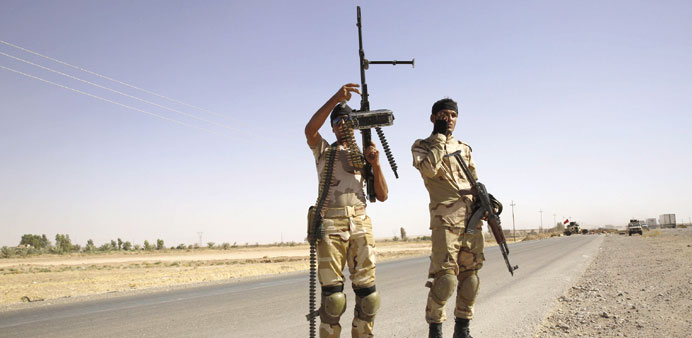
Fighters from the Shia Badr Brigade militia set up a checkpoint in Sulaiman Bek, northern Iraq, yesterday.
Arab nations rallied yesterday behind US efforts to form a broad coalition against militants in Iraq and Syria as Secretary of State John Kerry headed to the region to cement their support.
Saudi Arabia is to host talks tomorrow between Kerry and ministers from 10 Arab states and Turkey on joint action against the Islamic State group.
The moves came as Britain announced it was shipping $2.6mn worth of weapons to Kurdish forces fighting the militants in Iraq.
Kerry’s expected arrival in the region today comes with Washington buoyed by the formation of a new government in Baghdad.
It will coincide with a keenly awaited speech by President Barack Obama in which he has vowed to set out a strategy to defeat the militants whose wave of atrocities has shocked the world.
The foreign ministers of Gulf Arab states will be among those attending tomorrow’s talks in Jeddah, along with top diplomats from Egypt, Jordan, Lebanon, Turkey and Iraq itself.
They will address “terrorism in the region, extremist organisations behind it and means of fighting them”, Saudi state media said.
The Arab League, which has stopped short of explicitly backing ongoing US air strikes against IS, also drummed up regional support for the fight.
Ahead of his visit, Kerry vowed to build “the broadest possible coalition of partners around the globe to confront, degrade and ultimately defeat (IS)”.
“Almost every single country has a role to play in eliminating the (IS) threat and the evil that it represents,” he said.
Notably absent from Jeddah will be the Syrian government—facing a three-and-a-half-year uprising backed by many of the participants—and its regional ally Iran.
IS has taken advantage of the conflict to seize a big chunk of northeastern Syria in fighting with government forces, rival rebel groups and Kurdish militia.
Damascus views itself as a bulwark against the militants, but Washington has ruled out any co-operation for fear of alienating Syria’s Sunni majority, who largely support the uprising.
Washington launched air strikes against militants in Iraq on August 8.
Obama has so far held back from authorising strikes on IS in Syria but has promised a comprehensive strategy against the group on both sides of the border in a speech to the American people today.
An opinion poll published yesterday suggested Americans are hawkish toward the militants, with nine out of 10 saying IS is a serious threat.
And not only do nearly three-quarters favour the ongoing air strikes on the group in Iraq, but 65% would approve extending those operations into Syria.
The Pentagon said yesterday that more strikes had been carried out over the previous two days near western Iraq’s massive Haditha dam as part of operations to defend it from IS forces.
After months of wrangling, Iraq’s new Prime Minister Haidar al-Abadi finally formed a government on Monday that Washington said had “the potential to unite all of Iraq’s diverse communities”.
Kerry described the new government as a “major milestone” in efforts to woo the Sunni Arab minority away from IS after the divisive rule of Abadi’s predecessor, Nuri al-Maliki.
Iran said it hoped the change of government in Baghdad would help turn the tide against IS.
“I hope that during your new mandate, complete calm will return to your country,” President Hassan Rohani said.
In reality, the new government does not constitute quite the sea-change hailed by Washington. It remains dominated by Iraq’s Shia Arab majority, the Kurds hold fewer ministries than before and the Sunni Arabs relatively minor ones.
The divisive Maliki becomes one of three vice presidents, alongside a Sunni Arab, former parliament speaker Osama al-Nujaifi, and a secular Shia and ex-premier Iyad Allawi.
Fuad Masum, a Kurd, became president in July.
Abadi also put off filling the key interior and defence portfolios, promising to name the two ministers who will take charge of the fightback against the militants within the next week.
The commander of one of the Shia militias that have played a growing military role alongside the army has sought the interior ministry post.
In other developments, French President Francois Hollande will visit Iraq on Friday ahead of hosting a conference in Paris on security in the country next Monday, his office said.
UN move to ban foreign fighters from enlisting
The United States is seeking a UN resolution demanding that countries adopt laws making it a serious crime to enlist as a foreign fighter for Islamist groups in Iraq and Syria.
The draft resolution, which has been circulated to Security Council members, is expected to be adopted at a special session of the top world body chaired by US President Barack Obama on September 24.
Under the measure, governments would take action against their nationals who travel or make plans to travel to a country “for the purpose of the perpetration, planning, or preparation of, or participation in terrorist acts”.
It would also make it illegal to collect funds or help organise the travel of foreign fighters for groups like the Islamic State in Iraq and the Levant, which is on the UN terror list.
The text demands that “all states shall ensure that their domestic laws and regulations establish serious criminal offenses sufficient to provide the ability to prosecute and to penalise in a manner duly reflecting the seriousness of the offence”.
About 12,000 foreign fighters have travelled to Syria and recently to Iraq from 74 countries, in the biggest such mobilisation since the Afghan war of the 1980s, according to the London-based International Centre for the Study of Radicalisation, which tracks foreign fighters.
The UN Security Council last month adopted a resolution aimed at weakening Islamists in Iraq and Syria by cutting off financing and the flow of foreign fighters.
The US-drafted resolution goes further by putting the onus on governments to draft legislation allowing them to take action on their territory or use existing laws to address the threat of foreign fighters.
“The resolution will impose new binding obligations on countries to take action against foreign fighters, to prevent the facilitation of travel by foreign fighters and stop suspects,” a US official said.
The resolution would fall under Chapter 7 of the UN charter, which means the measures could be enforced by economic sanctions or military force.
With 12,000 fighters mobilised over the past three years compared to 20,000 in Afghanistan over a decade, the movement is “well on track to becoming the most significant mobilisation of foreign fighters that has ever taken place in living memory”, said Peter Neumann, director of the ICRS.
The overwhelming majority of foreign fighters, up to 75%, are from the Middle East and Arab countries, with Saudi Arabia, Tunisia and Morocco topping the list.
About 700 foreign fighters are from France, followed by some 500 from Britain, 400 from Germany and 300 from Belgium, according to Neumann.
The call for action to stem the flow of foreign fighters is fuelled by fears that new terror networks will emerge from the Syria-Iraq front, much in the same way that the September 11, 2001 attacks were linked to the Taliban and Al Qaeda in Afghanistan.
Many countries like France and Britain have already moved to enact measures to clamp down on aspiring jihadists, amid much concern over the need to balance security and protect civil liberties.
The draft demands that countries prevent entry to individuals suspected of taking part in foreign fighting and requires that airlines provide passenger information to detect the departure of a foreign fighter.
It also calls on governments to develop strategies to counter violent extremism, by reaching out to local communities.
Blast kills Syria Islamist group chief, top figures
An explosion killed the leader of one of Syria’s most powerful Islamist insurgent groups Ahrar al-Sham yesterday, the group said, and an organisation that monitors violence in the civil war said at least 28 of its senior commanders had died.
Ahrar al-Sham is part of the Islamic Front alliance that has been in armed conflict with the Islamic State group which has seized swathes of territory in Syria and Iraq. It was at one point considered the strongest insurgent group in the Syrian civil war.
A statement posted on Ahrar al-Sham’s official Twitter feed said the blast had hit a meeting in Idlib province in northwest Syria and confirmed Hassan Aboud, the group’s leader, among at least 12 dead.
The Syrian Observatory for Human Rights said some 50 of the group’s leaders had been gathered at a house when the blast went off. Rami Abdel Rahman, who runs the Observatory, said the blast had occurred inside the meeting.
Syrian state TV flashed an urgent news headline reporting Aboud’s death.
In January another senior Ahrar al-Sham leader, Abu Khaled al-Soury, was killed in a suicide attack. Soury had fought alongside Al Qaeda founder Osama bin Laden and was close to its current chief Ayman al-Zawahri.
Syria descended into civil war after an uprising against President Bashar al-Assad’s rule in 2011. The United Nations recently put the death toll at more than 191,000.
Staffan de Mistura, the new UN envoy on the Syrian crisis, arrived in Damascus yesterday for his first visit since being appointed to the post.
De Mistura was seen arriving at his hotel at the beginning of a trip expected to last three days and include meetings with Syrian government officials and members of the tolerated domestic opposition.
“Now we’re watching, listening, then we will be talking,” he said in brief remarks to journalists.
It was not yet clear whether de Mistura, who was accompanied by his deputy Ramzy Ezzedine Ramzy, would meet with Assad.
Syrian media reported on Monday that de Mistura would meet both government officials and members of Syria’s domestic opposition, which is expected to urge him to convene new peace talks in Geneva.
But two rounds of negotiations in the Swiss city have failed to move the two sides closer to a political resolution to the conflict that began in March 2011, and it remains unclear if there is much political will for a new effort.
The United Nations said on Monday that de Mistura’s trip to Syria would be followed by stops elsewhere in the region and beyond to speak with key players in the conflict.
Details of his travel plans were not released but it was expected that he would travel to Russia, Assad’s key ally.
De Mistura’s predecessor, veteran Algerian diplomat Lakhdar Brahimi, resigned in May after the failure of the second round of Geneva talks in January and February.
He had spent two years in the position, which he assumed after former UN secretary general Kofi Annan stepped down following a six-month stint in the role.
A former Italian deputy foreign minister, who has served previously in Iraq and Afghanistan, de Mistura was appointed to the Syria job in July.
The Syrian government welcomed his appointment, stressing he should demonstrate “objectivity and integrity” in pursuing his peace mission.