


IANS/New Delhi
The Indian military yesterday scaled up its massive operation to rescue thousands marooned in Jammu and Kashmir’s worst floods in 60 years that has claimed over 180 lives.
In well co-ordinated efforts, the army, navy and the air force used boats, helicopters and planes in a bid to reach out to the many thousands stranded on rooftops in Srinagar, a city now looking like a swollen Dal Lake following days of torrential rains and flash floods.
With seven more people dying in a landslide in Udhampur yesterday, the death toll in a week of devastation has crossed 180, officials said.
A defence ministry spokesman said the army had rescued 23,530 people from different regions of the state.
Deploying hundreds of men for rescue and relief work, the army has distributed 5,000 blankets, 140 tents, 23,000 litres of water and 600kg of biscuits.
Water bottles are being airlifted from Chandigarh and New Delhi. Eighty medical teams have swung into action. A total of 85 tonnes of medicines were airlifted.
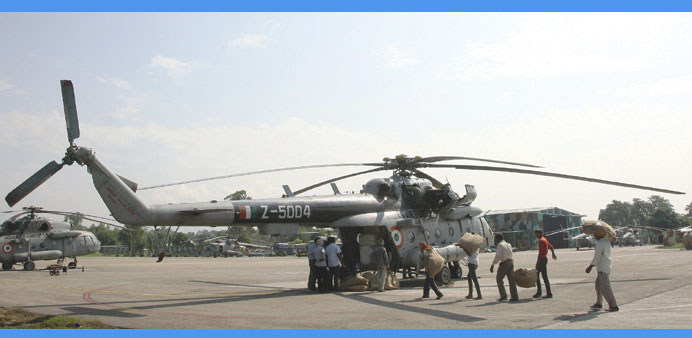
Fifty-two Indian Air Force helicopters and transport aircraft have flown 140 sorties and dropped 155 tonnes of relief materials.
But officials admitted that the situation was scary and there was no contact yet with the already remote areas in the Kashmir Valley now made more inaccessible due to all round destruction.
Srinagar, the summer capital of the state, remained mostly under water. The overflowing Jhelum took virtually the entire city in its grip, barring the old parts located on higher ground.
Residents said in some areas two- and three-storey houses had almost gone under water, and that thousands in Srinagar were sheltering on rooftops hoping and praying for an early rescue.
“I have never seen anything like this,” said Mohamed Ashraf, a long-time Srinagar resident. “This is like hell.”
Police and the Central Reserve Police Force also joined the rescue efforts, at places transporting the marooned to safer places in their huge trucks.
Most of Srinagar’s residential and commercial areas have been inundated. Residents and traders scrambled to save whatever they could from the muddy and swirling waters of the Jhelum river.
The waters have entered homes, shops, businesses, schools and colleges, hospitals, mosques and army camps. There was a sea of water at Lal Chowk, the city centre.
People used boats on flooded streets to reach higher ground.
The only communication tool still up and running was the police wireless system.
One army officer compared the destruction to the Uttarakhand tragedy of last year when thousands died in flash floods.
Speaking on the condition of anonymity, he said it would take huge efforts to rebuild damaged roads, homes, other buildings and bridges.
The army has established shelter camps at Poonch, Rajouri, Thanamandi, Bela, Potha, Sanai, Kishtwar, Akhnoor, Budhal, Gulabgarh, Sungri, Salomé, Gul, Kandi, Samote, Mahore and Chasana areas.
Each camp is now home to 50 to nearly 1,200 homeless people.