


|
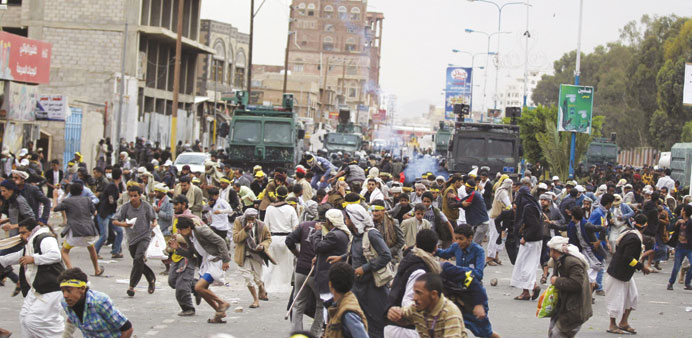
A man was shot dead yesterday when police tried to disperse a Shia rebel sit-in blocking the road to Sanaa airport as part of a protest campaign, demonstrators said. |
Police hurled teargas canisters and deployed water cannon against demonstrators who had camped along the road near the interior ministry.
The protest organising committee said one demonstrator was shot dead, adding that a number of protesters received gunshot wounds.
Yesterday’s move came after protesters did not heed an ultimatum to clear the area, and apparently after some approached a checkpoint leading to the nearby interior ministry.
The Houthi rebels, also known as Zaidis or Ansarullah, have been pushing for the government’s resignation, accusing it of corruption.
They have rejected overtures from President Abd-Rabbu Mansour Hadi who has offered to name a new prime minister and reduce a disputed fuel price hike.
Rebel spokesman Mohamed Abdulsalam accused the authorities of “using live bullets” against the demonstrators.
“We hold the authorities responsible for the repercussions of this aggression, and we stress the right of our people to self-defence using all means if the aggression continues,” he said in a statement.
But calm returned to the area later yesterday, despite protesters not clearing the blocked road.
Earlier in the day, protesters pitched new tents blocking access to the ministries of electricity and telecommunications on Airport Road, where they have been demonstrating for weeks.
They also blocked access from the capital to the international airport.
Authorities deployed anti-riot police around the interior ministry.
The protesters erected cement roadblocks along the road to the airport and wore yellow bands on their wrists and across their foreheads as a “warning” to authorities.
A source close to the presidency said the Houthis have submitted a list of demands, including “uprooting corruption” as well as “giving them more powers within the public prosecution, accountability panel, national security services and the intelligence” services.
They also demanded that the president “consult with them on naming the new prime minister” and the ministers of defence, interior, foreign affairs and finance.
Under the presidential initiative, Hadi himself would name the four key ministers.
Demonstrators yesterday carried portraits of Syria’s embattled President Bashar al-Assad as well as of the head of Lebanon’s Iran-backed Shia Hezbollah movement Hassan Nasrallah and of Yemen’s Shia rebel chief Abdulmalik al-Houthi.
Authorities in Sunni-majority Yemen accuse Shia-dominated Iran of backing the rebels, and Hadi on Saturday urged Tehran to be “reasonable” in dealing with his country.
Banners at the Houthi sit-in vowed that the protests will “continue until the fall of the Muslim Brotherhood government”, a reference to the Sunni Al Islah (Reform) party.
Tribesmen linked to Al Islah have been fighting the rebels alongside government troops since last year.
The rebels accuse the government of Prime Minister Mohamed Basindawa of close ties to Al Islah.
Tribal sources said yesterday that fighting also continued between army-backed tribes, allied with Al Islah, and Houthis in the Ghayl and Majzar regions straddling Jawf and Marib east of Sanaa.
The sources said there were “casualties”, but were unable to provide a toll. Thirty-f1our people were killed in similar clashes between Thursday and early Saturday.
Analysts say the rebels are trying to establish themselves as the dominant political force in the northern highlands, where Shias are the majority community.
Yemen has been locked in a protracted transition since long-time president Ali Abdullah Saleh was forced from power in February 2012 after a deadly 11-month uprising.