


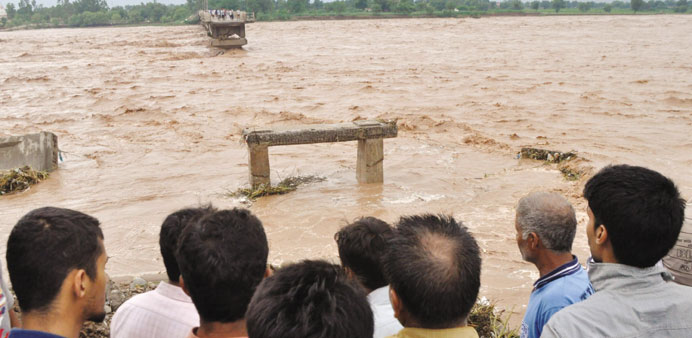
Vllagers look on at a missing section of a bridge across the overflowing Tawi river that was swept away in the Mandal area of Jammu. The death toll from serious flooding climbed to 175 yesterday, with homes, military bases and hospitals inundated.
Agencies/Srinagar
Soldiers were battling yesterday to rescue thousands of people trapped by Jammu and Kashmir’s worst flooding for half a century as the toll climbed to 175 people and left the main city of Srinagar under water.
Some 350 villages have also been submerged since torrential monsoon rains triggered flooding and landslides across the picturesque Himalayan state, officials said.
The rain-swollen Jhelum river flooded large parts of Srinagar yesterday and forced frantic residents onto rooftops, with reports the first floors of a children’s hospital and of another hospital were underwater.
Thousands of troops, police and other emergency personnel, backed by helicopters and boats, have been deployed across the state to reach those stranded, with at least 11,000 people rescued.
“Thousands of people are still stranded and we have rescued several thousands,” Inspector General of Police of Jammu region, Rajesh Kumar, said.
Prime Minister Narendra Modi toured the region and met top relief officials. He described the situation as “a national-level disaster.”
“We stand shoulder to shoulder with the people of J&K in this hour of crisis,” Modi said in a tweet.
He announced Rs11bn ($180mn) in disaster relief payments, as well as compensation to victims and their relatives.
He also announced that 100,000 blankets, 5,000 tents and 50 tonnes of milk powder would be distributed to those forced from their homes.
Modi’s visit comes in the build-up to state elections in the state by the end of the year.
His Bharatiya Janata Party is seeking to expand support beyond the mainly-Hindu lowlands of Jammu and oust the National Conference which was allied to the Congress government defeated by Modi in May.
Photos showed residents wading through thigh-deep waters clutching their belongings, stranded on rooftops or crammed into army boats with blankets, while others showed bridges and roads destroyed.
Chief Minister Omar Abdullah said the floods were “unprecedented” but urged residents not to panic, saying rescuers would eventually reach them.
A police official in Srinagar, a city of 900,000, said he feared the true extent of the devastation was not yet known because phone networks were down and areas cut off.
“We are in a catastrophic situation,” he said, adding that Srinagar’s police headquarters was under water.
“Many people may have died and houses collapsed but we are not getting to know much (information),” he said.
In Srinagar, an army headquarters was under water along with some government buildings, according to local reports and TV footage.
A resident in the city was forced to the third floor of his house after water flooded the second, with no sign of emergency officials to evacuate him.
“We will have to move to the roof but we are also worried about the building collapsing,” he said adding that water has risen about 12ft.
Another resident, Aakifa Javaid, said her local mosque announced on loudspeakers that “it would be a difficult night, no one should sleep” as the river overflowed.
Like hundreds of others in her neighbourhood in the city’s north, she fled in the middle of the night when the water reached her home.
Thousands of soldiers, backed by 22 helicopters and four aircraft, have fanned out across the Kashmir Valley and the rest of the state to deliver aid and restore communications, said federal Cabinet Secretary Ajit Seth.
“About 70 boats have (also) been airlifted, 20 have already left from Palam (in Delhi) a short while ago,” he told the NDTV network.
Several thousand villages in the region have been hit and 350 of them are submerged, the home ministry said late Saturday.