


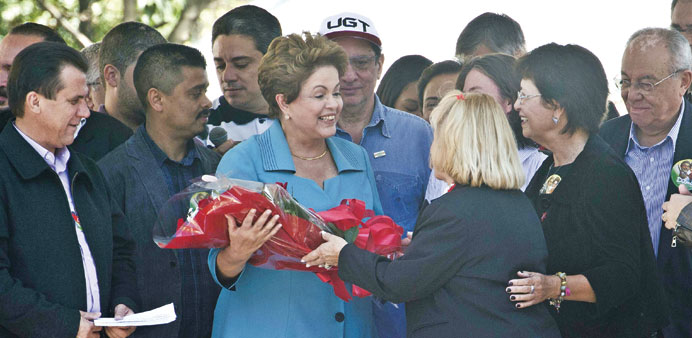
AFP/Sao Paolo
A jailed former director of Brazil’s Petrobras has named dozens of lawmakers and a governor said to have received kickbacks from the state-run oil firm, in revelations which could damage President Dilma Rousseff as she seeks re-election next month.
The allegations, detailed in major Brazilian newspapers yesterday, come with Rousseff battling to regain the initiative from environmentalist Marina Silva, whom polls see as winning an October 26 run-off vote.
Neither Rousseff nor her main rivals for the presidency commented on the case yesterday.
Paulo Roberto Costa, the former head of Petrobras’ refining and supply unit who was arrested as part of a money-laundering investigation, gave the names of 49 deputies, 12 senators and a state governor implicated in the scandal to federal police.
They come from three political parties of the congressional majority - Rousseff’s Workers’ Party, or PT, the Brazilian Democratic Movement Party, or PMDB, and the Progressive Party, or PP - according to opposition newspaper Folha de Sao Paulo.
The Estado de Sao Paulo newspaper spoke of at least 32 lawmakers and a governor belonging to five unspecified political parties. “There was a politician knocking at my door every single day,” Costa was quoted as saying.
Brazilian media did not give the names of the lawmakers implicated in a corruption scandal worth a reported $4.5bn.
Costa, who faces 30 years in prison, spoke to federal police investigators at the start of the week as part of a deal to reduce his sentence, reports said.
His deposition was sent to the Superior Court of Justice, which will rule on whether to validate the agreement.
According to Costa, the lawmakers received three% commissions on the value of the contracts signed by Petrobras while he served as director of refining and supply (2004-2012).
The contracts were signed with a variety of companies created within Petrobras, across nearly all sectors, in an attempt to conceal the wrongdoing, he alleged.
After long leading opinion polls Rousseff has lost her favourite status as Silva’s star has soared since she replaced original Socialist Party candidate Eduardo Campos, her running mate, who was killed in an August 13 plane crash.
Silva is promising a “new politics,” although she served as environment minister under Rousseff’s Workers Party predecessor Luiz Inacio Lula da Silva.
The corruption issue comes as a fresh blow to Rousseff, as she battles to regain poll momentum having already been buffeted in the past year by popular protests over the cost of staging the June-July World Cup.
More than a million people took to the streets last year to demand more cash for poor public services instead of billions on World Cup-related projects such as football stadiums.
Many Brazilians fear some stadiums will prove white elephants, and are outraged that a slew of planned urban mobility projects scheduled to be completed for the football extravaganza never saw the light of day.
Rousseff’s party has also recently been mired in an additional corruption case - the so-called ‘mensalao’ or vote-buying scandal dating back to 2005 when Lula was in office. A lawmaker unveiled to a national newspaper how Rousseff’s party paid thousands of dollars a month to congressmen to secure their votes for legislation, the funds coming via state owned companies.
Petrobras has itself endured other scandals aside from the one which has just broken, following last year’s revelation that the firm, a cash cow for state spending, massively overpaid to buy a refinery at Pasadena, Texas, in 2006 at a time when Rousseff herself chaired the Brazilian giant.
Petrobras has over the past five years seen its market capitalization value slump by hundreds of millions of dollars, leaving it the world’s most-indebted major oil company.
The government has hampered the company’s performance by forcing the firm to sell fuel to domestic consumers at below market prices in order to keep rising inflation in check, slashing potential revenue at a time when the company is in the early stages of an ambitious expansion plan focused on oil exploration.
Silva and Rousseff tied in first round: poll
Brazil’s President Dilma Rousseff and environmentalist Marina Silva would be tied in the first round of elections on October 5, a poll suggested yesterday, as a meteoric rise in support for Silva showed signs of plateauing.
The survey by polling firm Sensus showed Rousseff would get 29.8% in the first round of the vote, with Silva on 29.5%.
Silva is still shown winning a likely runoff, taking 47.6% of the vote against Rousseff’s 32.8%, according to the survey.
Two other polls published last week showed Silva’s dramatic rise in the polls has levelled out and Rousseff has gained some ground.
Analysts said the polls appeared to show the novelty of Silva’s candidacy and the outpouring of sympathy over the death of her party’s original candidate in a plane crash had begun to wane.
Revisions to her proposals, including the withdrawal of a commitment to back gay marriage after evangelical pastors denounced her, has also lost Silva some points among her core urban middle-class supporters.
Three weeks after Silva was thrust into the race, Rousseff has taken off the gloves and begun to attack her rival, painting her as a wild card whose policies would cause layoffs and undo social gains made under the ruling Workers’ Party.
Silva’s rejection rate - the proportion of voters who said they would never vote for her - was 22.3%, well below Rousseff’s 44.3%, but substantially higher than previous polls.
On Wednesday surveying firm Ibope had put Silva’s rejection rate at 12%.
Third-placed candidate Aecio Neves would take 15.2% of the first round vote, according to the poll.
Sensus said 2,000 people across the country took part in the poll between September 1-5.