


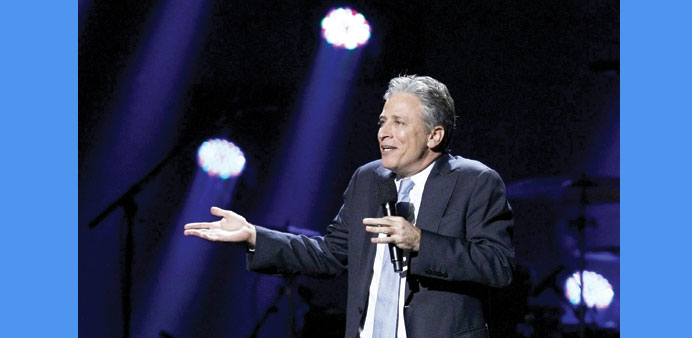
Comedian Jon Stewart speaks during a benefit concert for victims of Superstorm Sandy at Madison Square Garden in New York. The Daily Show host, and now film director brings his first film, Rosewater to the Toronto International Film Festival.
By Mary Milliken
Having hosted late night television’s satirical The Daily Show for 15 years, comedian Jon Stewart grew accustomed to a daily churn that he says “forgives sloppiness.”
Now, he has crafted his first feature film in a more meticulous fashion, and hopes it will not be more permanent evidence of his own idiocy. His directorial debut is the drama Rosewater, the story of Tehran-born Canadian journalist Maziar Bahari, who was imprisoned and tortured in Iran at the hands of a man who smelled of rosewater. Stewart advocated for Bahari’s release and then invited him to his nightly show.
Stewart, 51, spoke about the man who moved him, taking the film to the Toronto International Film Festival and a strange encounter in a hotel room in Jordan.
How do you think Rosewater will resonate with the Toronto audience?
Hopefully they will feel a real connection to Maziar. He is put in this extraordinary situation and his ability to maintain his humanity throughout is what is extraordinary about him. And his sense of still being able to see absurdity. He is a very mischievous guy and reclaiming that was his way for him to reclaim his humanity. Maybe also the cost of oppression. It is ultimately about the cost of oppression, not only for those that are held, but for those that are perpetrating that. It comes at a really steep cost on both sides.
Why did you decide to take on the direction and screenwriting rather than give it to someone with expertise?
I think because I felt so close to it. We approached it from the beginning, when Maziar asked me to get involved with it through the galleys of the book. The idea was to control the material as best we could.
We went through the process of sending it out to this screenwriter and that screenwriter, and we were trying to balance getting the experience of people with alacrity, trying to get this thing done. I felt it was a very relevant story and I didn’t want it to be the kind of movie you saw 15 years later. It came out of maybe an impatience with the film development process being slightly more ponderous than I imagined it was.
What was the most sobering challenge?
Honestly, I think it was feeling the responsibility to not **** the film up. I felt like Maziar was really trusting me with something that was very personal to him. I have a tremendous affection and respect for the guy and I wanted to do right by it.
I heard you were in Jordan filming and you are in your hotel room and you flip on the TV and you see a film by (Daily Show correspondent) Aasif Mandvi.
Aasif? Wait, how do you know that? I think the only person I told that to was Aasif.
He told me not to tell you where I got it.
Oh my god, that is hilarious.
Did you take that as some sort of sign about independent filmmaking?
I tell you what, it was
kind of a punishing schedule, we didn’t have a great amount of money, it was 100 degrees, it was Ramadan. We shot the movie backwards, we were doing night for day. It was one of those things where you were very much off your axis. There was not much sense of a grounding or a foundation and I came back into my room and turned on the TV and there is Aasif Mandvi with this beautiful story, Indian food and him as a chef in a restaurant, and it was like comfort, it was comfort food. It was a very nice taste of home, which helped dramatically at those times. — Reuters
Sofia Vergara is
highest paid TV actress
Actress Sofia Vergara has been declared the highest paid actress on television for the third year in a row. With an earning of $37mn from June 2013 to June 2014, the Modern Family star has topped the highest paid TV actresses’ list of Forbes magazine, reports contactmusic.com. Vergara earns more than the highest paying male star Ashton Kutcher, who collected $26mn last year for his work on Two and a Half Men. In second spot on the list is occupied by Mariska Hargitay, the star of Law and Order: Special Victims Unit with an estimated earning of $13mn, followed by The Big Bang Theory star Kaley Cuoco-Sweeting minting $11mn. — IANS
Brook has ‘traumatic’
childhood memories
Actress-model Kelly Brook has opened up about experiencing “horrific” and “traumatic” times during her growing up days. She grew up in Kent, Southeast England. Brook has revealed that although she enjoyed some aspects of growing up, she used to dread the weekends as a child as it meant going to the local pub with her parents who often got too drunk, resulting in regular fights.
“I used to dread the weekends growing up. Sundays especially. Sunday was pub day. We used to have a roast dinner every Sunday, and every other Sunday it would be burnt,” femalefirst.co.uk quoted her as saying. “My parents would spend too long in the pub, come home p****d and eat the burnt Sunday meal. Then there would be a fight and the police would be called. Or my dad would drive off in his truck,” she added. Brook also remembers one occasion when the police took her father, who died from cancer in 2007, away kicking and screaming.
Speaking in an extract from her autobiography Kelly Brook — Close Up, printed in The Sun newspaper, she said: “One of the worst times was when my dad came back from the pub and started throwing furniture around, while Mum and I huddled out of the way. “My mother, Sandra, called the police and my dad, Kenneth, tried to climb out of the window to escape. He broke his leg trying to avoid them and they had to carry him down the stairs ... It was one of the most traumatic events in my childhood.”
However, it wasn’t just her parents’ rows that Brook had to witness. “As kids we would be in the local pub ... From a very young age I would see fistfights, shouting matches. I’d hear terrible language and see so much violence. I remember one bloke having his head smashed against the bar, his nose exploding and blood pouring everywhere ... It was disgusting, so violent and horrific,” she said. — IANS