


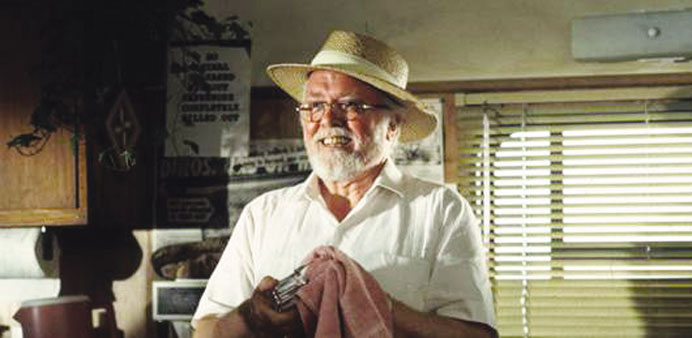
Attenborough in Steven Spielberg’s Jurassic Park.
The death last week of legendary screen and stage star Richard Attenborough brought great sadness to the world of entertainment and sport.
From Hollywood to Bollywood, from film lovers and theatre-goers to sports stars and the common man, tributes have been pouring in for the 90-year-old who lost his battle for life after seven glorious decades in showbiz.
He was by and large the most complete entertainer of all time – a stage actor, movie star, film producer, writer and director.
Famed for his Oscar-winning direction and production of the 1982 movie Gandhi based on the life and times of the Indian freedom fighter Mahatma Gandhi, Attenborough pursued his pet project for 20 years against much push back from the film industry before making it a reality.
It was a meeting with him at a theatre in London soon after his eight-Oscar triumph in Hollywood that he gave me, a student at the time, a few words of wisdom.
Do what you believe in. Never fear. Pursue your ambitions with drive and energy.
Attenborough spelled out his philosophy in simple words.
Not one to live the limelight, nor ignore up-and-coming youngsters, he gave me a few minutes of his time discussing my career plans and talking about his adopted city and my home town of Leicester in the heart of England.
It was at a time I was contemplating which career to follow before completing my studies with a particular eye on journalism, one which my parents gave me their full support. I never looked back.
My first-ever published piece was a 2,000-word feature on my experiences travelling through India. This was printed in a British newspaper as part of a nine-month-long Indian festival of arts and culture being celebrated in the UK.
The Indian connection was ironic. As a second-generation Indian born in the UK, my roots were very much in India. My double-page-spread dwarfed a twin column feature by a celebrated British icon – Attenborough himself on the making of his three-hour epic, Gandhi.
Sharing print space with the man who enjoyed a brilliant career was, indeed, a great honour.
Attenborough had a sense of belonging and love for Leicester where he studied and made his theatrical debut treading the boards. At the age of 17, he went to study and professionally train as an actor at the Royal Academy of Dramatic Art (RADA) in London.
The rest, they say, is history. During a glittering film career, which included critical acclaim for his portrayal of gangster Pinkie Brown in Brighton Rock, he became chairman and subsequently president of RADA until his last breath.
Born in the university town of Cambridge, it was Leicester that he had fond memories of. He remained honorary life president of the city’s Little Theatre where he began his art.
Most today will remember him as the fatherly figure and creator of the land of dinosaurs in Steven Spielberg’s Jurassic Park and its sequel. Many of the older generation will recall his role as the flight commander prisoner of war in the 1963 hit film The Great Escape which featured a notable cast of British and American actors.
He had a passion as a director to convey stories of fighters of justice onto the big screen. Cry Freedom, based on the life of South African anti-apartheid activist Steve Biko, was one of his prized undertakings. Attenborough was a longtime advocate of freedom and education with no boundaries. Colour, race, creed or religion, were all the same as far as he was concerned.
But it was the film Gandhi that propelled him into the global spotlight winning accolades around the world for his work on the life and times of the Indian civil rights leader who inspired millions, including the leaders of today.
With a stellar cast, including Sir John Gielgud, Sir John Mills, Edward Fox, Martin Sheen and notably Ben Kingsley in the starring role, he managed to overcome two failed attempts to finally take his project to the silver screen and enjoy the adulation that followed.
Having the courage to overcome obstacles demonstrated his willingness and determination to pursue what he believed in at any cost. He was obviously following the Gandhi philosophy of overcoming fear and not succumb to outside pressures.
His acting and directing prowess earned him great recognition on both sides of the Atlantic. In Britain, he was bestowed with a Knighthood from The Queen for services to the British film industry.
Sir Richard was later made a peer, becoming a member of the House of Lords in Britain that helped him pursue his charity work with vigour.
But sport too was his love, particularly Chelsea Football Club, of which he was an avid supporter for more than seven decades, serving as director for 13 years and earning other honorary titles before becoming Life President in 2008.
How ironic that just days before his death, the two places in his heart – Leicester and Chelsea – were playing in the London club’s first home match of the season, marking a return for his “adopted” to the Premier League after a 10-year absence.
He sadly wasn’t there to watch an exciting game of football as a long-term illness had confined him to a nursing home where he passed away.
Affectionately known as Dickie, Lord Attenborough was a monumental figure in cinema. He made a name for himself with grace and integrity with a passion for human dignity and equality for all.
He achieved plenty during his lifetime. He earned the plaudits from many. His words of wisdom and enduring energy remained.
Five years after my first meeting with Lord Attenborough, I was honoured once again to shake hands with the cinematic legend during a “reunion” in Leicester.
He was in the city to attend a charity event. I had just completed my training as a journalist on one of the country’s leading daily newspapers – Leicester Mercury – slogging it out on different beats covering crime, inquests, plane crashes, council meetings, sports stories and so on.
I was tasked to interview Lord Attenborough for a feature story on the legend. His words of wisdom years earlier echoed in my ears.
I revived those words during the interview and he said success doesn’t come easy. It comes with shear hard work, grit and determination. He said the Leicester Mercury was one of the finest newspapers around. I was chuffed.
Stick with it, he said. Make a name for yourself and then chart out a career path pursuing other avenues and the world is your oyster. To hear such words echoing family support is a blessing.
How true. The world then became my mission with a career in journalism and PR spanning the globe.
Lord Attenborough, I salute you.
*Updesh Kapur is an aviation, travel, tourism, social and entertainment writer. He can be followed on twitter @updeshkapur