


AFP/Baghdad
Iraqi officials worked yesterday to ease soaring tensions after 70 people were gunned down at a Sunni mosque, as attacks in Baghdad and areas to its north killed 30 more.
The attack at the mosque in Diyala province the day before, which most accounts said was the work of Shia militiamen, threatens to increase anger among Iraq’s Sunni Muslim minority with the Shia-led government at a time when an anti-militant drive depends on their co-operation.
The violence came as the US, which is carrying out air strikes in Iraq against Islamic State (IS) jihadists, ramped up its rhetoric over the grisly killing of journalist James Foley by the group and shown in a video posted online.
Deputy National Security Adviser Ben Rhodes said Foley’s beheading “represents a terrorist attack against our country”.
Yesterday, Iraq’s Sunni parliament speaker sought to calm sectarian tensions.
Salim al-Juburi called for political unity and said “the main aim (of the mosque attack) is to foil all the efforts that have been made to form a government”.
“All the political entities condemned the crime, all of them expressed their anger about what happened,” he said in televised remarks.
“Now we are waiting for practical measures to hold the criminals accountable.”
Premier-designate Haidar al-Abadi, a Shia, has condemned the attack and called for “citizens to close ranks to deny the opportunity to the enemies of Iraq who are trying to provoke strife”.
Rights group Amnesty International called Friday’s attack a “massacre”, and said Iraqi authorities “must properly investigate”.
Army and police officers said the attack on the Musab bin Omair Mosque in Diyala came after Shia militiamen were killed in clashes, while other sources said it followed a roadside bombing near one of their patrols.
Doctors and the officers put the toll from the attack, in which worshippers were sprayed with machinegun fire, at 70 dead and 20 wounded.
Two officers earlier blamed IS for the attack, but most accounts pointed to Shia militiamen.
The interior ministry announced an investigation into the attack, which it said was carried out by two men on a motorbike following a bombing targeting security and volunteer forces in the area.
The government turned to militiamen to bolster its flagging forces during an IS-led offensive that has overrun large areas of five provinces since June, but in doing so has encouraged a resurgence of groups involved in brutal sectarian killings in past years.
As officials sought to limit the fallout from the mosque attack, more violence killed at least 34 people and wounded more than 150, officials said.
Three car bombs exploded in the northern city of Kirkuk, killing 21 people, while six more died when a suicide bomber detonated an explosives-rigged vehicle at the entrance to the interior ministry’s intelligence headquarters in Baghdad.
The bodies of six soldiers killed yesterday, bearing bullet wounds and with hands bound, were left on a road south of the militant-held city of Tikrit, while a roadside bomb hit a vehicle carrying civilian volunteers north, killing one.
The United Nations, meanwhile, warned that the Shia Turkmen-majority Iraqi town of Amerli is under threat of a “massacre” by jihadists who have besieged it for more than two months.
“The situation of the people in Amerli is desperate and demands immediate action to prevent the possible massacre of its citizens,” UN Iraq envoy Nickolay Mladenov said in a statement.
Abadi and Iraq’s top Shia cleric, Grand Ayatollah Ali al-Sistani, both also called for efforts to help Amerli.
The United States launched an air campaign against IS in Iraq on April 8, and has since carried out more than 90 strikes, including one in the area of the Mosul Dam, the country’s largest, yesterday.
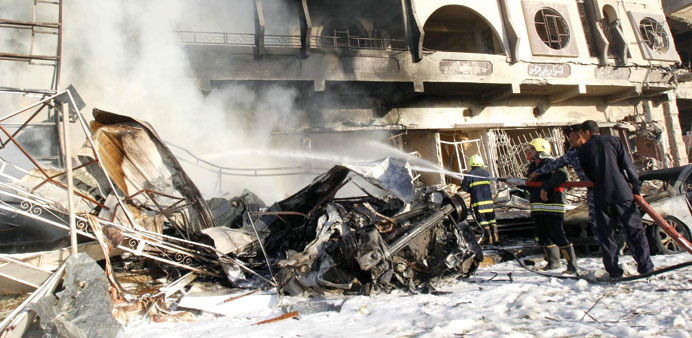
Firefighters spray water at the scene of a car bomb attack in Kirkuk yesterday.