


Agencies/Visakhapatnam
India yesterday unveiled its first home-built anti-submarine stealth warship in a move to deter China from conducting underwater patrols near its shores.
Defence Minister Arun Jaitley commissioned the 3,300-tonne INS Kamorta at the southeastern Vishakapatnam port. The move comes a week after Prime Minister Narendra Modi introduced the largest indigenously built guided-missile destroyer and vowed to bolster the country’s defences so “no one dares to cast an evil glance at India.”
India is pushing to catch up with China, which built 20 such warships in the past two years and sent a nuclear submarine to the Indian Ocean in December for a two-month anti-piracy patrol. The waters are home to shipping lanes carrying about 80% of the world’s seaborne oil, mostly headed to China and Japan.
“It’s a beef-up of the Indian Navy’s anti-submarine warfare capabilities against Chinese submarines,” Rear Admiral Raja Menon, a retired naval official, said, referring to the anti-submarine warship. “It was never in doubt that Chinese warships and submarines will come to the Indian Ocean region.”
Chinese warships voyaged to the Gulf of Aden for the first time to join anti-piracy patrols in December 2008, two months after India deployed its warships in that role, and have since maintained a presence there. About half of China’s oil imports pass through the Strait of Hormuz and three-quarters of Japan’s, according to data from the Observer Research Foundation.
China’s growth means its future energy needs can be met only by supplies from the Gulf region, Africa and North America, according to a 2010 study from the US Defence Department. Such supply points will keep China reliant on maritime transport even as it seeks to develop pipelines to avoid sensitive sea routes such as the Strait of Malacca, it said.
“As China grows into a naval, maritime power, it will be more and more active in the Indian Ocean,” Taylor Fravel, a professor at Massachusetts Institute of Technology who studies China’s ties with its neighbours, said. “Of course, it will not be due to some hostility or targeted at India, but because of its economic interests in the Indian Ocean, as a lot of trade passes through. Such a presence will certainly raise questions in India, but it need not necessarily be a cause of major conflict.”
Built by one of India’s four state-owned warship builders, the delivery of Kamorta -named after an Indian island that was a convict settlement in the 1800s - has been delayed by two years.
Kamorata can carry short-range surface-to-air missiles and Active Towed Array Decoy System. It can also carry an integral anti-submarine warfare helicopter.
About 90% of its components are local, with the hull developed by Steel Authority of India Ltd, medium-range guns by Bharat Heavy Electricals Ltd (BHEL) and torpedo launchers by the nation’s largest engineering company Larsen & Toubro Ltd (L&T).
Jaitley said the government was promoting indigenous manufacturing in defence.
“In recent months, amongst the various initiatives that the government has undertaken is indigenous manufacturing of our defence deployment,” Jaitley said.
“Kamorta is the first of the Rs78.5bn ($1.3bn) four-warship project that began in 2008,” said Commodore B B Nagpal, the navy’s principal director for naval design. “It was to be delivered in October 2012” and was delayed because vendors didn’t acquire materials on time, he said.
India has an outstanding order for 42 warships to be built across seven shipyards, according to Rear Admiral A B Singh, a navy official. These will be commissioned in about 10 years if inductions are as planned, he said. India has lacked anti-submarine corvettes in its 135-warship fleet for over a decade now, with the decommissioning of the last of the 10-ship Petya-class of 1960s-vintage Soviet corvettes in December 2003.
China commissioned the first of its Jiangdao-class corvettes in February 2013 and in the 18 months since has built 20 of these vessels in three of its shipyards. At least 10 more of the Jiangdao-class vessels are expected to join the Chinese naval service in the coming months, according to data from IHS Jane’s.
Jaitley, who’s also India’s finance minister, eased rules for foreign investment in the nation’s defence sector and budgeted for a 12% increase in spending in the current fiscal year to help modernise the armed forces. China - an economy that’s five times the size of India - also boosted spending by 12%.
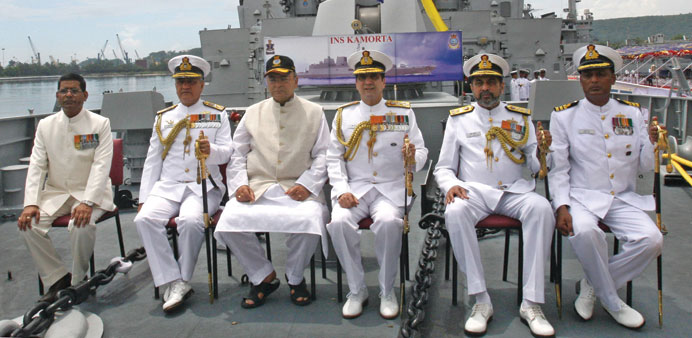
Defence Minister Arun Jaitley along with the Chief of Naval Staff, Admiral R K Dhowan and other officers on board INS Kamorta after commissioning the