


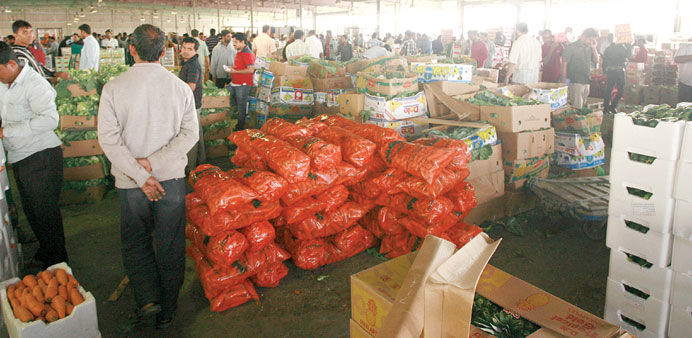
A general view of Qatar’s central vegetable market. Lower international prices are likely to continue to push Qatar’s food prices lower for the foreseeable future, according to QNB. PICTURE: Najeer Feroke
Qatar’s inflation should remain moderate at around 3.5% until the end of next year mainly on declining global food prices, according to QNB.
Highlighting that since the peak in 2011, global food prices have dropped significantly, largely in response to recent bumper harvests, the country’s largest bank said since the country has virtually no domestic food production, lower international food prices are likely to continue to push Qatar’s food prices lower for the foreseeable future, albeit with a lag.
“This means that Qatar’s inflation should remain moderate at around 3.5% at least until the end of 2015,” QNB said in its latest report.
In Qatar, whilst rising rents continue to push up domestic inflation, this has been partly offset by falling food prices. Food inflation in Qatar peaked at an annual increase of 5.9% in June 2011 and has since slowed to a negative 0.6% in June 2014.
Finding that the declining international food prices has heightened the risk of global deflation, it said “this is a cause of concern as deflation increases the real value of outstanding debts in the economy which can in turn reduce the income available for consumption and lead to lower growth.”
International food prices have been declining in recent months, reflecting record harvests and weak global demand. Declining food prices have in turn contributed to lower inflation in the eurozone, the UK and the US, QNB said in its weekly report.
This trend, coupled with a weak eurozone recovery and mixed economic data in the US, suggests that the risk of global deflation remains high. “As such, we expect the European Central Bank, the Bank of England and the Federal Reserve to keep to record-low interest rates for an extended period of time. Qatar’s policy rates are likely to follow suit,” the report said.
Looking ahead, the International Monetary Fund is projecting a further decline in global food prices (averaging -3.8% in 2014-15) on record yields, the report said, adding the global food production outlook continues to remain favourable, with the supply of major grains and oilseeds projected to surpass demand growth for the next two years.
Furthermore, China expects increased production of corn and wheat as a result of favourable weather while global rice supplies continue to be plentiful, it said.
“Overall, the risk of global deflation remains high as bumper harvests and a weak global recovery have pushed down inflation to record lows. This is likely to keep global interest rates low for the foreseeable future,” QNB said, noting that Qatar’s interest rates are likely to follow US policy rates, given the peg to the US dollar.