


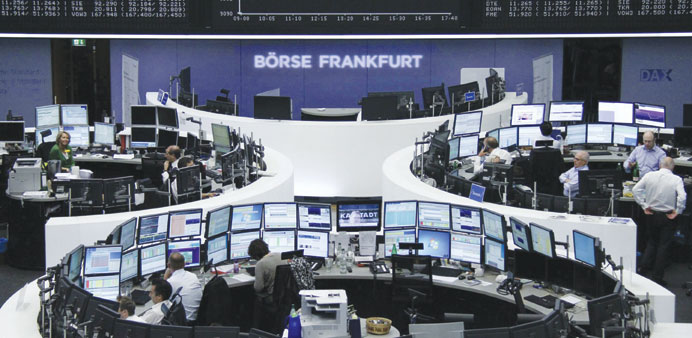
Traders are pictured at their desks in front of the DAX board at the Frankfurt Stock Exchange. The main DAX index yesterday added 1.68% to close at 9,245.33.
AFP/London
European stock markets rebounded sharply yesterday as traders breathed a sigh of relief over easing tensions in east Ukraine and gains by Western-backed forces in Iraq.
Frankfurt’s main DAX index added 1.68% to end the day at 9,245.33.
London’s benchmark FTSE 100 gained 0.78% at 6,741.25 points, while in Paris the CAC 40 rose 1.35% to 4,230.65 points, compared with Friday’s close.
“European markets were largely following through on Friday’s late recovery from the huge sell-off sparked by a clash between Ukrainian and Russian military forces,” said Jasper Lawler, a market analyst at CMC Markets. “A planned meeting between Russia and Ukraine mediated by France and Germany has fuelled the perception that the stand-off between the two countries can be diffused.”
Europe’s stock markets slid on Friday as news that Ukrainian artillery had destroyed part of a Russian military column spooked investors.
But Russia yesterday said that “certain progress” had been made during a marathon meeting in Berlin between the two countries’ foreign ministers and their counterparts from Germany and France.
“European equities are leading the way, as there is a growing sense that it is now safe to get back in the water,” said David Madden at IG Markets.
US stocks also pushed higher, with a new bid in a fight for the country’s largest dollar-store stirring up retailer shares.
In mid-afternoon deals, the Dow Jones Industrial Average was up 1.01% at 16,831.26.
The broad-based S&P 500 added 0.86% at 1,971.79, while the tech-rich Nasdaq Composite gained 0.98% to 4,508.80.
In European corporate news, shares in Vivendi ended the day up 1.12% after reports that Telecom Italia may offer up to €7bn ($9.4bn) for its Brazilian broadband unit GVT.
Spain’s Telefonica, which is already in talks for the unit, closed up 0.81% in Madrid while Telecom Italia shares ended flat.
On the economic front, a gloomy update from Germany’s central bank on the outlook for the eurozone’s biggest economy “has sparked speculation that the ECB will ramp up monetary easing,” said Madden.
That added to official data showing the crisis in Russia and sluggish demand from Turkey weighed on hopes for an export-led recovery in the eurozone in June.
Exports from the 18-nation single currency zone dipped by 0.5% in June compared with May to €162.2bn, the Eurostat statistics agency said.
“June’s eurozone trade data provided yet further evidence that the external sector remains too weak to make up for the region’s feeble domestic recovery,” said Jessica Hinds of Capital Economics.
In foreign exchange deals Monday, the euro fell to $1.3356 from $1.3397 late on Friday in New York.
The European single currency inched down to 79.88 pence from 80.25 pence on Friday, while the pound rose to $1.6720 from 1.6694.
The British pound won support from comments over the weekend from Bank of England governor Mark Carney that improving wage growth was not a prerequisite for increasing interest rates.
They stood in contrast to a report last week, which the market concluded meant the BoE would wait until at least the start of next year before rising its record-low interest rate of 0.50%.