


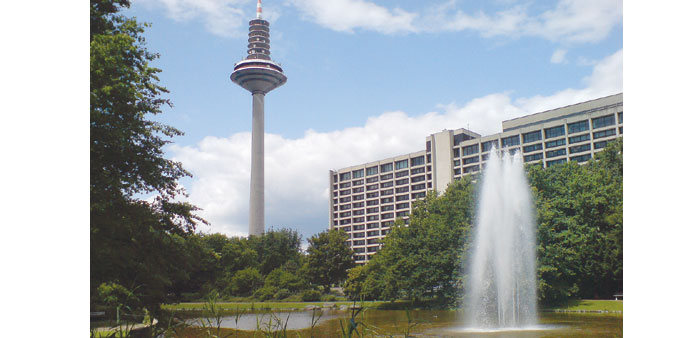
A view of the Bundesbank building in Frankfurt. Following second-quarter stagnation, the euro area is looking at a resumption of positive economic growth, albeit not at the pace predicted by many analysts in the spring, the Bundesbank said in its monthly report for August.
Reuters/Frankfurt
The eurozone economy is expected grow more slowly than initially expected during the rest of this year as conflicts in Ukraine and elsewhere weigh on business confidence, Germany’s central bank said yesterday.
The eurozone economy unexpectedly stalled in the second quarter, dragged down by shrinking growth in Germany and a stagnant France, leading to renewed calls for the European Central Bank to provide more stimulus, such as large-scale asset purchases.
The ECB cut interest rates to record lows and launched a fresh round of ultra-cheap loans in June, which the Bundesbank said was “justifiable, on the whole”.
But the German central bank also warned about overheating financial or property markets, and the risk of minimising governments’ incentives to reform their economies.
“Following second-quarter stagnation, the euro area is looking at a resumption of positive economic growth, albeit not at the pace predicted by many analysts in the spring,” the Bundesbank said in its monthly report for August 2014.
“The geopolitical tensions in Eastern Europe owing to the Ukraine conflict as well as in other parts of the world are now appearing to weigh more heavily on corporate sentiment.”
European sanctions against Russia and the country’s response had in particular dampened sentiment, the Bundesbank said, though noting that the trade restrictions would only affect a fraction of EU exports directly.
Investors were particularly anxious about the surprise second-quarter contraction in Germany, seen as the currency bloc’s growth engine.
Little improvement is expected in the second half of the year as the Bundesbank pointed to a dampened economic outlook.
“Current indicators cast doubt on the assumption on which the spring forecasts were based, namely that the underlying cyclical trend would strengthen further in the second half of 2014,” the Bundesbank said.
“Nonetheless, sentiment has deteriorated from a high level, which, together with the fact that the trend for domestic demand remains basically upwards, suggests that the economy will not change direction.”
Private consumption and housing construction formed the main pillar of German growth, the Bundesbank said, in light of increasing disturbance from the external economic situation.
Exports hit by Russian crisis
Economic crisis in Russia and sluggish demand from Turkey weighed on hopes for an export-led recovery in the eurozone in June, official data showed yesterday.
Exports from the 18-nation single currency zone dipped by 0.5% in June compared with May to 162.2bn euros ($217bn), the Eurostat statistics agency said.
“June’s eurozone trade data provided yet further evidence that the external sector remains too weak to make up for the region’s feeble domestic recovery,” said Jessica Hinds of Capital Economics.
Eurozone exports were dragged down by a 14% slump in demand from sanction-hit Russia and an 8% drop from Turkey, which is suffering an economic slowdown.
With imports up a slight 0.5%, this meant countries in the eurozone posted a marginally higher 16.8bn-euro trade surplus in June, up from €15.4bn the month before.
“Weaker external demand played an important part in the slowdown of the eurozone export-led recovery in the second quarter,” said Christian Schulz, economist at Berenberg Bank.
Policy-makers in Brussels had hoped the eurozone economy was recovering on the back of exports from periphery countries that have pushed through reforms recommended by the EU.
But there are fears the crisis in Ukraine will weigh on growth this year and some EU leaders have warned that sanctions against Russia, which came into effect this month, could further derail the bloc’s fragile recovery from the eurozone debt crisis.
“Not just the crisis of Russia’s economy, but also the temporary slowdown in the US and some emerging markets contributed to the spring lull,” said Schulz.
Growth figures last week showed the eurozone economy ground to a halt in the second quarter, casting a cloud over the crisis-hit region.
In June, powerhouse Germany was the only major eurozone economy to post a significant increase in exports for the year to date, which rose three% from the same period in 2013.
Exports in Spain and Portugal, which slumped into deep recessions during the eurozone debt crisis, dropped one%. Greek exports were down 8%.
Meanwhile, demand for eurozone exports was up a strong 8% in Britain, where an economic recovery is underway. Demand from China was also up 8%.
“The UK was one of the few very strong bright spots for trade in the first half of the year,” Berenberg’s Schulz said.
In June, Britain posted the widest trade deficit in the 28-nation EU, at €48.1bn, followed by France, Spain and Greece.
Overall, the EU posted a trade surplus of a €2.9bn in June, pushed wider than the previous month by a drop in imported energy.
Looking ahead in the eurozone, Hinds of Capital Economics forecast improvement “as exporters start to feel some benefit from the recent depreciation of the euro”.
A strong euro especially against the dollar has been criticised by both governments and companies as a major constraint to expanding exports.