


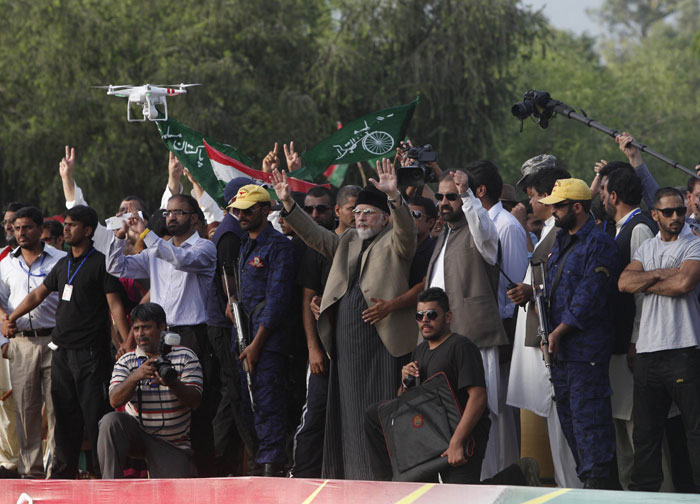
Tahir-ul-Qadri (centre), leader of the Pakistan Awami Tehreek, gestures before addressing his supporters during the Revolution March in Islamabad on Monday. Pakistani opposition leader Imran Khan and the firebrand cleric either ignored or rejected an offer of talks from Prime Minister Nawaz Sharif on Monday, the fourth day of anti-government protests in the capital.
AFP/Islamabad
Pakistani opposition politician Imran Khan's party announced on Monday it will resign all its parliamentary seats, in a bitter row with the government over alleged poll rigging.
Former cricket star Khan claims last year's general election, in which his Pakistan Tehreek-e-Insaaf (PTI) party came third, was rigged and has demanded Prime Minister Nawaz Sharif resign and hold new polls.
The dramatic twist came as the government tried to launch formal talks with Khan and populist cleric Tahir-ul-Qadri, who is leading a parallel protest, also calling for new elections.
Khan and Qadri led thousands of supporters on a "long march" to the capital from the eastern city of Lahore, hoping to mobilise a mass movement to oust Sharif.
But Khan's protest failed to attract the vast crowds he had promised and other opposition parties on Monday shunned his call for a campaign of civil disobedience, leaving him looking increasingly isolated.
PTI vice-chairman Shah Mehmood Qureshi announced the shock mass resignation late on Monday afternoon.
"We are resigning from the National Assembly, Punjab Assembly, Baluchistan Assembly and Sindh Assembly," Qureshi told reporters.
He said the party was still making a decision about what to do in northwestern Khyber-Pakhtunkhwa province, where they are in power.
The MPs' resignations must be submitted to the national assembly speaker and passed on to the election commission. Qureshi did not say when this would happen.
PTI scored their best ever performance in last year's election, which Sharif won in a landslide victory and was rated as free and credible by international observers.
They won 27 seats - which will now go to by-elections - and were awarded seven more through Pakistan's quota system for getting women and religious minorities into parliament.
Before PTI's unexpected, high-stakes gamble, other opposition parties had distanced themselves from Khan's call for people to stop paying taxes and utility bills in protest against the government.
Former president Asif Ali Zardari, co-chairman of the Pakistan People's Party, the largest opposition party, said Khan's willingness to use "unconstitutional means" to pursue his goals threatened democracy.
"Democracy and nation will not be served by calls for civil disobedience nor by a stubborn refusal by any side to engage in a meaningful dialogue on political issues," Zardari said in a statement.
The authorities deployed tens of thousands of security personnel on Islamabad's streets and blocked main roads to contain the protests, but by Monday their numbers had ebbed and life was returning to normal.
There was more condemnation for Khan's civil disobedience call from the business community. The Federation of Pakistan Chambers of Commerce and Industry said the focus should be on getting the shaky economy back on track.
"Pakistan is in critical economic and political condition and political activities have hampered the process of economic and commercial development of the country," its president Zakaria Usman said in a statement.
A stinging editorial from Dawn, Pakistan's oldest English-language newspaper, said Khan had "miscalculated disastrously and painted himself and his party into a corner".