


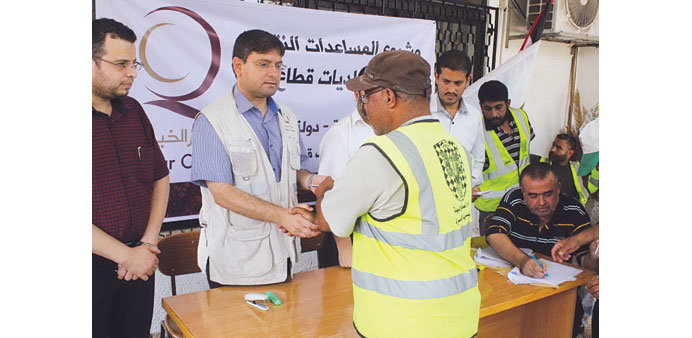
Qatar Charity (QC) has distributed QR2.5mn cash assistance in the Gaza Strip.
The money went to 3,500 government employees working in 25 municipalities of the Gaza Strip, in collaboration with the ministry of local government and mayors.
Each employee received QR730 in recognition of the efforts made to maintain the delivery of water and sewage and waste services throughout the aggression, despite repeated attacks on government facilities and installations and the targeting of employees, many of whom have been injured and killed while providing basic and vital services to citizens.
This intervention comes in light of the fact that many municipal employees have not received their salaries for several months.
The beneficiaries expressed their thanks and appreciation for QC’s consistent support
and the efforts of the State of Qatar to stand beside the Palestinian people.
The undersecretary in the ministry of local government and the mayors also commented on the significant role played by QC in supporting the Gaza Strip.
QC has implemented several projects and urgent relief interventions in the Gaza Strip, beginning on the third day of the aggression that started on July 7. These efforts have included the supply of urgent medicines and medical consumables to hospitals in the Gaza Strip at a cost of around QR2mn. Distributions of over 13,000 food baskets were made to people in shelter, as well as breakfasts, which benefited more than 60,000 people.
QC has launched a programme for emergency intervention in the Gaza Strip, valued at QR20mn and including urgent relief aid for tens of thousands of poor families, medicines for hospitals and projects related to the rehabilitation, building and furnishing of homes, providing shelter to those whose homes were destroyed, the provision of fuel to run hospital generators and early recovery in the subsequent period.
QC’s Gaza office operates according to principles of co-ordination, co-operation and networking with international institutions working in the emergency interventions sector, including United Nations organisations and governmental and private institutions, to ensure that the activities carried out are responding to the direct needs of the people and reducing overlap and duplication.